


Lahore is a city of gardens, culture, and vibrant growth — but below this thriving surface lies a deepening crisis that few are paying attention to. Between 2000 and 2025, the city’s underground water reserves have been quietly depleting. Experts, courts, and environmentalists have been sounding the alarm, but public focus remains weak. With water levels dropping year after year, we’re heading toward a future where clean water may no longer be a guarantee for Lahore’s residents. The signs are clear, the warnings have been issued — and yet, the water keeps sinking.
The Hidden Emergency: Underground Water in Free Fall
Once accessible just 15 to 16 feet below the ground in the 1980s, Lahore’s underground water has now slipped to alarming depths. In central areas, it was around 28 meters (92 feet) in 2000, according to this IAEA study. Today, in many parts of the city, you need to drill 150 feet or more to find clean, drinkable water. By 2025, reports indicate that the water table is declining at an average rate of 2.61 feet per year — the highest rate in Punjab (DAWN report).
A WWF-Pakistan analysis back in 2018 warned that this trend, if left unchecked, would push groundwater in the city center beyond 70 meters (230 feet) by 2025. Unfortunately, that warning is now becoming reality. As the water table drops, the pressure on electricity and infrastructure increases, and ordinary residents of Lahore are paying the price.
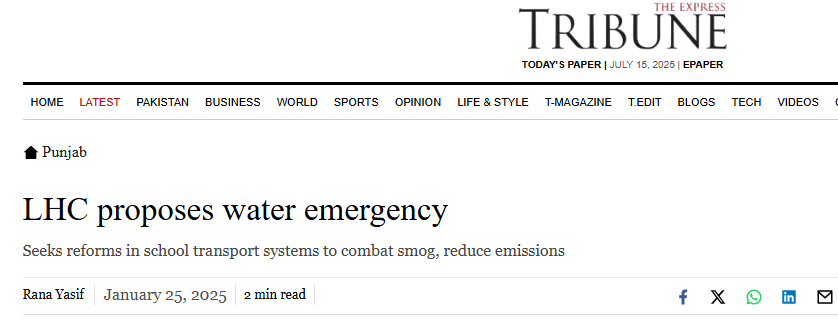
Source: The Express Tribune
The Usual Suspects: Overuse and No Recharge
What’s causing this silent collapse beneath our feet?
The main culprit is clear: over-extraction. Lahore’s rapidly growing population, increasing housing demand, and expanding industrial sector are all putting intense pressure on the water resources beneath. Thousands of unregulated private tube wells operate around the clock, draining the aquifer with no concern for sustainability.
But that’s only half the problem. Natural recharge — the process by which rainwater seeps back into the ground — has also slowed dramatically. Concrete roads, buildings, and poor urban planning prevent rain from reaching the underground reservoirs. In short, we’re consuming water at a rate much faster than nature can replenish it.
A report by the Asian Development Bank further highlights the failure of institutional mechanisms to manage groundwater sustainably. While our taps keep flowing, the source is slowly drying up.
False Hope: The 2020 Pause That Didn’t Last
In 2020, there was cautious optimism. WASA Lahore and the Punjab government launched several new initiatives, including the introduction of aquifer charges, the installation of rainwater storage tanks, and the timing of groundwater pumping. Prime Minister Imran Khan even announced that Lahore’s underground water level had “stopped falling for the first time since 1980” (Business Recorder).
And for a while, there was improvement. In places like Gulberg and Shahdara, water levels stabilized at 50 meters and 23 meters, respectively. The crisis might finally be slowing down.
But recent data paints a different picture. The water table is falling once again — and faster than before. Temporary success was not followed up with long-term planning. Now, in 2025, the Lahore High Court has gone so far as to suggest a formal “water emergency,” urging immediate and concrete action.
Why This Should Worry You
This is not just a problem for future generations — the crisis is already affecting lives today.
- Access is becoming increasingly difficult: Shallow wells are no longer effective. People must drill deeper, which costs more and consumes more electricity.
- Water quality is declining: Deeper water often contains harmful minerals and pollutants.
- The urban poor are the first victims: Communities relying on hand pumps or outdated infrastructure are losing access altogether.
- Our green spaces are in danger: Parks, gardens, and even domestic plants are affected by water scarcity.
In a city as large and fast-paced as Lahore, clean water can no longer be taken for granted.
What Must Be Done — And Urgently
Even now, the situation can be turned around. But it will take serious political will, responsible urban planning, and public cooperation.
Recharge Lahore: Let the Water Go Back In
We must restore Lahore’s ability to recharge its underground water. Rainwater harvesting systems should be mandatory for large buildings, societies, schools, and mosques. These systems aren’t expensive, and they work.
Regulate Tube Wells: No More Free Extraction
The government needs to control how and where underground water is extracted. A permit system for tube wells, with strict limits and fees for large users, can slow down reckless overuse.
Promote Green, Not Grey
Cities need green patches, not concrete jungles. Parks, unpaved pathways, and green rooftops allow water to seep into the earth. Urban policies should favour permeable surfaces and discourage unnecessary construction sprawl.
Educate, Engage, Enforce
Public awareness is key. People need to know what’s at stake. Media campaigns, school programs, and religious leaders can all play a role in spreading the message. But awareness must be backed by enforcement. Without fines and accountability, policies remain just words.
Upgrade and Modernize Water Infrastructure
Our drainage, sewage, and water supply systems are outdated. The Urban Unit Master Plan emphasizes the need for investment in modern water management. The time to implement these plans is now, not five years from now, when it may be too late.
Conclusion: Before the Taps Run Dry
Lahore’s water crisis is no longer hidden underground — it’s here, and it’s growing. What we do in the next five years will decide whether the city sinks into drought or rises with resilience. The Lahore High Court’s recent warnings, WASA’s stalled efforts, and WWF’s predictions all point to the same conclusion: we are running out of time — and out of water.
This is not just an environmental issue. It’s a social, economic, and public health emergency. If we want clean water tomorrow, we must act today.