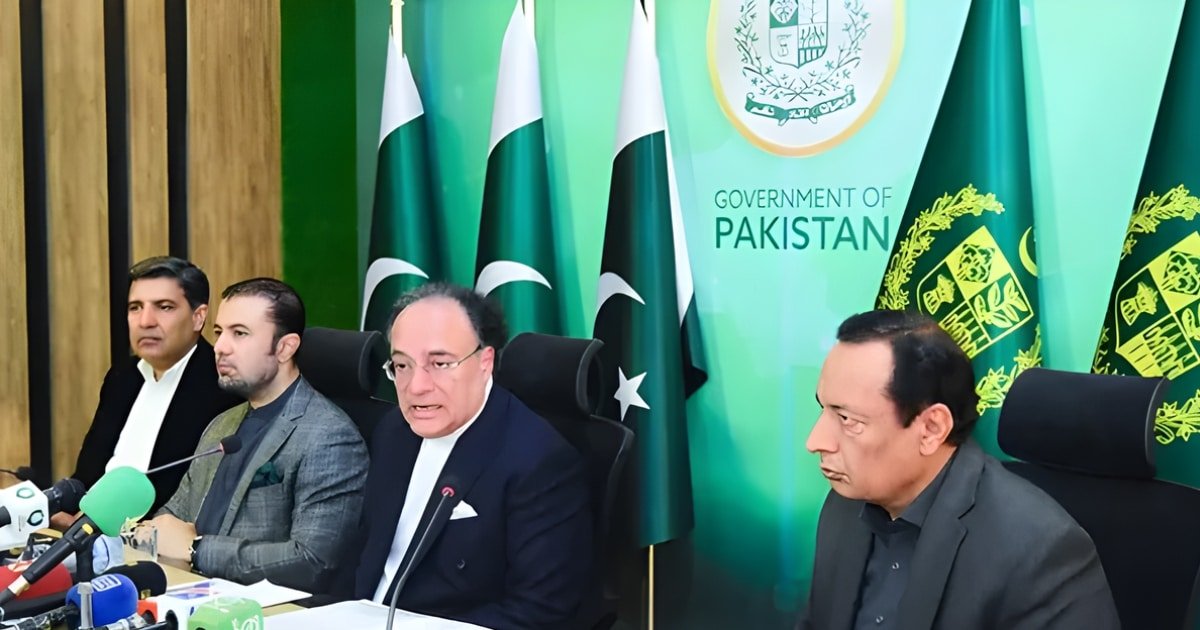



ISLAMABAD — Finance Minister Muhammad Aurangzeb said on Sunday that the International Monetary Fund’s (IMF) widely discussed governance diagnostic report, which identified major financial irregularities and institutional weaknesses in Pakistan, should be viewed “not as criticism but as a catalyst for accelerating long-overdue reforms”.
Speaking at a press conference in Islamabad, the minister said the government itself had requested the IMF’s assessment to support its institutional reform agenda. The report, published as a precondition for the release of the next $1.2 billion loan tranche, cited preferential treatment for select businesses, weaknesses in public-sector governance and transparency, and inefficiencies in state functions as key constraints to sustained growth. It also laid out reform steps for the next three to six months aimed at elevating Pakistan’s growth trajectory to 5–6.5 per cent.
Opposition parties reacted sharply, calling for an investigation into what they termed “the worst financial scandal” in the country’s history. Aurangzeb, however, stressed that the report also acknowledged progress in governance and taxation, adding that many recommendations were already being implemented.
“We see this as an opportunity to accelerate reforms essential for Pakistan’s economic turnaround,” he said, emphasising that structural issues had developed over decades and required sustained, institutional solutions.
Exports and IT Sector Show Momentum
Highlighting recent economic indicators, the finance minister said exports had risen 5 per cent, while IT exports recorded over 20 per cent growth year-on-year. He pointed to the abolition of the Export Development Surcharge — in place since 1991 — as evidence of the government’s shift toward “inclusive, private-sector-driven and export-led growth”.
Aurangzeb said the government had strengthened the governance of the Export Development Fund and was prioritising high-growth sectors, including minerals and mining. He noted that the $3.5 billion Reko Diq financing arrangement had reached financial close and was expected to generate nearly $3 billion in annual exports once production begins.
Remittances, he added, continued to provide a “strong buffer”, with inflows expected to cross $41 billion this year.
Structural Reforms Underway
Aurangzeb said reforms in taxation, energy, pensions, state-owned enterprises and debt management were progressing. The newly formed tax policy office under the Finance Division had held its first advisory meeting and would now lead budget formulation, bringing “analytical rigour and private-sector input” to policymaking.
Federal Minister for Finance & Revenue Senator Muhammad Aurangzeb held an extensive press conference today, outlining the Government’s clear shift toward an inclusive, private-sector-driven and export-led growth strategy, while also emphasising ongoing institutional reforms… pic.twitter.com/XrDOdpFVVj
— Ministry of Finance, Government of Pakistan (@Financegovpk) November 30, 2025
Pakistan’s domestic debt stock had stabilised for the first time in nine years, he said, with debt servicing costs declining due to the reduced policy rate. He confirmed that Pakistan’s first Panda Bond, backed by credit enhancements from the ADB and AIIB, would be issued before December or before the Chinese New Year.
NFC Award Talks to Begin Next Week
The minister said discussions on the 11th National Finance Commission Award would begin next week, expressing hope that the provinces would adopt a “Pakistan-first” approach in revenue and governance reforms, as demonstrated in the National Fiscal Pact.
Addressing concerns about high energy tariffs and the tax burden, Aurangzeb said the government was committed to expanding the tax base, enhancing enforcement and reducing leakages. He added that tax refunds had grown from Rs200bn to Rs250bn over five months, indicating improved responsiveness.
You May Also Like: Three Pakistani Prisoners Repatriated via Wagah Border, Says High Commission
Aurangzeb said persistent distortions in the sugar and commodities sectors could only be resolved through “full deregulation and transparency”, reducing government involvement across the supply chain.
He added that international investment interest remained strong across sectors including energy, mining, IT, logistics, electric vehicles, and construction, citing commitments from global firms such as Aramco, Barrick, BYD, Google, and others.
Pakistan, he concluded, had “turned a corner from the crisis of two years ago” and was now moving toward a more stable, export-driven and investment-focused economic model anchored in structural reforms.