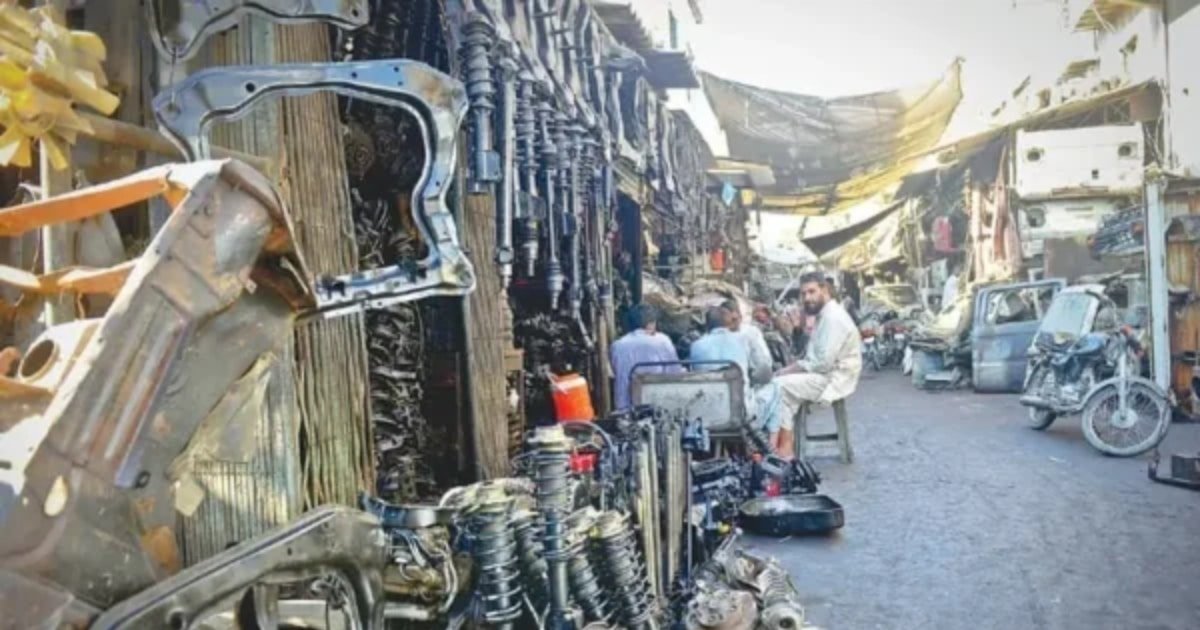


KARACHI: Once a bustling hub for imported used auto parts and engines, Karachi’s decades-old Shershah Market is facing a sharp decline in buyers despite a surge in imported used cars and growing vehicle numbers on city roads.
According to local importers, around 40,000 used cars, mostly from Japan, arrived in Pakistan in the last fiscal year, with 660cc models making up 98 percent of the total. Another 18,000 cars were imported between July and December 2025. While this growth might have been expected to boost demand for spare parts, market traders report a significant slowdown in footfall.
Traders attribute the decline to multiple factors, including steep prices for duty-paid parts, the availability of cheaper alternatives in other markets, and long-standing infrastructural challenges. Shershah Market, located near Lyari and the old SITE industrial area, comprises roughly 4,500 shops and 3,000 godowns, but narrow roads, poor parking, and dilapidated internal pathways have made access difficult for buyers.
Competition from other markets
Buyers are increasingly turning to smaller or alternative markets for axle, suspension, and shock absorber parts, where prices are lower, and transactions are perceived as easier. Chinese-made parts, though cheaper, are considered one-time use, whereas imported Kabuli parts—considered higher quality and repairable—remain Shershah’s core offering.
For instance, a Chinese front axle boot pair for a Suzuki Alto 2004 sells for Rs7,000-8,000, compared to Rs4,000-5,000 for Kabuli parts at Shershah. Similarly, engines have seen massive price increases; a 660cc engine now costs around Rs150,000, up from Rs25,000-30,000 five years ago. Prices for larger engines, including Isuzu 2,500cc and Hyundai Shehzore 2,400cc, have also more than doubled in recent years.
Security and infrastructure challenges
Traders said that although the market has seen improved security since past incidents—including the killing of over a dozen people in 2010—buyers remain cautious. Working conditions are further hampered by the lack of streetlights, cameras, proper drainage, and water supply, with heavy rains sometimes forcing the market to close for days.
You May Also Like: Urea sales hit record high as cement and oil demand show recovery
Duty-paid vs smuggled parts
Shershah traders emphasized that their stock is duty-paid, imported directly from countries such as Japan, Dubai, and Hong Kong. While smuggled parts may be cheaper by up to 80 percent, the market prides itself on legal trade, which contributes to higher prices. Traders pay over Rs10 million in duties and taxes for a 26-tonne container of parts, compared to Rs1.5-2 million for smuggled shipments.
Kabuli parts “are repairable due to their good quality even after usage for two to three years. Chinese parts lack satisfaction and are unable to be repaired. They can only be replaced”, a suspension and axle maker said.https://t.co/frPDt2dH4a
— Dawn.com (@dawn_com) January 4, 2026
Despite the slowdown, Shershah Market remains a critical hub for engines and other key auto components, serving as a supplier for upcountry markets. Traders have urged the Sindh government to improve roads, provide basic amenities, and ensure adequate security to revive one of Asia’s largest and oldest used auto parts markets.
With rising prices, stiff competition, and infrastructural challenges, Shershah Market’s survival depends on balancing quality, affordability, and accessibility to attract buyers back to its historic stalls.
Check out our latest video: