


Monsoon rains have once again turned Pakistan’s northern regions into disaster zones. Torrential downpours, cloudbursts, and accelerated glacier melts have unleashed deadly floods, claiming lives and tearing apart communities. Entire districts have been cut off, infrastructure washed away, and families left without shelter or food. Yet amid the chaos, one institution has once again stepped forward as the first and most decisive responder—the Pakistan Army.
🚨BREAKING: According to PDMA, 202 people have lost their lives in KP in 24 hours due to flash floods. pic.twitter.com/CzTuRymQkL
— The Daily CPEC (@TheDailyCPEC) August 15, 2025
The Immediate Crisis
According to the National Disaster Management Authority (NDMA), the floods since June 26, 2025, have claimed at least 657 lives nationwide, while more than 929 people have been injured. The devastation has been most severe in Khyber Pakhtunkhwa (K-P), where the death toll has crossed 390 people, with Buner district alone reporting over 200 fatalities. Rescue teams warn the toll may rise further, as dozens remain missing in remote valleys still cut off by swollen rivers and landslides.
Unlike seasonal rains that bring minor damage, this year’s floods have been shaped by above-average rainfall, cloudbursts, and accelerated glacier melt, phenomena that climate experts link directly to global warming. Fragile mountain slopes, poor local infrastructure, and unregulated settlements along riverbanks have compounded the tragedy.
Entire communities in Gilgit-Baltistan and Khyber Pakhtunkhwa now depend on relief supplies dropped by helicopters. Roads, particularly sections of the Karakoram Highway, have been destroyed. Livelihoods tied to farming and small-scale trade lie in ruins. The challenge ahead is not only survival, but also rebuilding lives amid a deepening cycle of vulnerability.
You May Like To Read: BLA’s Fall from the Shadows: A Strategic Win for Pakistan, A Strategic Loss for India
The Army’s Crucial Role
Once again, Pakistan’s armed forces have emerged as the backbone of relief efforts. While civil departments such as NDMA and PDMA provide the framework, it is the Pakistan Army that carries out the most difficult operations in areas where civilian institutions have no reach. The floods of 2025 have been no different.
Key Relief Measures by the Army
One Day’s Salary Donated – All Army personnel have contributed a day’s salary for flood rehabilitation, setting the tone for a nationwide call to solidarity.
600+ Tonnes of Rations Distributed – Military rations have been allocated to families stranded in flood-hit regions, with special focus on districts like Buner, Chitral, and Swat.
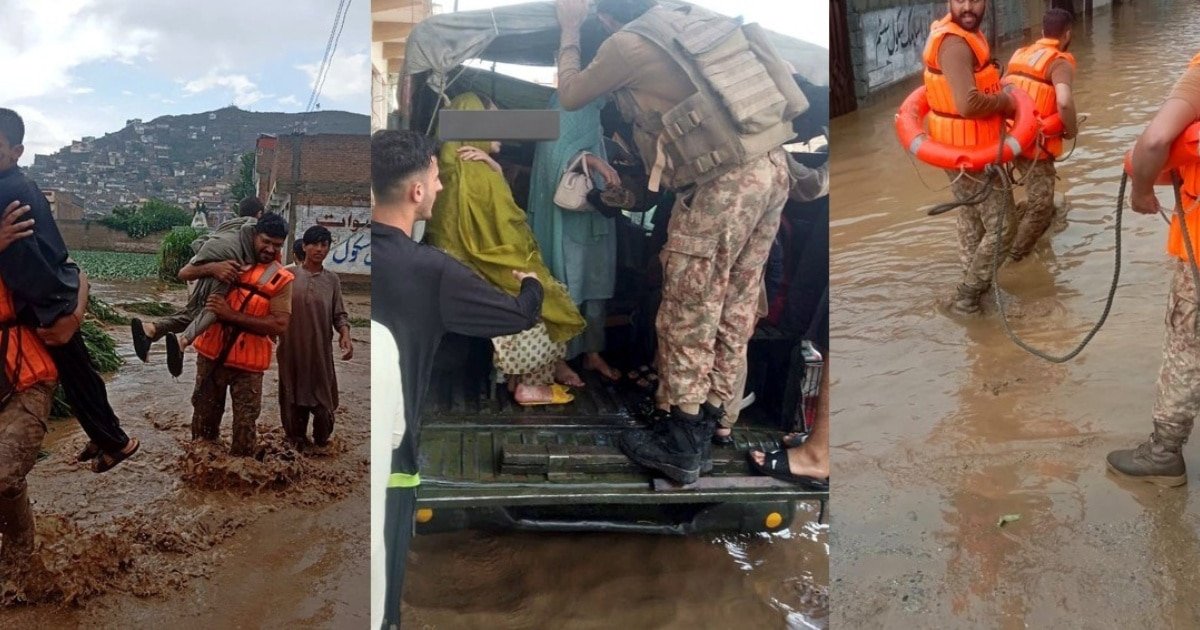
Troop Deployment Intensified – Additional contingents of soldiers have been deployed to the worst-affected districts, conducting rescue missions often under dangerous weather conditions.
Bridges & Roads Repaired – The Army Corps of Engineers is working around the clock to repair washed-out bridges and install temporary crossings, restoring vital connectivity to cut-off valleys.
USAR Teams & K-9 Units – Urban Search and Rescue teams, supported by sniffer dogs, have been deployed to locate survivors in collapsed homes and submerged areas.
Army Aviation Support – Helicopters remain the lifeline of relief, conducting medical evacuations, airlifting supplies, and rescuing those stranded on rooftops or in mountainous terrain.
These are not one-off measures, but a continuation of a tradition. From the 2005 earthquake to the 2010 super floods, from landslides in Gilgit-Baltistan to drought relief in Sindh, the Army has consistently been the nation’s first responder—often the only responder in remote zones.
COAS Asim Munir calls for urgent actions to aid flood-stricken areas in KPhttps://t.co/g4P4nYAZk8#KPKFloods #armychief #AsimMunir #abbtakk pic.twitter.com/bjyms24GhJ
— AbbTakk (@AbbTakk) August 17, 2025
Beyond Rescue: A Pattern of Dependence
The Army’s presence in every major calamity highlights two realities. First, it proves the unmatched organizational capability, discipline, and reach of the military. No other institution can mobilize resources at such a scale and speed. Second, it underscores the persistent weakness of Pakistan’s civilian disaster management systems.
While NDMA has improved coordination over the years, it remains dependent on the Army’s manpower, machinery, and logistics. This raises a difficult but unavoidable question: should Pakistan continue to rely on its armed forces for every natural disaster, or should civilian structures be strengthened to reduce this dependency?
For now, what matters most is relief. Thousands of families are displaced, children are hungry, and entire villages are without electricity or clean water. In such a moment, debates over institutional reform fade before the urgent need for survival. And survival, once again, is being made possible by the soldiers in uniform.
You May Like To Read: Police Martyrs’ Day Commemorated Across Punjab
Climate Change: The Long War
While rescue and relief are urgent, Pakistan cannot ignore the root cause of its repeated flood tragedies: climate change. The country is among the top ten most vulnerable nations to climate disasters, yet investment in climate resilience remains inadequate.
Floods in 2022 killed over 1,700 people and displaced millions. Just three years later, history repeats itself with alarming intensity. Without robust adaptation strategies—such as flood-resistant housing, modern drainage systems, glacial monitoring, and planned relocation from high-risk zones—such tragedies will return with greater force.
Here again, the Army’s role may expand beyond relief into resilience. Military engineers, with their expertise in building infrastructure in extreme terrains, can support government efforts to develop climate-resilient systems. But ultimately, it is the state’s responsibility to make long-term investments, while the Army serves as an emergency shield.
The Human Story
Behind every statistic is a human tragedy. In Buner, families mourn the loss of entire households swept away overnight. In Chitral, villagers dig through rubble searching for loved ones. In Gilgit-Baltistan, children stranded in cut-off hamlets wait for helicopters carrying food.
For them, the sight of a soldier carrying a child on his shoulders, or a helicopter dropping bags of rations, is not just a rescue operation—it is hope itself. It is the assurance that the state has not abandoned them, even when nature has turned cruel.
Conclusion: The Shield of the Nation
The floods of 2025 will be remembered as another chapter in Pakistan’s long struggle against climate-driven disasters. They will also be remembered as yet another moment when the Army rose to shield its people.
Yes, the country must strengthen its civilian institutions. Yes, long-term climate adaptation is non-negotiable. But in the hour of crisis—when rivers overflow, bridges collapse, and lives hang by a thread—it is the Pakistan Army that turns the tide from despair to survival.
And that, perhaps, is the truest meaning of service: to stand guard not only at borders, but at every floodplain, every collapsed house, and every valley where Pakistanis cry out for help.