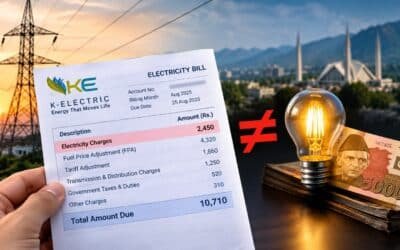



ISLAMABAD: The government on Wednesday announced that electricity consumers will continue to pay a debt surcharge of Rs3.23 per unit for up to six years, as it notified a revised uniform national base tariff for the current year without any change.
In a statement issued alongside the tariff notification for all power distribution companies (Discos) and K-Electric, the Power Division said the debt surcharge would be withdrawn only after the clearance of circular debt, which is expected to take five to six years. “Once the circular debt is cleared, the debt surcharge currently charged at Rs3.23 per unit will be withdrawn, providing further tariff relief to consumers,” the statement said.
The Power Division said a comprehensive circular debt settlement plan had been launched to eliminate outstanding liabilities within the stated timeframe. It added that the government had also introduced a surplus power package under which industrial and agricultural consumers could access additional electricity at a concessional rate of Rs22.98 per unit for three years. The initiative aims to reduce average industrial tariffs and support economic activity.
Acknowledging structural challenges in the power sector, the Power Division said the rapid growth of off-grid solar consumption had distorted subsidy requirements. According to official data, the number of protected electricity consumers has doubled from 11 million in 2021 to 22 million in recent years due to hybrid consumption patterns.
“This has not only strained fiscal resources but has also increased the cross-subsidy burden on industrial and commercial users, undermining their competitiveness,” the statement said. It added that commercial, bulk supply and high-consuming domestic consumers were currently bearing a significantly higher cross-subsidy burden compared to the industrial sector.
You May Also Like: Three women suffocate to death in Rawalpindi due to gas leak from geyser: Police
Responding to criticism over high energy costs — an issue also highlighted by Finance Minister Muhammad Aurangzeb as a factor behind the exit of foreign firms and challenges faced by exporters — the Power Division said it was exploring additional measures to further reduce the cross-subsidy burden on industrial consumers. These measures include subsidy reforms and debt refinancing, in addition to tariff reduction steps already taken.
Rs3.23 per unit debt surcharge on electricity consumers to continue for up to six years. https://t.co/xVttNaUYGz
— Dawn Business (@dawn_business) January 15, 2026
The division said data showed a substantial reduction in the industrial cross-subsidy burden, which had declined from Rs225 billion, or Rs8.9 per unit, in March 2024 when the current government assumed office, to Rs102bn, or Rs4.02 per unit, at present — a reduction of Rs123bn.
It further said industrial electricity tariffs, including taxes, had fallen from Rs62.99 per unit in March 2024 to Rs46.31 per unit in December 2025. Over the same period, the national average electricity tariff declined from Rs53.04 per unit to Rs42.27 per unit.
To further bring down electricity costs, the Power Division said the government had terminated inefficient power plants and successfully renegotiated contracts with several independent power producers (IPPs). It added that these measures had contributed to tariff reductions, while negotiations with remaining IPPs were ongoing.
Check out our latest video: