

In March 2026, as the world observes International Women’s Day under the banner of “Rights and Justice,” a quieter, more subversive revolution is unfolding on our bookshelves. For women across the Global South, specifically in regions where systems of power are actively working to erase their presence from the public sphere, the act of picking up a pen is rarely a mere hobby. It is a primary form of survival. It is an act of building a “country of words” where no decree or border can follow.
We are living through a paradox: while we are more connected than ever, the voices of women in crisis zones are being systematically muffled. Literature, however, remains the only archive that power cannot burn. When a woman writes from a place of state-enforced silence, she isn’t just filling a void; she is reclaiming her fundamental right to exist. To understand this struggle, we must look toward the specific geographies where the most vital work is being done.
arundhati roy’s ‘mother mary comes home’ is so fucking beautiful and gut-wrenching and bone-chilling and just…..Gorgeous. having the time of my life reading it but also i can’t stop crying lol.
— ف (@mitenkabutgirl) February 25, 2026
Pakistan: Ecofeminism and the Interior Ecology
In Pakistan, the literary landscape is moving beyond traditional protest to explore the intersections of gender, nature, and systemic power. A standout work is What Kept You? by Raaza Jamshed. Jamshed develops what critics call an interior ecology, where the grief and memory of the female protagonist become a form of resistance against patriarchal domination.
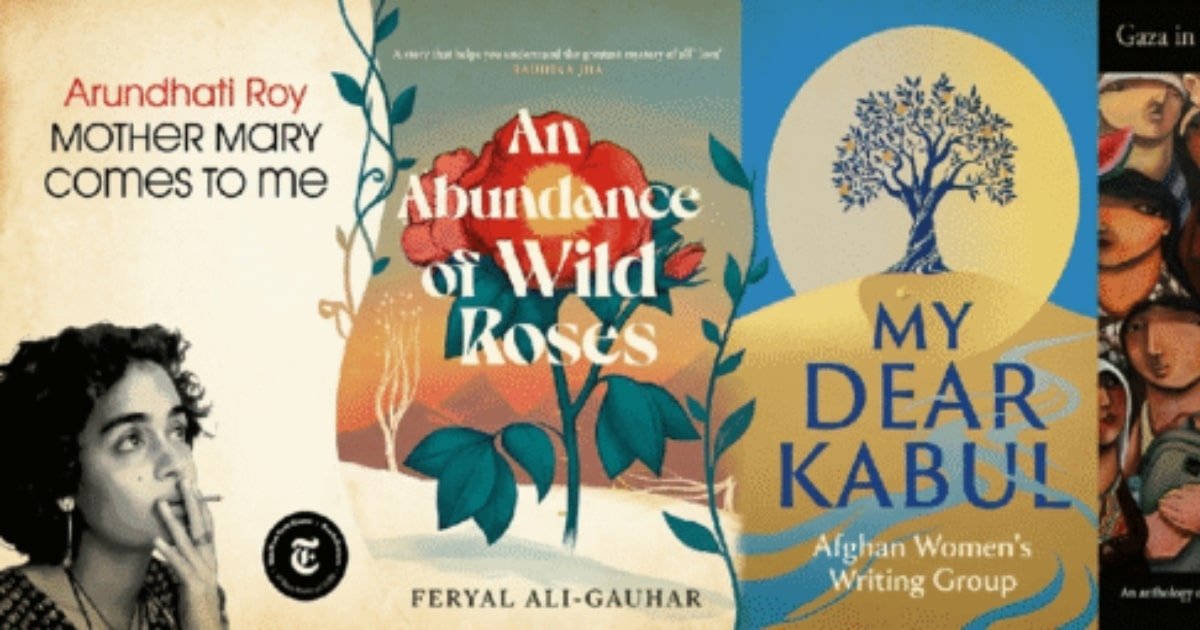
By centering the domestic and emotional landscape, Pakistani women writers are reframing resistance; it is no longer just about the shouting in the streets, but the persistent, quiet refusal to let one’s inner world be colonized. This follows the brave legacy of authors like Feryal Ali-Gauhar, whose 2024 work An Abundance of Wild Roses continues to influence the 2026 discourse on how women’s subjectivities are inseparable from the land they inhabit.
The Ink of Defiance: Reclaiming Women’s Voices in a Silent World
Source: Cannongate Books
India: Maternal Ghosts and Literary Roots
A central pillar of the 2026 literary landscape is Arundhati Roy’s long-awaited work, Mother Mary Comes to Me. Published late last year and currently sweeping the 2026 award circuits, including the Mathrubhumi Book of the Year, this work is a visceral exploration of Roy’s relationship with her mother, Mary Roy.
For the Indian reader, this book is more than a biography; it is a search for the roots of a woman’s evolution into a writer. Roy describes her mother as her “shelter and her storm,” a woman who shaped her fierce independence but also resented it. In an era where the Indian state frequently challenges dissenting voices, Roy’s return to her personal origins reminds us that the personal is always political.

Goodreads
Source: Goodreads
Afghanistan: The Clandestine Diaries of Kabul
In Afghanistan, where the unwritten chapters of a generation of girls are being forcibly closed, writing has moved to clandestine WhatsApp groups and encrypted notes. The most significant release of early 2026 remains My Dear Kabul, a collective diary featuring twenty-one anonymous female authors. Compiled from a secret digital writing group, it serves as a visceral map of life under a collapsing system.
These women used a group chat as a lifeline to preserve their reality, proving that even when schools are shuttered and the public square is cleared, the mind remains an open, sovereign territory. The book is an act of digital masonry, building a wall of words to protect a history that the state is actively trying to delete.
Honoured to attend the launch of ‘My Dear Kabul’ at the @britishlibrary .
This powerful memoir offers a poignant glimpse into the lives of girls under Taliban rule in #Afghanistan.
Hosted by amazing @bbclysedoucet.
Incredible work by the @WritersUntold team!@LucyHannah19 pic.twitter.com/oDfPkTcY4P
— Suhrab Sirat (@SuhrabSirat) September 17, 2024
Iran: Magical Realism as Political Sanctuary
From Iran, the 2026 literary scene is currently celebrating the resurgence of Shahrnush Parsipur’s Women Without Men. Although originally banned for decades, its new 2026 translations have turned it into a contemporary anthem for the “Woman, Life, Freedom” movement. This novel was also long-listed for the International Booker Prize.
Parsipur uses magical realism to follow five women who escape the confines of family and state to find refuge in a mystical garden. It remains a hauntingly relevant condemnation of the policing of women’s bodies. In the Iranian context, where the eye of the state is omnipresent, writing fantasy becomes a way of carving out a space where women can finally be human, rather than symbols of ideology.
Pleased to see Shahrnush Parsipur’s excellent ‘Women without Men’ (https://t.co/dYD1jRbm55) longlisted for Int’l @TheBookerPrizes, and presumably the @FeministPress ed. never ‘came out’ in the UK, hence eligible, but isn’t it a 2012 (©2011) translation ? https://t.co/WO5ZaL5IUj
— Michael Orthofer (@MAOrthofer) February 24, 2026
Palestine: The Poetics of Ruin and Resilience
In Palestine, the 2026 literary landscape is defined by a “Poetics of Ruin.” Authors here are documenting a genealogy of hope amid an ongoing attempt to erase their future. A standout work this year is the anthology Every Moment Is a Life, edited by Susan Abulhawa.
This collection brings together essays and poems from women in Gaza, documenting the unseen moments that traditional journalism misses, the small domestic joys, the shared recipes in shelters, and the crushing weight of loss that defines the human spirit under siege. These voices do not just report on tragedy; they insist on their humanity, refusing to be reduced to mere statistics in a news cycle.
pls take the time to read this book. It is brutal and I have never cried as much reading a book as I did with this one. it is deeply essential and important. Pls add it to your tbrs and read it. https://t.co/nquQB4eMvW
— beyza🍉 is ramadaning🌙✨ (@daisy_bey) March 14, 2026
Bangladesh & Sri Lanka: Migration and Memory
In Bangladesh, Farhana Afrin Rahman’s After the Exodus offers a powerful feminist lens on life in Rohingya refugee camps, challenging humanitarian stereotypes about the agency of displaced women. Meanwhile, in Sri Lanka, Saraid de Silva’s Amma continues to garner acclaim for its exploration of the fraught nature of maternal inheritance, what women carry from their mothers across borders and through the trauma of war.
🎉Congratulations to Dr Farhana Afrin Rahman who has been awarded the prestigious L.H.M. Ling Outstanding First Book Prize at the 2025 BISA Awards for her groundbreaking work, After the Exodus: Gender and Belonging in Bangladesh’s Rohingya Refugee Camps.📚https://t.co/tB5ZGOdM83 pic.twitter.com/YKaDc4Y9bK
— Politics and International Studies Cambridge (@Dept_of_POLIS) June 24, 2025
The Polyphony of Resistance
As we look at these works across the Global South in March 2026, the takeaway is clear: these books are not just “reading material.” They are acts of defiance. From the secret WhatsApp groups of Kabul to the magical gardens of Iran, women are proving that the voice is the only territory that cannot be permanently occupied.
To support these voices is to move past the “pink-washed” corporate slogans of March and engage with the difficult, incendiary, and beautiful words being written in the shadows. We read them to ensure that when the history of this decade is finally told, it is not a monologue of power, but a polyphony of resistance.
You May Like To Read: Mashion Bazaar 2026: Mahira Khan’s Masterclass in Community Retail
Check out our latest video: