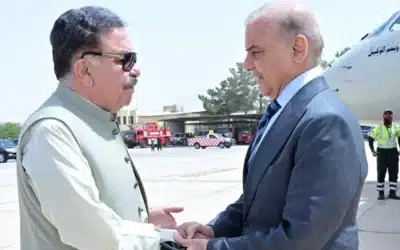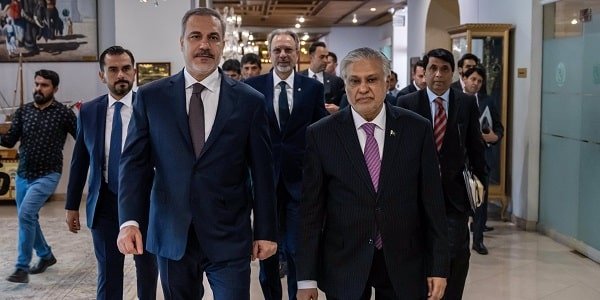


Turkey’s foreign minister’s upcoming visit to Pakistan (expected next week) emphasizes a growing partnership amid major regional and global challenges. This diplomatic trip is more than just symbolic—it shows changing geopolitical realities, expanding economic initiatives, and shared security concerns.
Brotherly Bonds Reinforced
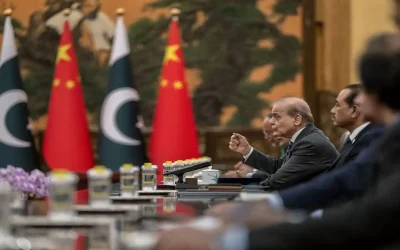
The relationship between Pakistan and Turkey has matured remarkably over recent years. Historically rooted in cultural and religious affinity, the strategic dimension has undergone significant growth. In February, President Erdoğan’s two-day visit to Islamabad yielded 24 memoranda of understanding across the defense, energy, trade, and technology sectors. That visit culminated in the seventh session of the High-Level Strategic Cooperation Council (HLSCC), co-chaired by Erdoğan and Prime Minister Shehbaz Sharif. It emphasized a commitment to elevate bilateral trade to $5 billion.
Echoing this momentum, Pakistan’s Prime Minister recently thanked Turkey‘s leadership for its robust support during Islamabad’s regional tensions, particularly with India. Turkish Foreign Minister Hakan Fidan himself had praised the bilateral trade target and Pakistan’s efforts in counterterrorism during his May 2024 visit. This upcoming visit continues that diplomatic cadence, focusing on operationalizing agreements and expanding cooperation.
Economic Synergy: Beyond Rhetoric
The strategic agenda is not limited to rhetoric. Both nations have demonstrated intent to operationalize cooperation in high-impact sectors:
- Defence and security: Turkey and Pakistan aim to deepen joint production in aerospace and electronic warfare. Earlier MoUs between Turkish Aerospace Industries and Pakistan’s naval research entities signal the seriousness of this agenda.
- Trade and energy: The shared goal of reaching $5 billion in annual bilateral trade depends on agreements in energy, mining, IT, and infrastructure.
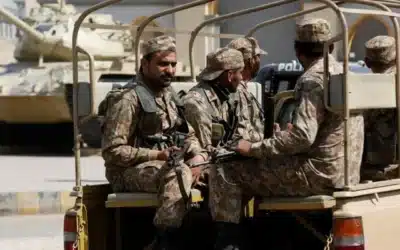
- Counterterror cooperation: With regional instability in Afghanistan and Gaza, Islamabad and Ankara have pledged to “vow a united front” against terrorism .
The foreign minister’s visit thus presents an opportunity to begin implementing these frameworks—translating memoranda into joint ventures, defense manufacturing initiatives, and trade facilitation mechanisms.
Shared Geopolitical Concerns
Pakistan and Turkey’s alignment extends across key regional flashpoints:
- Afghanistan: Both continue to advocate for non-state actors to be restrained following Taliban’s takeover—concerns reflected in HLSCC communiqués.
- Middle East tensions: Erdoğan’s public support for Palestine and criticism of Israel during his Islamabad trip highlighted overlapping agendas.
- Kashmir and Cyprus: Pakistan reaffirmed support for Turkey on Cyprus while Turkey empathized with the Kashmiri cause.
Such alignment positions this partnership as a diplomatic counterweight to competing narratives in South and West Asia.
Media and Public Diplomacy: The Soft Power Edge
An often-overlooked aspect of this relationship is media and cultural outreach. In late 2024, both governments agreed to improve media collaboration, joint broadcasting, and efforts to fight Islamophobia, using soft power through state media. The upcoming visit could advance this goal by launching joint cultural projects and bilateral media training programs.
A Realistic Assessment
While the foundation is solid, implementation poses the real challenge. Critics highlight that many MoUs risk staying symbolic if follow-through is weak. Domestic economic pressures in both countries and geopolitical sensitivities—especially Pakistan’s balancing act with China and the U.S.—could hinder execution. However, the repeated high-level exchanges, inclusive agreements, and shared strategic goals provide a credible framework. This visit presents an opportunity to turn diplomatic goodwill into lasting projects: joint naval systems, industrial zones for Turkish firms in Pakistan, technology and energy collaboration, and cultural exchange programs.
Final Perspective
Turkey’s foreign minister’s visit to Pakistan signifies an important chapter, not just pageantry, but a meaningful diplomatic step toward concrete partnerships. As global alignments change, Islamabad and Ankara seem committed to establishing a comprehensive alliance: military, economic, diplomatic, and cultural.
Success will rely on post-visit momentum: signing projects, allocating budgets, and securing early wins to build public confidence. If both governments focus on execution rather than optics, the visit could mark a new era in South-West Asian collaboration, centered on shared identity, mutual trust, and strategic necessity.