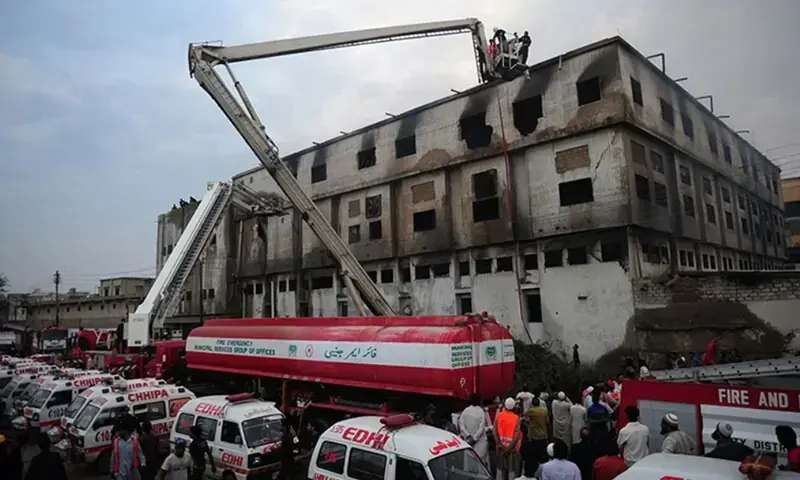





ISLAMABAD — The Supreme Court of Pakistan on Wednesday overturned the convictions and death sentences of two Muttahida Qaumi Movement (MQM) workers, Abdul Rehman alias Bhola and Zubair alias Chariya, who were previously convicted for their alleged involvement in the catastrophic 2012 Baldia Town factory fire. The catastrophic blaze at the Ali Enterprises garment factory on September 11, 2012, resulted in the deaths of over 260 workers who were burnt alive, making it the deadliest industrial fire in the nation’s history.
Key Highlights
- The Supreme Court annulled the death sentences of MQM workers Abdul Rehman and Zubair, granting them the benefit of the doubt.
- The decision nullifies a 2020 anti-terrorism court verdict and a subsequent 2023 Sindh High Court ruling that had upheld the capital punishment.
- Defense counsel argued that the Joint Investigation Team (JIT) report used to convict the men was legally inadmissible as primary evidence.
- The top court highlighted gaps in the prosecution’s case, including unchallenged acquittals of co-accused individuals and lack of evidence regarding extortion demands.
- The bench rejected a petition to implead the families of the victims as formal parties to the ongoing legal appeal.
Overturning the Sentences on Benefit of Doubt
A three-member apex court bench—headed by Justice Malik Shahzad Ahmed and comprising Justice Aqeel Ahmed Abbasi and Justice Shakeel Ahmad—set aside the convictions on charges of murder, arson, extortion, and terrorism. Both Abdul Rehman, a former MQM sector in-charge, and Zubair had been sentenced to death by an anti-terrorism court (ATC) in September 2020. While the Sindh High Court (SHC) upheld their death penalties in 2023, the apex court accepted the convicts’ subsequent appeals, noting that a detailed written judgment would follow.
Gaps in the Prosecution’s Evidence
During the proceedings, senior defense counsel Farogh Naseem argued that both men were innocent and had been falsely implicated by the police more than two and a half years after the tragedy took place. The defense emphasized that neither individual was named in the initial First Information Report (FIR). Instead, their implication rested entirely on a 2015 Joint Investigation Team (JIT) report initiated after the arrest of an informant, Mohammad Rizwan Qureshi, who was never produced as a witness or co-accused in court to verify the claims.
The defense further contended that the prosecution failed to produce any CCTV footage or direct witness testimonies confirming the state’s allegation that the factory was torched over unpaid bhatta (extortion). Furthermore, no forensic report from Karachi University’s Science Laboratory was brought on record to prove that chemical substances were used to initiate the blaze.
The court also took note of structural factors surrounding the high casualty count. Evidence presented indicated that the factory windows were heavily blocked by iron grills, and three main exit gates had been ordered locked by the factory management shortly before the incident, leaving the trapped workers with no viable emergency escape routes.