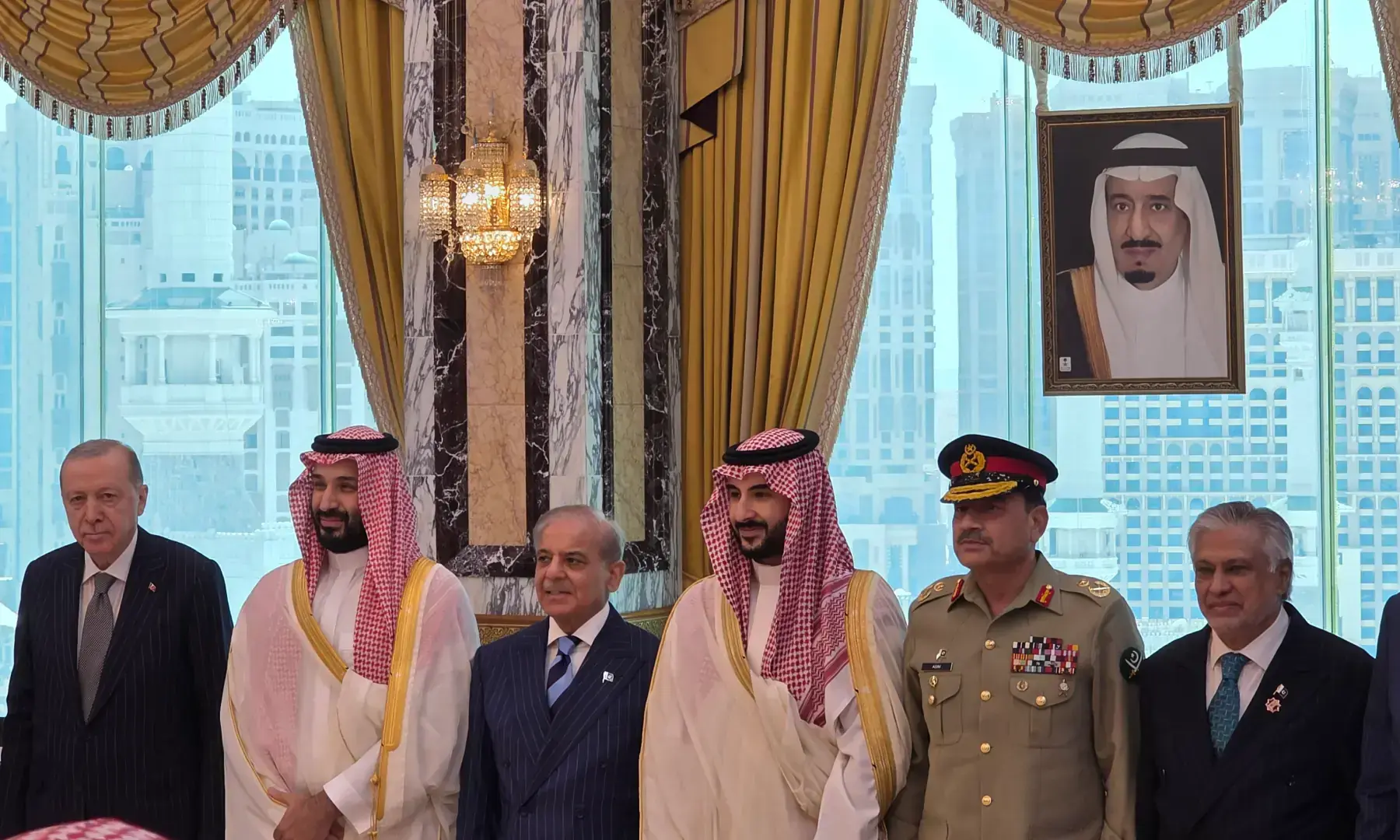



Pakistan, Saudi Arabia, and Turkiye signed a landmark joint defense agreement in Makkah on Friday, one that binds the three nations to treat an attack on any one of them as an attack on all, marking a defining moment for Muslim-world security cooperation. The Foreign Office (FO) said the Makkah Joint Defense Agreement was signed to strengthen “collective deterrence against any act of aggression” at a time when the region has grown increasingly volatile.
Key Highlights
- Pakistan, Saudi Arabia, Turkiye sign Makkah Joint Defense Agreement
- Pact declares an attack on any signatory as an attack on all three
- Signed by PM Shehbaz Sharif, Crown Prince Mohammed bin Salman, President Erdogan
- Comes amid expanding US-Israel-Iran tensions across the Gulf
- Builds on last September’s Pakistan-Saudi Strategic Mutual Defense Agreement
Pakistan’s Prime Minister Sharif, and the Chief of Defense Forces, Field Marshal Asim Munir have been received by the Saudi Crown Prince Muhammad Bin Salman in Makkah prior to the signing of the trilateral defense agreement between #Pakistan,#Türkiye and #SaudiArabia
🇵🇰 🤝🏻 🇹🇷 🤝🏻… pic.twitter.com/i1LJL9QLVt
— Developing Pakistan (@developingpak) August 7, 2026
Three Powers, One Pact
Prime Minister Shehbaz Sharif, Saudi Crown Prince and Prime Minister Mohammed bin Salman, and Turkish President Recep Tayyip Erdogan signed the agreement following the Makkah Al-Mukarramah Summit for Joint Defense, held at Al-Safa Palace. According to the FO, the pact reflects the three countries’ shared commitment to strengthening collective security and promoting peace and stability “in the region and beyond,” and provides for deeper cooperation across all aspects of defense.
The agreement, the FO said, draws on the “longstanding historical ties” among the three nations and the “enduring bonds of brotherhood and Islamic solidarity” that connect them, building on decades of shared strategic interests. Together, the three countries bring formidable weight to the arrangement: Pakistan stands as the only nuclear-armed Muslim nation, Saudi Arabia hosts Islam’s two holiest sites and ranks among the world’s largest oil exporters, and Turkiye fields NATO’s second-largest military. Few defense arrangements anywhere carry that particular combination of strategic depth and symbolic significance.
Signed Against the Backdrop of a Widening Regional Crisis
The timing of the agreement is no coincidence. It comes as the US-Israel conflict with Iran continues to send shockwaves across the Middle East and the Gulf, with missile fire increasingly reaching Gulf oil exporters as Iran retaliates against strikes launched from US military bases in the region. Against that backdrop, Friday’s pact reads as a clear signal that Pakistan, Saudi Arabia and Turkiye intend to face any future threat as a united front rather than as separate targets.
The agreement builds directly on an earlier commitment. Pakistan and Saudi Arabia signed a Strategic Mutual Defense Agreement in Riyadh last September, under which an attack on either country would be treated as aggression against both. Friday’s tripartite pact effectively widens that same principle to include Turkiye, giving it a broader geographic and military reach across three of the Muslim world’s most consequential states.
A Visit Rooted in Faith and Diplomacy
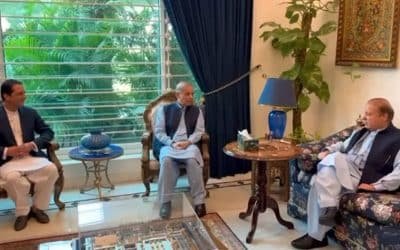
The signing capped a day that blended state diplomacy with spiritual significance. Earlier Friday, PM Shehbaz, accompanied by Chief of Defense Forces and Army Staff Field Marshal Asim Munir, met the Saudi crown prince at Al-Safa Palace, with Deputy Prime Minister and Foreign Minister Ishaq Dar and Defense Minister Khawaja Asif also present, according to the Prime Minister’s Office (PMO). That morning, the Pakistani delegation visited the Holy Kaaba and performed Umrah, before the premier was set to travel to Madina to visit Masjid-i-Nabvi.
PM Shehbaz had arrived in Jeddah on Thursday for a three-day visit, received by Makkah’s Deputy Governor Prince Saud bin Mishal bin Abdulaziz, with CDF Munir, Information Minister Attaullah Tarar and Special Assistant to the PM Tariq Fatemi joining the delegation soon after. Erdogan, for his part, made a one-day visit, landing in Jeddah before traveling to Makkah by road, according to Anadolu Agency.
The FO had earlier described the visit as carrying weight “beyond the immediate crises and short-term considerations” gripping the Gulf, framing it instead as part of a deeper effort to deepen strategic cooperation and reinforce Pakistan’s decades-old partnership with Saudi Arabia, one now expanded, with Friday’s signing, into a three-way alliance built to weather whatever the region has in store next.