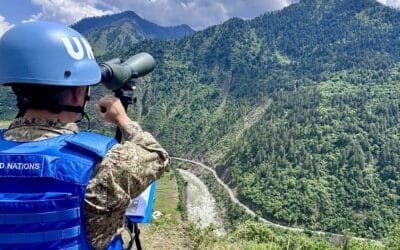





One of the reasons why Pakistan could not make considerable military progress in the Siachen sector was the unprovoked launch of Operation Meghdoot. Before 1984, India had not publicly expressed any issues through media or diplomatic channels concerning foreign expeditions accessing Siachen from the Pakistani side. The vague wording of the 1949 Karachi Agreement and 1972 Simla Agreement that demarcated only up to Point NJ9842, referred to the area beyond as running “north to the glaciers”. Not only Pakistan, which was already preoccupied with fighting the giant that was the Soviet Union at that time, but anyone in the world would have never thought that India would aim to occupy a glacier illegally. Considered as a common water source for both countries, despite three major wars with India, Pakistan had never intended to militarize this glacial mass. It came as a disappointment when a regular patrolling party of the Special Service Group (SSG) came across a hastily vacated Indian Army post that contained service cards, documentation, and other belongings, confirming the existence of the Ladakh Rifles. Thus began the planning of a retaliation: Operation Ababeel.
Operation Ababeel
Intelligence regarding the Indian movement on the glacier had reached GHQ, and planning was underway to send in Pakistani troops, but this was not a conventional operation where soldiers could be heli-dropped. The terrain was harsh and unfamiliar. While the Indian army had been carrying out reconnaissance parties in secret and training as well as studying the arctic environment for a few years, the Pakistan army had a very narrow bracket of time in which logistical supply chains had to be made, high-altitude gear to be procured, troops to be trained and educated for high-altitude warfare.
You May Like To Read: Point NJ9842: Origins of Siachen Conflict and the Ambiguity of Demarcation
This was a completely new theatre for the soldiers who had, at most, served in Kashmir but not above a glacier. It was one of the two armies in the world about to fight on a glacier for the first time. Another tactical issue arose with the process of acclimatization, which involved the slow ascent of soldiers on foot to the front, a process that took weeks. They could not be dropped through helicopters as that ran the risk of high-altitude cerebral edema and the more common frostbite that makes one lose their limbs. The operation was well-planned, and the intention was to secure the passes of Bilafond La, Sia La, and Gyong La by the men of the Northern Light Infantry (NLI) and SSG, with the support of the PAF. The objective: to reassert the rightful Pakistani control over the Saltoro Ridge to check further Indian incursion.
Harsh Weather: The Worst Enemy
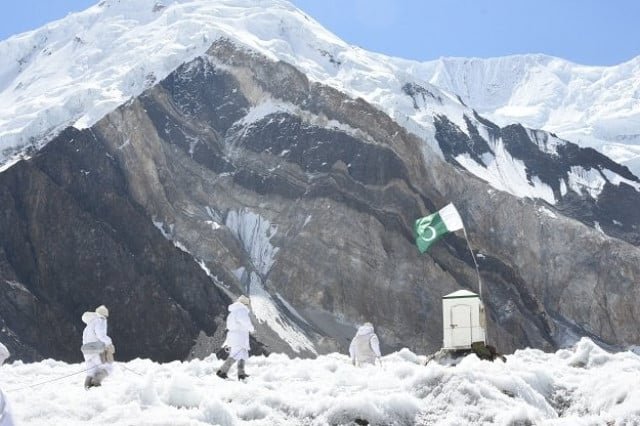
India launched Operation Meghdoot on 13 April 1984, just four days before the Pakistan Army reached the battlefield. As most of their elements were already present on the glacier, they had an upper hand in occupying key heights along the Saltoro Ridge. Despite this major setback, Pakistani elements geared up and immediately took over positions on the significant Saltoro Ridge. Counter-posts were built while being under heavy artillery fire at extreme altitudes with temperatures dropping as low as -50 degrees Celsius. Although the Pakistan Army could not seize the initial strategic opportunity due to logistical issues and time constraints of deploying complete battalions on a glacier, it ensured that once it reached Siachen, India would not be allowed to move an inch further.

Source: X/@PakistanFauj
Post 1984 Life at Siachen
Lt Col Syed Ishfaq Ali, in his book “Fangs of Ice,” describes the raw account of a Pakistani soldier’s everyday life and their fight with not only Indian soldiers but against nature’s fury as well. He writes, “It was not the bullet that claimed most of our men; rather it was the white silence, the deathly cold, and the betrayal of altitude. In his book, he chronicles the mental rigor, camaraderie, and discipline of Pakistani troops who had to transition from being planners to survivors overnight and did not retreat an inch to a larger and strategically better-positioned enemy.

Source: X/@PakistanFauj
A Battle Frozen in Time
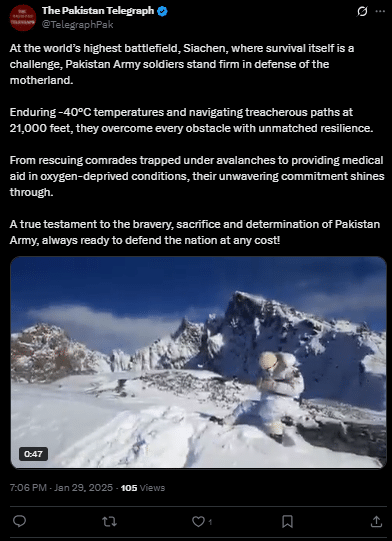
Source: X/@TelegraphPak
Despite Indian claims of strategic victory, their positions remain vulnerable. The conflict, like none other of its time, was unconventional to put it mildly. The major clash of 1984 and a minor one in 1987, which was under then Brigadier Pervez Musharraf, Pakistani troops captured and later lost the Quaid post due to political restraints, and it remains the only notable event of this conflict. The late 1980s to 1990s saw a stalemate marked by sporadic artillery duels, skirmishes, and mountaineer patrol wars. A conventional battle could not be fought to recapture the passes; however, Pakistan’s present position remains more conducive to the terrain and for long-term presence at Siachen. Many international observers, as well as notable mountaineers and former Indian Generals who have been to Siachen, believe that India holds the heights. Still, Pakistan holds the heart of the glacier.