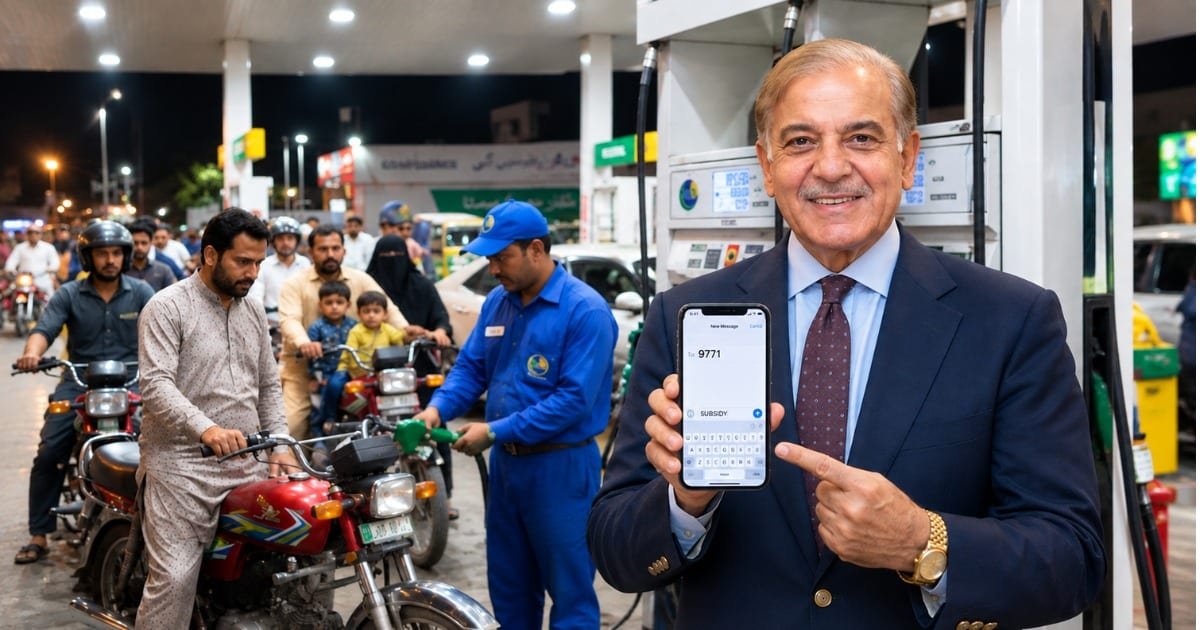



If you own a motorcycle, a rickshaw, or a small car and you’ve been watching the pump price climb past Rs 380 a liter, the federal government now has a scheme that puts some of that money back in your pocket, and getting into it takes about two text messages. The Prime Minister’s Petrol Relief Scheme went live in Islamabad at midnight between September 14 and 15, 2026, and rolls out across the rest of the country, including Azad Jammu and Kashmir and Gilgit-Baltistan, from midnight between September 16 and 17. Here is exactly how to register, what you’ll actually save, and where past versions of this idea went wrong.
Key Highlights
- The scheme gives Rs100 off every liter of petrol for motorcycles, rickshaws, Qingqis, and other two- and three-wheelers, on up to 20 liters a month, and for cars up to 800cc, on up to 30 liters a month.
- Registration runs entirely through SMS to the short code 9771, no app, no office visit, and no fee.
- You’ll need your CNIC, your vehicle’s number plate, your province code, and your vehicle’s registration date to complete the SMS.
- The Petroleum Division has pegged the monthly cost of the scheme at roughly Rs25 billion to Rs30 billion, and officials have said one CNIC can register only one vehicle to prevent duplicate claims.
- This is a federal scheme, separate from the earlier Punjab and Sindh provincial subsidy programs launched in April 2026; if you registered with one of those, you’ll still need to register separately here.
What the Scheme Actually Offers
The help is on the basis of the type of vehicle, as a flat Rs100 discount per liter. Motorcycles, rickshaws, Qingqis, Chingchis, and other two- and three-wheeled vehicles will get a discount up to 20 liters of gas a month, saving up to Rs 2,000. Cars with engines up to 800cc are charged up to 30 liters or Rs 3,000 per month. If you buy more than your monthly limit, you pay the normal pump price, so there is no point in buying above your limit when you reach the limit .
This is not being considered as a general fuel subsidy by the government but as a way of helping daily commuters and low-income families, hence the capping of the categories of vehicles at what they are now. Petroleum Minister Ali Pervaiz Malik has said the scheme costs between Rs25 billion and Rs30 billion a month to run. This is something to keep in mind in case the scheme’s future is raised in budget discussions later this year.
Who Qualifies
You qualify if you own, in your own name, one of the following: a motorcycle, a rickshaw, a Qingqi or Chingchi, another two- or three-wheeler, or a car with an engine capacity of up to 800cc. The vehicle has to be registered, and it has to be registered to the CNIC you use to sign up. If your bike is still registered in your father’s or brother’s name, the subsidy will attach to their CNIC, not yours, until the registration is transferred.
The federal government has announced a special fuel relief scheme offering a Rs100-per-litre discount on petrol for eligible motorcycles, rickshaws, three-wheelers and small cars amid rising global oil prices and supply disruptions. Here’s a step-by-step guide on how to avail the… pic.twitter.com/lw9SWSLd3A
— Times of Karachi (@TOKCityOfLights) September 13, 2026
Step-by-Step: How to Register
Step 1: Use a SIM registered in your own name. The system checks the mobile number against your CNIC, so a borrowed SIM or one registered to someone else will likely fail verification.
Step 2: Compose the registration SMS in the exact format below.
REG [CNIC number, no dashes] [vehicle plate number, no spaces or dashes] [province code] [vehicle registration date]
For example, a Lahore-based bike owner would send something structured as REG 3520112345671 LEA1234 P 15-03-2019, adjusted to match their actual CNIC, plate, and registration date. The province code has to match where your vehicle is registered, not necessarily where you currently live.
Step 3: Send it to 9771. This is a standard short code, so it should cost the same as a normal SMS, not a premium-rate charge.
Step 4: Wait for the confirmation message. A successful registration triggers a confirmation SMS back from the system. If you don’t get one within a reasonable window, the most common causes are a typo in the CNIC or plate number, a mismatch between the SIM owner and the CNIC, or sending the message before your area’s rollout date.
Step 5: Request your fuel token before you go to the pump. Send the word TOK to 9771. This generates a one-time digital token that also tracks how much subsidized fuel you’ve already claimed that month, so it doubles as your quota tracker.
Step 6: Show the token at a participating pump. Present the SMS to the attendant, who will verify it before applying the discount. Once verified, you pay the discounted rate on your eligible liters and the normal rate on anything beyond your quota.
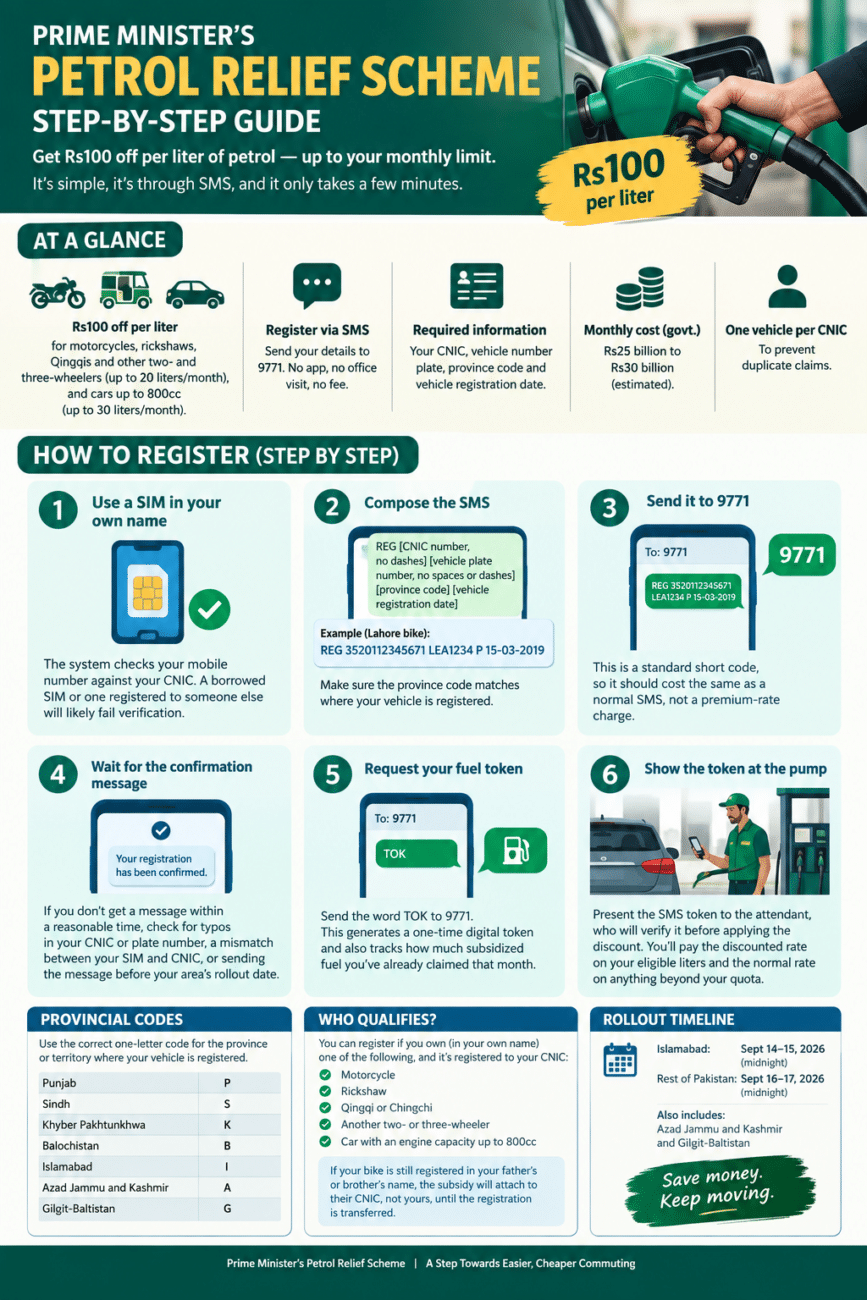
Step-by-step guide to registering for the Prime Minister’s Petrol Relief Scheme via SMS and receiving a subsidized fuel token.
Provincial Codes You’ll Need
Your registration message needs the correct one-letter code for the province or territory where your vehicle is registered.
| Region | Code |
|---|---|
| Punjab | P |
| Sindh | S |
| Khyber Pakhtunkhwa | K |
| Balochistan | B |
| Islamabad | I |
| Azad Jammu and Kashmir | A |
| Gilgit-Baltistan | G |
Rollout Timeline
Islamabad went live first, at midnight between September 14 and 15, 2026. The rest of the country, including AJK and Gilgit-Baltistan, follows from midnight between September 16 and 17. If you registered before your region’s activation date, your registration should still be captured; you just won’t be able to redeem a token or get discounted fuel until the scheme is actually live in your area.
Common Mistakes That Will Get Your Registration Rejected
With the scheme going live, there are already some patterns emerging due to the format of the scheme. One of the most common mistakes is to give dashes or spaces in the CNIC or plate number where the system expects a continuous string. This is because the format requires the CNIC and plate number to be entered without any dashes or spaces. Another alternative is to use a family member’s SIM card to register your own car, as the system will check the registering phone number against the CNIC already in the system. Furthermore, you can’t register a car that is still in someone else’s name and not yours, as you have to match the ownership of the car.
A car can be associated with only one CNIC, and only one CNIC can be associated with a car. In the past, Pakistan’s relief efforts have been plagued with duplicate claims. This is to prevent fraud, so if you own two qualifying motorcycles, you will be required to choose which one you want to register unless someone else in your household registers the other one in their own CNIC.
Fraud Warning: Protect Your CNIC
The Ministry of IT and Telecommunication has been explicit on this point: the government will not ask for any information beyond what the official SMS format requires, and there is no registration fee at any stage. Minister of State for IT Shaza Fatima has specifically urged citizens not to share their CNIC numbers or personal details with anyone claiming to help them register outside the official 9771 channel. Given how quickly copycat websites and social media pages tend to appear around any cash-adjacent government scheme, treat any app, third-party website, or phone call asking for your CNIC, OTP, or a processing fee as a red flag, and stick to the 9771 short code and the scheme’s official government channels.
If You Already Registered Under a Provincial Scheme
Both Punjab and Sindh ran their own emergency fuel relief programs, which were launched in April 2026 when heavy fighting in the area sent prices at the pump soaring. In Punjab, it was done through the app and website “Maryam Ko Batayen”. In Sindh, the excise department provided monthly cash subsidies. These were temporary, local measures put in place for only one month and not meant to be permanent infrastructure. They are not part of the new federal plan and are administered separately. If you registered for any of those earlier schemes, you will have to go through the 9771 registration process to get the Rs100-per-liter federal relief. The two systems do not have a shared database.
What Happens If You Exceed Your Quota
Do not worry. So if you take the full amount of fuel you are allowed in a month (20 liters for a bike or 30 for an 800cc car) and need more, you just pay normal pump prices for the extra fuel that month. The token system is supposed to automatically keep track of your running total, so you shouldn’t have to calculate it yourself. The pump’s verification step should display whatever’s left of your quota.
FAQs
Who is eligible for the Rs100 petrol subsidy in Pakistan?
Owners of motorcycles, rickshaws, Qingqis, Chingchis, other two- and three-wheelers, and cars with engines up to 800cc are eligible, provided the vehicle is registered in the same name as the CNIC used to register for the scheme.
How do I register for the petrol subsidy?
Send an SMS to 9771 in the format REG followed by your CNIC number, your vehicle’s plate number, your province code, and your vehicle’s registration date, all without dashes or spaces between the CNIC and plate number. You’ll get a confirmation message if registration succeeds.
How much can I actually save each month?
Motorcycle, rickshaw, and other two- or three-wheeler owners can save up to Rs2,000 a month on 20 litres of petrol. Owners of cars up to 800cc can save up to Rs3,000 a month on 30 litres.
Is there a fee to register for this scheme?
No. Registration through 9771 is free, and the government has stated it will never ask for a processing fee or additional personal information beyond the standard SMS format. Treat any request for payment or extra CNIC details as a scam.
Can I register more than one vehicle?
No. The system links one CNIC to exactly one vehicle, and one vehicle to exactly one CNIC, specifically to prevent duplicate claims.
I already registered for Punjab’s or Sindh’s provincial fuel subsidy. Do I need to register again?
Yes. The federal PM Petrol Relief Scheme is a separate system from the provincial programs Punjab and Sindh ran starting in April 2026. Registering with one does not automatically enroll you in the other.
You May Like To Read: The Indus Waters Treaty Fight Pakistan Is Actually Losing: It’s Not With India, It’s With Itself