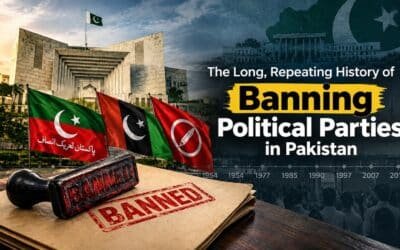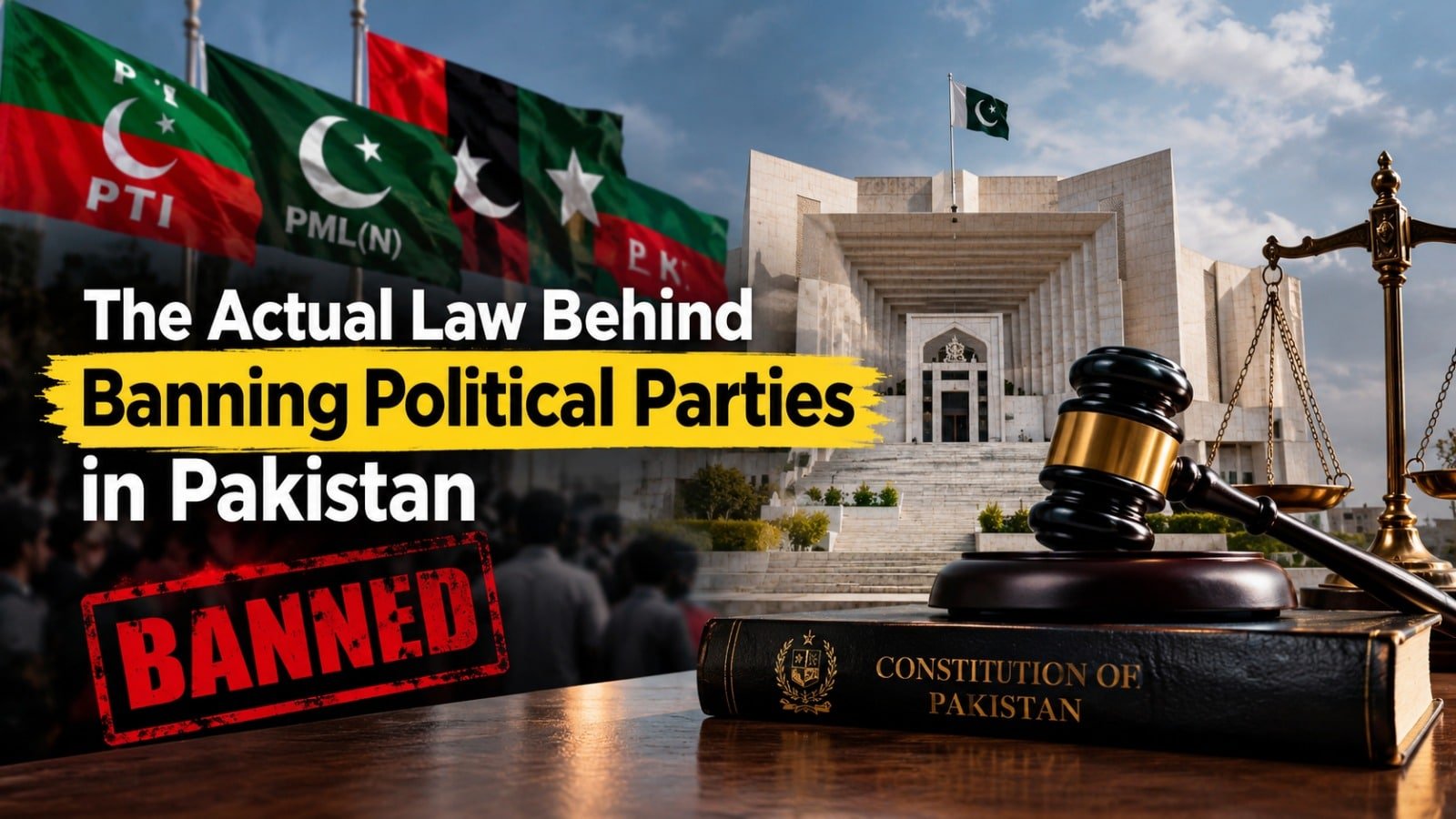



Every time a Pakistani government threatens to ban a political party, the same confusion follows online. Some people say the government can just do it by announcement. Others insist only the Supreme Court can. Others point out that some parties get “banned” and keep functioning within months under a new name, while others disappear from politics entirely. All of these things are true at different times, because Pakistan doesn’t actually have one law for banning political parties. It has at least two different legal tracks; they work in genuinely different ways, and governments have learned to pick whichever one is faster.
If you’re one of those people who tries to read the news without a law degree, this post breaks down the actual language of the Constitution and relevant laws, how courts have interpreted them since the 1960s, and the real warning signs that a party is heading into what lawyers call a constitutional red zone.
Start with the right to form a party in the first place
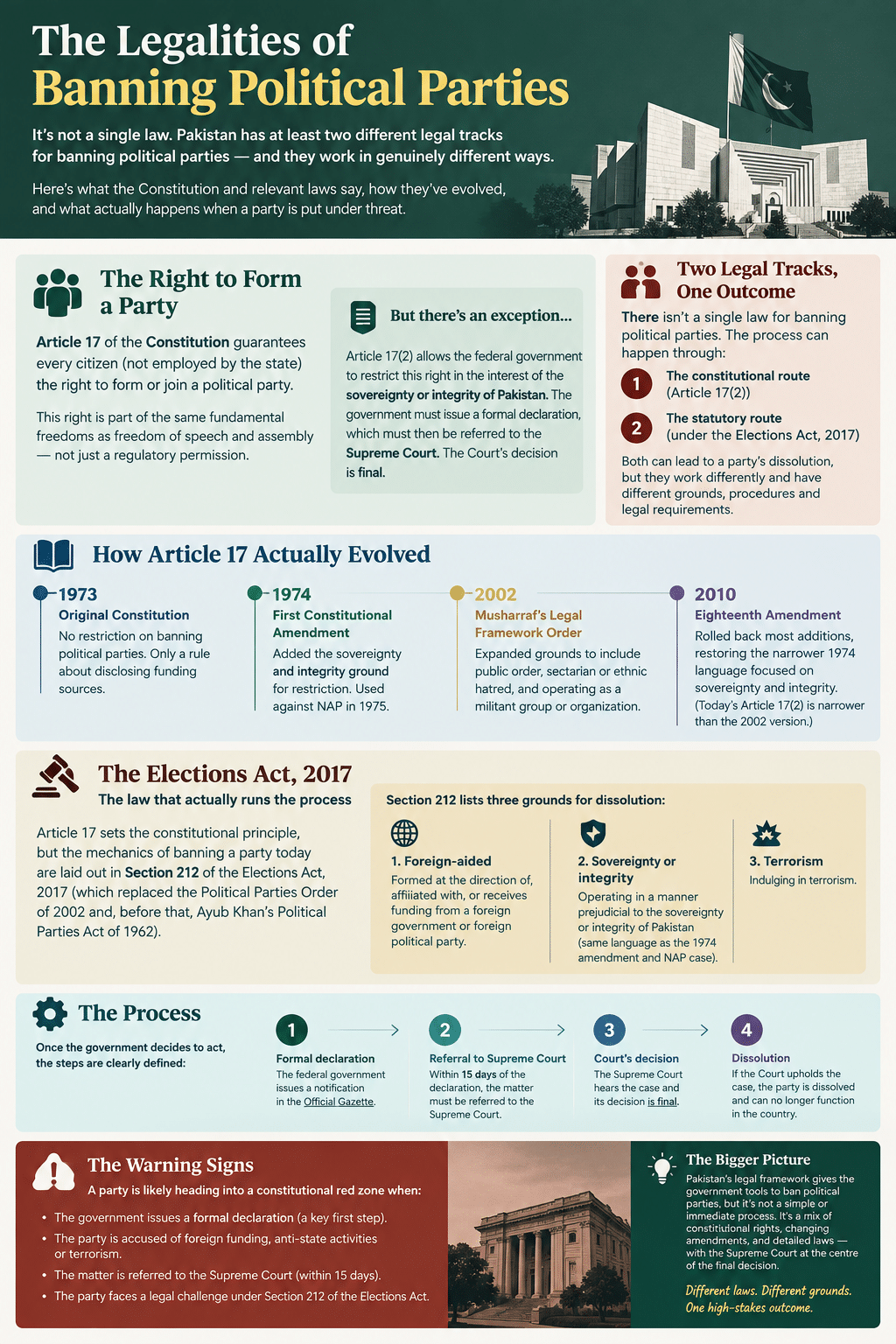
Before getting into how a party gets banned, it helps to know what right is actually being taken away. Article 17 of Pakistan’s Constitution guarantees every citizen not employed by the state the right to form or join a political party. This is a fundamental right, sitting in the same part of the Constitution as freedom of speech and freedom of assembly, not some ordinary regulatory permission the government hands out.
But Article 17(2) builds in its own exception. It allows the federal government to restrict that right “in the interest of the sovereignty or integrity of Pakistan,” and it spells out exactly how that restriction has to happen: the government issues a formal declaration, and that declaration must be referred to the Supreme Court, whose decision on the matter is final.
That single sentence is the foundation for every legal ban attempt in the country’s history since it was written. But the sentence itself has changed more than most people realize.
How Article 17 actually evolved
Pakistan’s original 1973 Constitution didn’t include this restriction at all. The only rule about political parties concerned disclosing their sources of funding, nothing about sovereignty or dissolution.
The restriction on national sovereignty and integrity grounds was added through the First Constitutional Amendment in 1974, the year after the Constitution was adopted, and it’s not a coincidence that this happened right before the National Awami Party ban followed a year later. The government that wrote the sovereignty clause into the Constitution in 1974 used it against NAP in 1975.
The next major change came under General Pervez Musharraf’s Legal Framework Order of 2002, which expanded the grounds considerably, adding public order, promoting sectarian or ethnic hatred, and operating as a militant group or organization to the list of reasons a party could be restricted. This gave the executive branch a much wider net to work with, useful in an era when the state was simultaneously trying to rein in sectarian militant groups that had built political fronts.
The Eighteenth Amendment in 2010, passed as part of a broader effort to undo military-era constitutional changes, rolled most of those additions back, restoring the narrower 1974 language centered on sovereignty and integrity. The government at the time described this as restoring the Constitution to its “original” 1973 form, though as the sovereignty clause itself shows, that’s not quite accurate, since that particular clause was never in the 1973 text either. What matters practically is that today’s Article 17(2) is narrower than the 2002 version, focused specifically on sovereignty and integrity rather than the broader public order and sectarian hatred grounds Musharraf’s government had added.
The Elections Act: the law that actually runs the process
Article 17 sets the constitutional principle, but the actual mechanics of banning a party today run through the Elections Act, 2017, which replaced the Political Parties Order of 2002 and, before that, Ayub Khan’s original Political Parties Act of 1962.
Section 212 of the Elections Act operationalizes Article 17(2) and lays out exactly three grounds on which a political party can be put forward for dissolution:
The party is foreign-aided, meaning it was formed at the direction of, is affiliated with, or receives funding from a foreign government or foreign political party.
The party is operating in a manner prejudicial to the sovereignty or integrity of Pakistan, the same language traced back to the 1974 amendment and the NAP case.
The party is indulging in terrorism.
The process itself has a clear sequence. The federal government makes a formal declaration against the party through a notification published in the Official Gazette. Within fifteen days of that declaration, the matter must be referred to the Supreme Court. If the Supreme Court upholds the government’s declaration, the party is dissolved immediately, and Section 213 spells out what happens next: every sitting member of that party in the National Assembly, provincial assemblies, the Senate, and local government seats is disqualified for the rest of their term, and the Election Commission has to formally notify each disqualification in the gazette.
Two points of this process bear emphasis, since they are often glossed over by political discourse whenever a ban is proposed. The statement by the government does not at first have the force of law. It is a provisional statement, not a final judgment. Second, the fifteen-day referral is not a matter of discretion: it is a constitutional and statutory mandate. So, when a government announces a ban but does not refer it to the Supreme Court, it is legally not banning anything yet, no matter what the headlines say.
The other track: proscription under the Anti-Terrorism Act
Here’s where it gets genuinely more complicated, and where most public confusion comes from. Since the Elections Act came into force, no political party has actually been dissolved through the Section 212 process described above. Not one. Instead, when Pakistani governments have wanted to restrict organizations that blur the line between political party and militant group, groups like Sipah-e-Sahaba, its successor Ahle Sunnat Wal Jamaat, and Tehreek-e-Labbaik Pakistan, they’ve reached for a completely different law: Section 11B of the Anti-Terrorism Act, 1997.
Under this section, the federal government can add an organization’s name to the ATA’s First Schedule, effectively proscribing it as a terrorist-linked entity. This process can happen ex parte, meaning without giving the organization a chance to respond beforehand. Once proscribed, the government can seal the organization’s offices, seize its materials, restrict its members’ travel, freeze their access to loans and arms licenses, and prohibit media coverage of the group. The organization does get some recourse afterward: it can seek a review within 30 days, the government has to decide that review within 90 days, and if the review is refused, the organization can appeal to a High Court.
Notice what’s missing from that list. There’s no mandatory referral to the Supreme Court, no fifteen-day deadline, none of the constitutional machinery Article 17(2) and Section 212 require. That’s exactly why governments have preferred this route: it’s faster, it doesn’t require winning over the country’s highest court in advance, and it can be executed through an interior ministry notification rather than a formal parliamentary or judicial process.
But proscription under the ATA and dissolution under the Elections Act are legally distinct outcomes, and this distinction matters enormously in practice. Being added to the ATA’s First Schedule restricts an organization’s activities and public presence, but it does not, by itself, dissolve its legal existence as a political entity or strip its members of their seats. A proscribed party’s status is genuinely ambiguous: banned in the sense that its offices might be sealed and its leader’s speeches can’t be broadcast, but not dissolved in the sense that Section 212 describes, and in TLP’s case, the party remained on the Election Commission’s rolls throughout its 2021 ATA ban, meaning it stayed legally eligible to contest elections even while formally proscribed.
Legal analysts, including the Free and Fair Election Network, have flagged this as a genuine gap in the law, one Parliament has never closed. Using ATA proscription against a political party arguably sidesteps the constitutional requirement for Supreme Court confirmation altogether, since the government never has to prove its case to the country’s highest court the way Section 212 requires. It’s a shortcut, and it’s one that’s been used more often than the constitutionally proper channel.
How the courts have actually ruled
Two cases, decades apart, define how Pakistan’s judiciary has approached this issue, and reading them together tells you something important: courts have consistently insisted on process, but have been willing to accept sovereignty-based bans when the government’s evidence looked strong enough.
The first is the Jamaat-e-Islami case in 1964, when the party was banned by the government of Ayub Khan for opposing the Muslim Family Laws Ordinance. The Supreme Court overturned the ban the same year on the specific ground that it had been enacted without due process and had violated the fundamental right to freedom of association. From the very beginning it was clear that a prohibition imposed by mere executive notification, without any legal basis, would not withstand judicial scrutiny.
The second is the 1975 National Awami Party case, decided by the Supreme Court on October 30 of that year. Here the outcome went the other way: the Court upheld the Bhutto government’s ban, ruling that the evidence presented showed NAP had genuinely been working toward an independent Pakhtunistan and a Greater Balochistan, findings the Court accepted as meeting the sovereignty and integrity threshold Article 17(2) had just been amended to include. This is the case that proved the mechanism actually works as a ban, not just as a political threat, when a government brings a credible enough case to court.
The judicial pattern, which arises from the comparison of the two rulings, is that process matters more than motive. In the end, a government that does not respect the proper legal procedures, as was the case with Ayub’s government in 1964, is defeated. Even a government that recently won a provincial election can be defeated by a government that makes an evidentiary case and follows the procedure required by the constitution, as Bhutto’s government did in 1975.
The PTI situation since 2024 sits in an unusual position relative to this history because the same Supreme Court that would have to rule on any Article 17(2) reference against the party had, days before the ban announcement, already ruled in a separate case that PTI was a legitimate political party entitled to reserved seats. That creates a genuine legal tension no earlier case quite had to deal with: asking the same court to validate a party’s legitimacy and its alleged threat to national sovereignty within the same year.
The red flags: how a normal person can tell a party is in danger
You don’t need a law degree to read the warning signs. Here’s what to actually watch for, in roughly the order these things tend to escalate.
Government officials start using specific constitutional language in press conferences. When a minister starts saying phrases like “foreign-aided,” “prejudicial to sovereignty,” or “operating against the integrity of Pakistan” about a specific party, rather than general political criticism, that’s not incidental. Those are the exact three grounds written into Section 212 of the Elections Act. A government doesn’t use that language by accident; it’s laying groundwork for a formal declaration.
A formal notification appears in the official gazette. This is the real beginning, in a legal sense, not a press conference. The rest is political noise until it is actually gazetted as a declaration. The clock of fifteen days for a Supreme Court reference starts to run legally from the date it is gazetted.
Simultaneous treason references against individual leaders. Beware of Article 6 proceedings, Pakistan’s high treason clause, being filed simultaneously or right before a party-ban announcement, as happened with PTI in 2024. This is often an indication that the government intends to hit the organization and its top leadership at the same time, a one-two punch that dramatically raises the political stakes.
The organization’s name suddenly appears in an Anti-Terrorism Act notification instead of a Supreme Court reference. In fact, this is the more common and, in a way, more pressing red flag, because ATA proscription can happen quickly and without notice, with offices being sealed and accounts frozen even before any court gets involved. If a party’s name is in the First Schedule of the ATA, the restriction is live and active—not just a moot threat.
Media coverage of a leader’s speeches gets restricted through PEMRA or similar regulatory bodies. A ban on broadcasting someone’s statements, common under ATA proscription, is a strong signal the state has already moved past the discussion phase into active restriction, even if the party’s legal registration technically remains intact.
A pattern of the party or its predecessor having been banned and rebranded before. If you’re looking at an organization with a history of being banned and reappearing under a new name, Sipah-e-Sahaba becoming Millat-e-Islamia becoming Ahle Sunnat Wal Jamaat is the clearest example; that history itself becomes a factor authorities cite in justifying fresh action, since it demonstrates the underlying network never actually disbanded.
Provincial government requests precede federal action. In TLP’s 2021 case, the ban originated as a request from the Punjab government before the federal cabinet approved and enforced it. Watch for provincial governments publicly requesting federal action against a party operating heavily within their territory; it’s often an early signal of what’s coming at the national level.
International or diplomatic pressure entering the domestic conversation. In PTI’s case, a resolution passed by members of the US Congress became part of the government’s stated justification. When international statements or foreign parliamentary actions start getting cited domestically as evidence in a party’s file, it suggests the government is building a broader public case, not just a narrow legal one.
None of these signs guarantees a ban will actually happen or survive a court challenge, as the aborted or reversed cases show. But together, they mark the difference between ordinary political rhetoric and an actual move through the legal machinery that has, historically, ended a handful of Pakistani political parties for good.
Frequently asked questions
Can the Pakistani government ban a political party just by announcing it?
No. A government announcement or press conference has no legal effect on its own. The party is only formally at risk once the government publishes a declaration in the official gazette under Section 212 of the Elections Act, and that declaration must then be referred to the Supreme Court within fifteen days for a final decision.
What’s the difference between banning, proscribing, and dissolving a party?
Dissolution means the formal, permanent ending of the legal existence of a party and may only be achieved through the process described in Article 17(2) and Section 212, culminating in a ruling by the Supreme Court. It is a faster and more restrictive measure under the Anti-Terrorism Act that restricts media coverage, freezes assets, and limits the activities of an organization without necessarily ending its legal status as a party. Both terms are interchangeable, and the public/media use the term “banning” to refer to either.
Has any political party actually been dissolved under the Elections Act, 2017?
No. Since the Act came into force, every restriction placed on a party-like organization has come through Anti-Terrorism Act proscription instead, not through the Section 212 dissolution process.
What are the three legal grounds for banning a party in Pakistan?
Under Section 212 of the Elections Act, a party can be targeted for dissolution if it’s foreign-aided, if it’s operating in a manner prejudicial to Pakistan’s sovereignty or integrity, or if it’s indulging in terrorism.
Why did the ban on Jamaat-e-Islami get overturned in 1964 but the ban on NAP get upheld in 1975?
The Supreme Court overturned the Jamaat-e-Islami ban because it found the government had failed to follow due process, violating the party’s fundamental right to freedom of association. In the NAP case, the government built and presented an evidentiary case that persuaded the Court the party was genuinely working toward separatist goals, meeting the sovereignty and integrity threshold under Article 17(2).
Is it legal to ban a party’s leader from speaking in the media without banning the party itself?
Yes, this is a common outcome of Anti-Terrorism Act proscription, which allows restrictions on media coverage of a proscribed organization or individual without necessarily dissolving the party’s legal registration or ending its right to contest elections.
You May Like To Read: The Long, Repeating History of Banning Political Parties in Pakistan