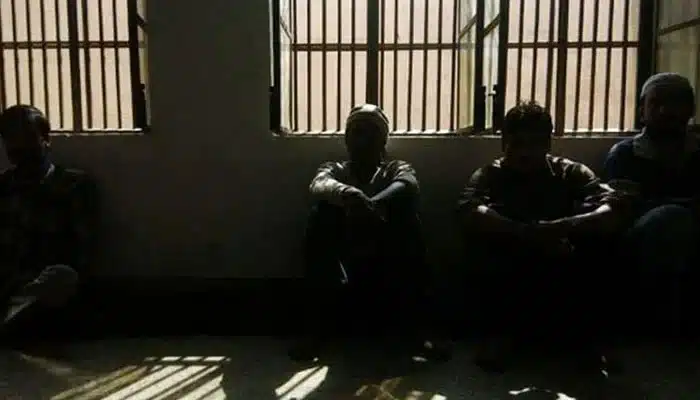




Behind Karachi’s traffic and trade is another battle. It is a battle that doesn’t always make the news but steadily harms families, youth, and neighborhoods. This battle is against narcotics: a global scourge that has found local roots. In 2025, a string of successful anti-drug operations across Karachi made it clear that Pakistan is not indifferent, and more so, it is not powerless.
The story of these operations is more than police work. It is about moral duty, state strength, and the fight to protect a generation from the grip of despair. It is a test of whether the ideals of justice and community welfare, deeply rooted in our faith and constitution, can withstand the challenges posed by organized crime.
Karachi: A City on the Frontline
Karachi’s strategic location has always made it vulnerable. As a coastal city near Afghanistan and Iran, it becomes both a transit point and a target for traffickers. These networks don’t just trade in drugs; they trade in futures lost, families broken, and dreams wasted. According to Sindh Police’s Special Branch, 5,891 drug dealers have been arrested in Karachi in just the first part of 2025.
That number is not merely a statistic but a signal that tells us that the state is engaged. That our institutions are awake. And that the fight is no longer silent.
The Crackdowns That Changed Everything
The series of recent busts has redefined how drug control is approached in Pakistan. These aren’t scattered arrests; they are systematic disruptions of networks that reach far beyond our borders.
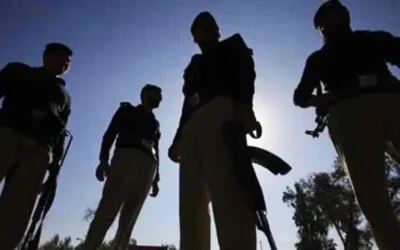
- In Machar Colony, a place often linked to drug activity, Rangers and the ANF worked together to arrest three suspects and seized over 142 kg of hashish and 400 grams of ice.
- At Karachi Airport, Customs officers found Rs 49 million worth of drugs hidden in luggage headed overseas.
- In another case, traffickers attempted to hide drugs in spice packets at Karachi Port—a tactic that vigilant officers foiled.
- In another notable case, five Iranians and one Pakistani were given life sentences for smuggling drugs across borders.
Each raid peeled back a layer of a larger network. But more importantly, each one restored a little more safety to Karachi’s neighborhoods and a little more hope to its youth.
The following video captures a real-time anti-drug operation carried out by Rangers and police in Karachi. It brings to life the very efforts described above—where state institutions are not just arresting suspects, but dismantling entire networks.
From Reaction to Strategy: Rethinking Drug Enforcement
What we are witnessing in 2025 is not merely enforcement; it is intelligence-led, community-backed intervention.
- Rangers, ANF, Customs, and Police are sharing data, surveillance, and leads. This inter-agency synergy is new, and it is working.
- Advanced tools, such as digital tracking, scanners, and drones, are enhancing detection capacity.
- As DGP Punjab Police recently highlighted on social media: “Biggest Heroin seizure of 2025: In an intelligence‑led operation … Drones were used to transport drugs from #Pakistan. Arrested the accused.”
- This statement underscores the reality that Pakistan’s drug enforcement is no longer reactive—it is informed, tech-enabled, and coordinated across borders and provinces.
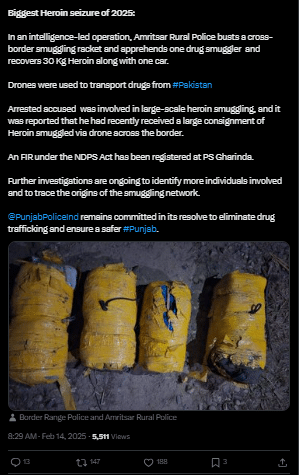
Source: X/@DGPPunjabPolice
- Community reporting has also emerged as a quiet force. Tip-offs from citizens have led to several breakthroughs.
- These changes reflect a deeper strategy: not just arresting, but disrupting the system by targeting suppliers, not just street dealers. Follow the money. Trace the networks.
This is a shift from chasing symptoms to addressing causes.
Faith and Responsibility: The Islamic Case for Action
Drug abuse is not a personal failing alone—it is a communal corrosion. Islam treats intoxication not as a casual vice, but as a grave threat to the soul and society. The Quran commands in Surah Al-Ma’idah (5:90):
“O you who believe! Intoxicants, gambling, idolatry, and divining arrows are abominations of Satan’s handiwork. Avoid them so that you may prosper.”
This verse doesn’t merely prohibit; it frames avoidance as a path to success. Success in Islam is not just personal gain; it is moral clarity, social harmony, and service to others. By this standard, those who stand against narcotics—officers, citizens, counselors—are not merely doing jobs. They are enacting moral resistance.
Each trafficker Pakistan brings down is not just a win for security; it’s a stand for sacred justice.
The Way Forward: From Arrest to Reform
A mature state does not stop at seizure; it goes further. To truly end the drug crisis, Pakistan must:
- Invest in long-term border tech—more intelligent surveillance, AI profiling, and maritime scanners.
- Set up rehab centers that not only treat addiction but also teach skills, offer faith-based guidance, and help people rejoin society with purpose.
- Involve the pulpit and the classroom—mosques and schools must teach the dignity of sobriety.
- Legal reforms must simplify prosecution processes for repeat offenders and improve oversight of drug evidence handling.
Let this not be a campaign of raids, but a movement of renewal, a movement of protecting minds, souls, and homes.
Conclusion: Faith, Sovereignty, and a Better Tomorrow
What Pakistan has shown in 2025 is not perfection—but potential. These drug busts are more than enforcement milestones; they are signs of a nation choosing clarity over chaos, justice over decay, and life over ruin.
This is not only a struggle for law and order. It is a spiritual test of whether we protect the next generation with the same urgency we defend our borders.
Islam reminds us that saving one life is like saving all of humanity (Quran 5:32). Through these operations, Pakistan is saving thousands. And in doing so, it is quietly reclaiming not only its streets but also its soul.