





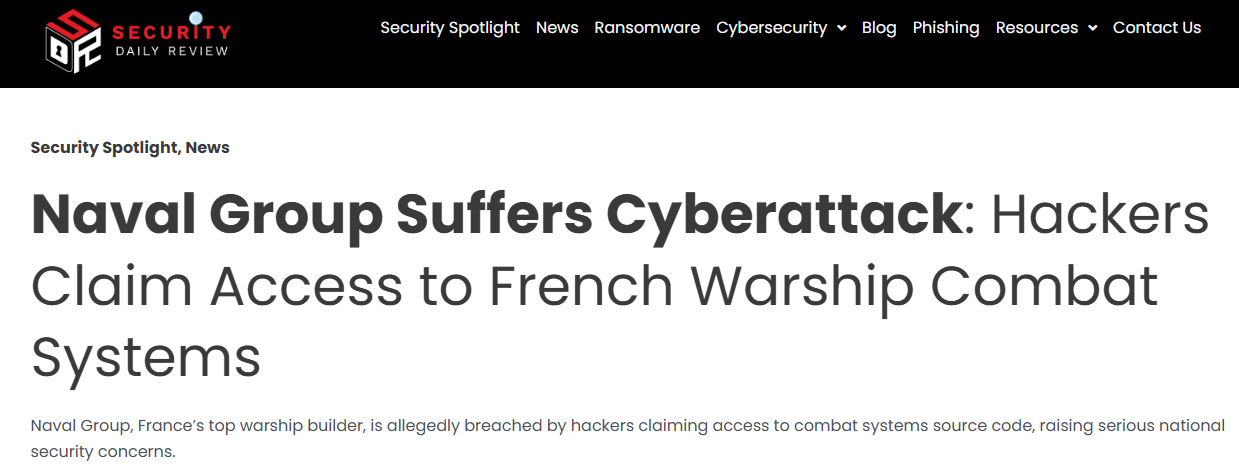
In a stunning breach of national security, France’s state-owned defense shipbuilder, Naval Group, has been hit by a cyberattack of unprecedented scale. The attackers, believed to be criminal hackers, claim to have accessed and extracted deeply sensitive military data, including the source code for Combat Management Systems used in French submarines and warships.
Confirmed: This is a verified catastrophic data breach targeting Naval Group, the French military-industrial giant specializing in submarines and advanced naval platforms. The leaked package, posted openly on a dark forum by a user named SaxX / Neferpitou, contains:
Full CMS… pic.twitter.com/0fN8am3UOs
— Thomas Keith (@iwasnevrhere_) July 28, 2025
The claims emerged between July 23 and 25, when the group posted samples of the stolen data on a known leak forum. The breach reportedly includes a massive trove—up to 13 GB—of files containing internal network maps, naval simulator environments, technical documentation spanning nearly two decades, and confidential internal communications.
More Like This:
- Pakistani Jails and Afghan Nationals: A Look into Cross-Border Criminal Cases
- Pakistan’s Border Management Strategy: Are Biometric Fences Enough?
- The History of Pakistan-China Joint Military Exercises: Beyond Symbolism
If confirmed, this breach could compromise the security architecture of France’s naval fleet. The Combat Management Systems control how naval vessels detect threats, respond in combat, and communicate. Losing control—or even partial exposure—of this code could force France to reconfigure entire systems to avoid operational compromise.
Source: Daily Security Review
Naval Group, the crown jewel of France’s maritime defense industry, plays a crucial role in designing and maintaining high-profile assets, including the Charles de Gaulle aircraft carrier and nuclear submarines. The implications of this breach stretch far beyond a single company—they go to the heart of France’s defense readiness.
The attackers are not believed to be offering the data for sale. Instead, their goal appears to be extortion. They reportedly gave Naval Group 72 hours to respond or face full public disclosure of the stolen material. This pressure adds to an already fragile European security landscape.
History of Data Breaching in France
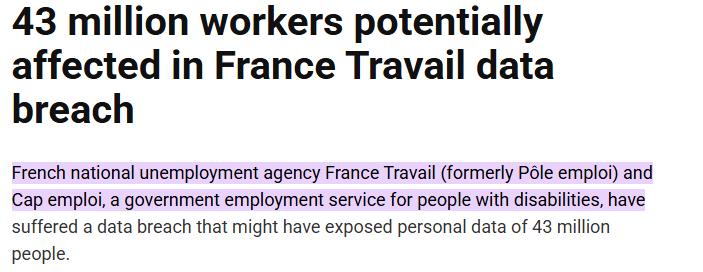
But this is not the first such incident. Just last year, France Travail, the national employment agency, suffered a cyberattack that compromised the personal data of 43 million people. The breach was one of the largest in France’s history. In July of this year, a follow-up incident again affected France Travail—this time impacting over 340,000 individuals through a partner platform.
Source: Help Net Security
There is also a growing pattern of state-linked cyber activity. In April, France’s own foreign ministry publicly blamed the Russian intelligence service GRU and its APT28 hacker group for a series of attacks targeting French government entities and businesses. These incidents, spanning several years, even involved organizations associated with the 2024 Olympic Games.
Meanwhile, France’s national cybersecurity agency confirmed another wave of intrusions exploiting vulnerabilities in widely used enterprise systems. A hacking group, known as Houken, allegedly breached French utilities, government systems, and private sector platforms. Security experts believe this group may be linked to foreign intelligence services seeking strategic access.
Taken together, these breaches paint a troubling picture—not just of technical failure but of strategic exposure. And yet, international silence has been deafening.
Point to Ponder
There is an unmistakable double standard at play. When Pakistan’s security programs are brought up, particularly its nuclear assets, critics rush to question safety and oversight—despite no such high-profile breaches ever being recorded. But when a NATO power like France loses control of its naval command systems, there is no global outcry. No urgent calls for audits. No demands for international inspections.
This inconsistency reveals more than bias—it reveals selective outrage, often driven by politics rather than principle.
France now faces a major test. It must not only repair the technical damage but confront the uncomfortable truth: even advanced nations with massive defense budgets and cutting-edge infrastructure are vulnerable to invisible enemies sitting behind keyboards.
BREAKING:
Massive cyberattack hits French defense sector.
Naval Group, France’s top shipbuilder, has suffered a major breach.
Over 13GB of internal data leaked so far as part of a 1TB data dump. THALES, Dassault, and Safran also affected. pic.twitter.com/cz8Lber6Pq
— Current Report (@Currentreport1) July 28, 2025
In a world where code is as dangerous as a missile, national security is no longer just about borders and arsenals. It’s about networks, servers, and the silent wars being fought in cyberspace.
Pakistan, often targeted in international narratives, has every right to ask a simple question: When will the world apply the same scrutiny to itself that it demands from others?
Because if the theft of combat source codes and confidential defense data from a nuclear-powered state doesn’t spark alarm, what will?