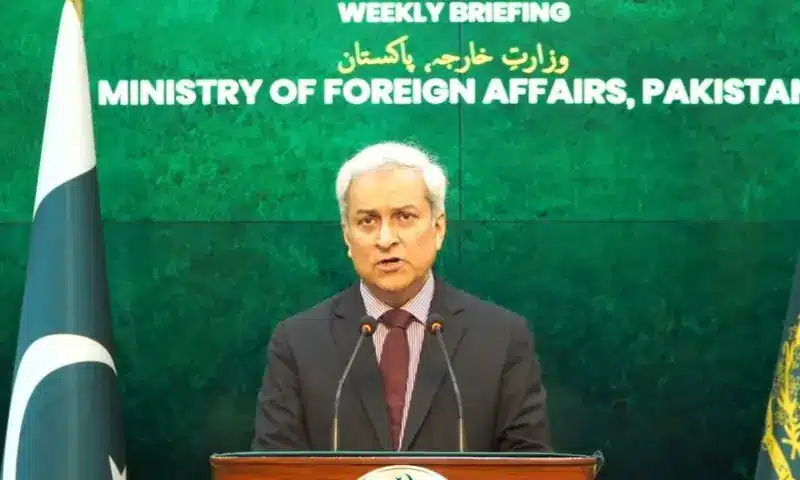




Pakistan will establish a multinational maritime defense coalition, the Foreign Office (FO) announced on Wednesday. The statement came a day after three Pakistani sailors died in strikes by Houthi rebels on a Saudi cargo ship. FO spokesperson Tahir Andrabi confirmed Pakistan’s commitment during a weekly press briefing. He said Pakistan remains a signatory to the coalition’s joint statement and is in touch with Saudi authorities on next steps.
Key Highlights
- Three Pakistani sailors killed in Houthi strikes on a Saudi cargo ship
- FO says Pakistan will implement the Saudi-led maritime coalition “in full earnest”
- Interior Minister Mohsin Naqvi holds security talks in Tehran
- FO reaffirms Pakistan’s mediation role between the US and Iran
- Pakistan, Saudi Arabia and Turkiye’s Makkah defense pact called “highlight of the week”
- FO rejects Indian remarks on AJK as “baseless”
Coalition Formed to Protect Red Sea Shipping Routes
Last month, Saudi Arabia proposed a defense coalition to protect shipping and energy routes across the Red Sea. Fourteen countries, including Pakistan, Turkiye and Egypt, backed the plan in a joint statement. Andrabi said Pakistan takes the commitment seriously. Following the instructions of Deputy Prime Minister and Foreign Minister Ishaq Dar, he said officials are now finalizing the agreement details with their Saudi counterparts.
Naqvi Holds Security Talks in Tehran
The FO also addressed Interior Minister Mohsin Naqvi’s visit to Iran, which began Tuesday. Andrabi said the trip aims to discuss bilateral relations, security matters and regional developments, with a focus on peace and stability. Naqvi was received in Tehran by his Iranian counterpart, Eskandar Momeni. He later met Iranian Foreign Minister Abbas Araghchi and President Masoud Pezeshkian. A diplomatic source told Dawn the visit’s main goal is to follow up on the Islamabad Memorandum of Understanding and Pakistan’s role in mediating between Iran and the United States.
Mediation Between US and Iran Continues
Andrabi reiterated that Pakistan is working alongside allied states to help resolve the standoff between Washington and Tehran. He said Pakistan is making every effort to bring both sides back to the table, using the Islamabad MoU as a framework. He also warned that Pakistan would keep working to “offset spoilers” through both direct and indirect channels.
The 60-day window for US-Iran talks under the Islamabad MoU is set to expire on August 17. Andrabi said the deadline “can always be extended” if both sides remain willing to talk. He noted that five days still remain before that date, adding that Pakistan is “not closing the chapter” even if the current deadline passes without a breakthrough.
Asked why Pakistan remains hopeful despite ongoing tensions, Andrabi said mediators need to hold a steady kind of optimism. He pointed out that the conflict has moved through repeated cycles of escalation and calm, calling this pattern typical of major international conflicts. Pakistan, he said, stays engaged without overreacting to either outcome.
#WorldNews | Pakistan’s foreign minister has said Islamabad “strongly condemns” Houthi attacks on commercial vessels while offering condolences to the families of the dead.https://t.co/IOmSBu0vEM
— Times of Oman (@timesofoman) August 12, 2026
Makkah Defense Pact Hailed as Key Development
Andrabi also pointed out the defense pact signed last week in Makkah. This pact involves Pakistan, Saudi Arabia, and Turkiye, and he called it the week’s most important development. The agreement allows the three countries to treat an attack on one member as an attack on all. Andrabi described it as purely defensive, meant to strengthen collective security and regional stability. He recalled Dar’s August 10 statement, which stressed the pact was not directed against any country.
Asked whether other nations might join the agreement, Andrabi said he was not aware of any specific plans. He also said he had no information on talks with the US or China about the pact. But he noted that communication channels with both countries are still open.
FO Pushes Back on India’s AJK Remarks
Andrabi dismissed India’s recent claims about rights abuses in Azad Jammu and Kashmir (AJK) as baseless. He said India’s record in Indian Illegally Occupied Jammu and Kashmir (IIOJK) hurts the credibility of those statements. He pointed to excessive force, arbitrary detentions, and restrictive laws. He said Pakistan is committed to protecting the rights and freedoms of AJK residents. He also urged India to honor its past commitments for a UN-supervised plebiscite in IIOJK.