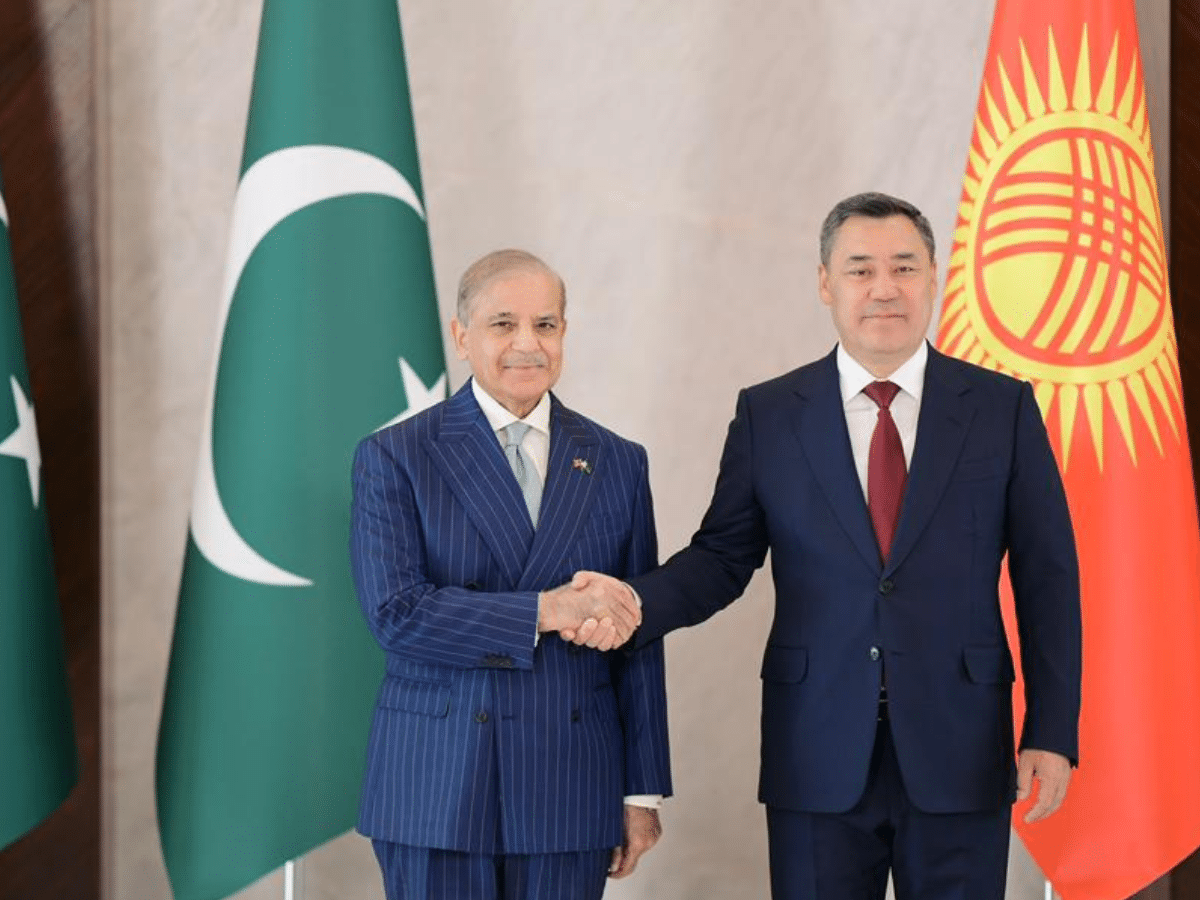



ISLAMABAD: Prime Minister Shehbaz Sharif on Wednesday said Pakistan and Kyrgyzstan would work to enhance bilateral trade to $200 million. He made the announcement in Bishkek, standing next to Kyrgyz President Sadyr Zhaparov after the two countries signed a raft of memorandums of understanding. Bilateral trade stands at around $16 million now, which Shehbaz termed “not a patch on our friendship and our very strong relations”.
Key Highlights
- Pakistan, Kyrgyzstan to boost bilateral trade from $16 million to $200 million
- Countries sign over a dozen trade, security and education agreements
- Lahore and Osh declared sister cities
- Both sides reaffirm commitment to CASA-1000 energy project
- Afghan soil cannot be used to threaten regional security, leaders said
Pakistan and the Kyrgyz Republic on Wednesday signed multiple bilateral accords to enhance bilateral cooperation across trade, security, education, environment and technology sectors.
Prime Minister Muhammad Shehbaz Sharif and President of the Kyrgyz Republic Sadyr Japarov… pic.twitter.com/jnRL9oQkJV
— Government of Pakistan (@GovtofPakistan) September 2, 2026
PM Wants Quick, Practical Results
Shehbaz didn’t mince words about the magnitude of the gap between current trade and potential trade. “We should have signed an agreement today and not an MoU to ensure that we increase our bilateral trade from $16m to $200m per annum in the next two years.” “And this is not a very difficult task,” he said, suggesting that the two countries formalize their understanding in an agreement right away.
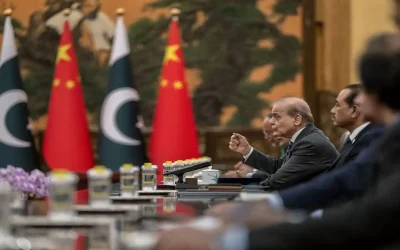
The two leaders discussed economic cooperation and agreed that the partnership needed to move into a more practical, results-oriented phase, he said. He welcomed greater engagement between the Pakistani and Kyrgyz business and financial communities to advance that vision.
Common Objectives: Connectivity and Energy
Connectivity, Shehbaz said, was key to deeper economic integration between South and Central Asia. He welcomed the signing of a transit trade agreement which he said will improve logistics and open new opportunities for regional connectivity. Both sides also reiterated the importance of implementing the quadrilateral agreement on traffic and transit and agreed to simplify transport, customs and administrative procedures in the future.
Energy cooperation was also under the spotlight. “This is a very important pillar of the partnership,” said Shehbaz, highlighting the renewed commitment to the timely implementation of the CASA-1000 project. The two countries also set up a new joint working group on energy, to develop practical cooperation in the fields of electricity, hydropower, renewable energy and modern energy technologies.
Education, Culture, and a New Sister-City Tie
Besides trade and energy, Shehbaz also highlighted enhanced cooperation in education, science and technology, health, culture and tourism. He especially welcomed the establishment of sister-city relations between Osh and Lahore, describing both as ancient cities whose landmarks reflect deep historical and cultural roots.
The talks also discussed security and defense cooperation. Shehbaz said both sides reaffirmed their resolve to work together against terrorism, extremism and other modern security threats. The two leaders also discussed regional and international issues beyond the bilateral relationship, agreeing that effective multilateralism remains key to solving today’s biggest challenges. “Pakistan considers the Kyrgyz Republic as its most important and valued partner in Central Asia, and we mean it,” Shehbaz said, inviting President Zhaparov to visit Pakistan at a mutually convenient time.
Shehbaz also thanked Kyrgyzstan for its hospitality and congratulated the country on its independence day and, separately, on hosting the World Nomad Games, being elected to a non-permanent seat on the UN Security Council for 2027-28, and its recent SCO chairmanship.
Zhaparov: Economy at Center of Partnership
President Zhaparov, speaking in Kyrgyz through translation carried by Radio Pakistan, said: ‘With the growing international tensions, the need to build friendship and cooperation is more important than ever. He said the economy was one of the main pillars of the bilateral relationship and the two countries agreed to boost trade, expand the range of goods exchanged and attract more investment.
Zhaparov listed pharmaceuticals, agriculture, energy, light industry, tourism, digital economy and virtual assets among areas where joint projects could be implemented. He also pointed out a practical advantage for Kyrgyzstan: Pakistan’s seaports provide a natural route to South Asian markets and global trade routes. He recalled the long-standing cooperation between the two countries at the UN, SCO, Organization of Islamic Cooperation, and the Economic Cooperation Organization and congratulated Pakistan for assuming chairmanship of the SCO.
Joint Statement on Security in the Region
The Foreign Office, after the talks, issued a joint statement condemning terrorist attacks in the region and elsewhere. The statement underlined that stability and security in Afghanistan are a precondition for seamless connectivity between South and Central Asia and reiterated that Afghan territory should not be used for activities threatening the security of other countries. They agreed that a secure environment is still a prerequisite for the full benefits of South-Central Asian cooperation.
Pakistan also supported Kyrgyzstan’s international initiatives on the global mountain agenda, including the sustainable development of mountain regions and climate adaptation, and said it was ready to actively participate in the Second Mountain Summit Bishkek+25 scheduled for 2027.
A Long List of Ratified Agreements
During the visit, the two countries signed a wide range of agreements. They included a diplomatic Program of Cooperation between the two foreign ministries for 2026-27, an MoU between the Institute of Strategic Studies Islamabad and Kyrgyzstan’s National Institute for Strategic Initiatives, and agreements on transit trade and cooperation in science and technology. The two sides also signed an extradition treaty and drew up an agreement on mutual legal assistance in criminal matters, as well as an interior ministry MoU targeting illicit trafficking of narcotics and precursor chemicals.
They also signed agreements on cooperation in medical education between Kyrgyzstan’s health ministry and the Pakistan Medical and Dental Council, on broader education cooperation between the two countries’ education ministries, and on environmental cooperation between Kyrgyzstan’s Ministry of Natural Resources and Pakistan’s Ministry of Climate Change. Pakistan’s National Defense University signed an academic research MoU with Kyrgyzstan’s National Institute for Strategic Initiatives, and regulatory agencies of both countries agreed to work together on virtual assets.
In addition to the sister-city pact between Lahore and Osh, Kyrgyz Post and Pakistan Post inked a cooperation agreement concerning postal services and e-commerce, while the chambers of commerce of the two countries agreed to boost business linkages.
Warm Welcome in Bishkek
PM Shehbaz arrived in Bishkek on Monday for a three-day visit to attend the SCO summit, which concluded Tuesday. At the presidential palace, Yntymak Ordo, he received a red-carpet welcome and a guard of honor from detachments of the Kyrgyz armed forces, with both national anthems played as the leaders stood at the salute dais.
Shehbaz also visited the Ata Beyit Memorial Complex, where he offered Fateha and laid a wreath at the grave of the famous Kyrgyz writer Chingiz Aitmatov. Later, he visited Ala Archa National Park with President Zhaparov, where he saw demonstrations of Kyrgyz cultural dances and traditional arts. Shehbaz said Kyrgyzstan’s cultural traditions are admirable and stressed the need for further deepening of historical and cultural ties between the two peoples.