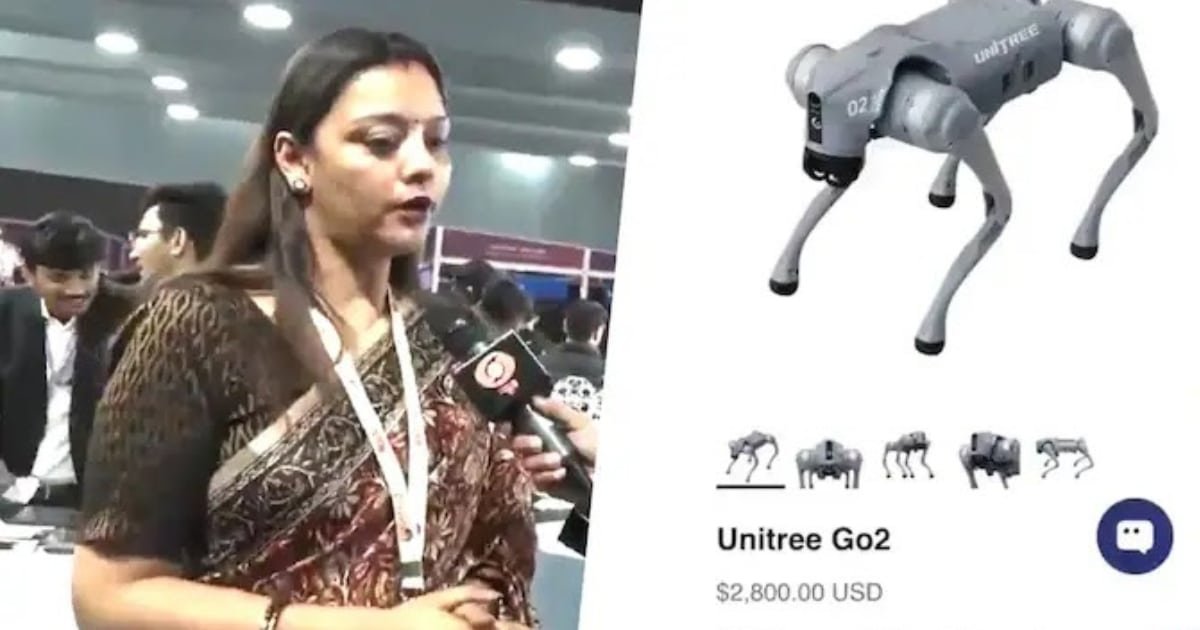





New Delhi — An Indian professor’s televised gaffe at a major AI summit — claiming a Chinese-made robot dog as her university’s creation — has sparked ridicule and debate, shining a light on the fragile line between hype and reality in the booming AI industry. The incident, quickly dubbed “truly embarrassing” by critics, comes amid revelations of similar deceptions, including the collapse of a high-profile startup that promised AI miracles but relied on hidden human labour.
The AI Impact Summit in Delhi: How an Indian university turned the entire event into a scandal and a farce.
A detailed thread.
— China pulse 🇨🇳 (@Eng_china5) February 18, 2026
The episode unfolded at the AI Impact Summit in New Delhi this week, where the silver mechanical dog performed tricks like waving and standing on its hind legs. The professor, from Galgotias University, enthusiastically told a reporter it was developed by their centres of excellence. Online backlash was swift, forcing the university to clarify it had only acquired the Unitree model for student experiments — not built it.
— Galgotias University (@GalgotiasGU) February 17, 2026
Key Highlights
- Professor claimed Chinese Unitree robot as university-developed.
- University clarifies: acquired for student testing, not built.
- Opposition calls it “embarrassing” for Modi govt’s AI push.
- Echoes Builder.ai scandal: AI startup bankrupt after human worker exposé.
- Builder.ai raised $700M, valued at $1.5B, backed by Microsoft.
- Exposed using 700 Indian engineers posing as AI.
- 2019 WSJ report questioned claims; 2025 bankruptcy followed.
- Indian media seizes on summit mishap as policy shift sign.
The Summit Gaffe and Immediate Fallout
It started innocently enough — or so it seemed. At the bustling AI Impact Summit, attended by global leaders and tech enthusiasts, the professor introduced “Orion” with flair. “This has been developed by the centres of excellence at Galgotias University,” she said, as the robot waved at the camera. “As you can see, it can take all shapes and sizes… it’s quite naughty also.”
Viewers at home, many tech-savvy, immediately spotted the mismatch. The robot was a standard model from Chinese startup Unitree, available online for a few thousand dollars. Social media erupted with memes and mockery, some users joking that India’s AI push was “all bark, no byte.”
— Galgotias University (@GalgotiasGU) February 17, 2026
The university scrambled to respond on X that Galgotias has not built this robodog. They described it as a “classroom in motion” for students to tinker with.
The opposition Congress party wasted no time, using the blunder to jab at Prime Minister Narendra Modi. “The Modi government has made a laughing stock of India globally, with regard to AI,” they posted on X. “In the ongoing AI summit, Chinese robots are being displayed as our own. This is truly embarrassing for India,” adding it was “brazenly shameless.”
The Modi government has made a laughing stock of India globally, with regard to AI.
In the ongoing AI summit, Chinese robots are being displayed as our own. The Chinese media has mocked us. This is truly embarrassing for India.
What is even more shameful is the fact that… pic.twitter.com/xaRwm7j9Wv
— Congress (@INCIndia) February 18, 2026
The TV reporter who interviewed her, Tapas Bhattachary, later urged calm. “If one out of hundreds of exhibitors wasn’t being upfront, I would not give up on the entire India’s youth who are very innovative,” he said. But the damage was done — the incident became a symbol of overzealous promotion in an industry where hype often outpaces reality.
Echoes of the Builder.ai Debacle
This isn’t the first time such claims have backfired. Just last year, Builder.ai — a London-based startup founded by Indian entrepreneur Sachin Dev Duggal — collapsed in spectacular fashion after being exposed for similar deception. Valued at $1.5 billion and backed by tech giants like Microsoft and Qatari investors, the company promised to “democratise software development” with an AI assistant named Natasha that could build apps in minutes.
In 2019, the $1.5 billion AI programming company BuilderAI was exposed. The ‘AI’ turned out to be 700 Indian people acting as AI programming bots. pic.twitter.com/Vkx205qD8w
— Historic Vids (@historyinmemes) August 14, 2025
Investors poured in $700 million, drawn by the vision of automated coding. But in 2019, the Wall Street Journal first raised doubts, reporting that most work was done manually by human engineers. The truth emerged fully in 2025: Builder.ai relied on 700 developers in India, paid to act like bots and manually code apps while the company marketed it as pure AI.
Former employees described it as “all engineer, no AI.” Natasha wasn’t a sophisticated algorithm — she was a team of coders in call centers, typing responses and building software by hand. The scam unravelled when Bloomberg exposed inflated revenues through “round-tripping” — fake billing cycles with Indian firm VerSe Innovation to boost books.
BuilderAi once valued at $1.5B, collapsed after being exposed for faking its AI. They raised $450M from backers like Qatar Investment Authority, MSFT, SoftBank. A no-code AI unicorn but behind the scenes, the work was done by humans in India.#AI stands for “Actually Indians.” pic.twitter.com/HRamU6YNMn
— 𝙋𝙚𝙩𝙚𝙧 𝙎𝙖𝙙𝙙𝙞𝙣𝙜𝙩𝙤𝙣 (@AgilePeter) June 5, 2025
Creditors seized assets, and Builder.ai filed for bankruptcy in the US, UK, and India by June 2025. VerSe called the allegations “baseless,” but the fallout was swift: lawsuits, investor losses, and a black eye for India’s tech reputation.
The Human Cost Behind the Hype
Behind these stories lies a deeper issue — the exploitation of cheap labour to fuel AI dreams. In Builder.ai’s case, those 700 Indian engineers weren’t just coders; they were instructed to “pretend they didn’t exist,” as one report put it, behaving like machines in client chats. Paid low wages in a country where tech talent is abundant but often underpaid, they became the invisible backbone of a billion-dollar lie.
It’s a pattern seen elsewhere. Amazon’s “Just Walk Out” technology, touted as AI-powered cashierless shopping, was later revealed to rely on 1,000 reviewers in India watching cameras to process transactions. Or take Zume Pizza, a US startup that promised AI robots making pizzas — it went bankrupt in 2020 after admitting humans did most of the work.
For Pakistan, watching from across the border, it’s a cautionary tale. Our own AI sector is growing, with startups in Lahore and Karachi exploring machine learning for agriculture and healthcare. But as we push forward — think of initiatives like the National AI Policy — we must avoid the pitfalls of hype over substance. True innovation comes from ethical practices, not smoke and mirrors.
Broader Implications for Global AI Trust
These incidents erode trust in AI at a time when the technology is touted as the next big revolution. Investors, already wary after crypto crashes, now question claims of “AI-powered” solutions. Governments pushing AI agendas — like India’s summit or Pakistan’s policy drafts — face skepticism if such blunders continue.
Galgotias University pavilion lights cut off at #AIImpactSummit2026.
Staff and students packing up and leaving.
Reason? They tried passing off a Chinese robot as “Made in India” and embarrassed Bharat globally.
Government said pack up and go home.Deserved! pic.twitter.com/AxvFBjNZqI
— Mohit Suryavanshi (@SaffronSyndcate) February 18, 2026
In the professor’s case, it was a simple misstep — perhaps overenthusiasm at a high-profile event. But linked to scandals like Builder.ai, it raises questions about transparency in tech education and industry. Students at Galgotias, experimenting with the robot, deserve better than being caught in the crossfire of viral embarrassment.
You May Like To Read: The Shared Pain of Sacred Spaces: Jamia Masjid Srinagar and Al-Aqsa Under Occupation
As AI summits wrap up and startups rise and fall, the lesson is clear: authenticity matters. For countries like Pakistan, building genuine tech ecosystems — with investments in local talent and ethical innovation — will outlast any fleeting hype. Let’s hope the next “AI breakthrough” is the real deal, not another illusion waiting to crumble.
Check out our latest video: