
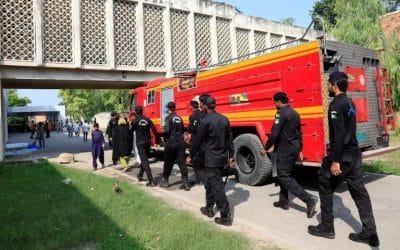



BANNU / PESHAWAR: For nearly five months, beginning in June, police personnel in the southern district of Bannu have found themselves battling a threat more complex and technologically advanced than any previously encountered in the region’s long and violent history. The spike in militant activity following the United States’ withdrawal from Afghanistan has reshaped the local security landscape, introducing weaponry and methods that have forced Pakistani security forces — particularly police — to adapt at unprecedented speed.
As one senior police officer in Bannu described the experience, personnel have been compelled to stand guard with “one eye on the barrel of the gun and another on the sky”. What began as sporadic skirmishes soon morphed into a sustained wave of quadcopter-based attacks, marking the first time militant groups operating inside Pakistan have weaponised drones at scale.
A new threat emerges
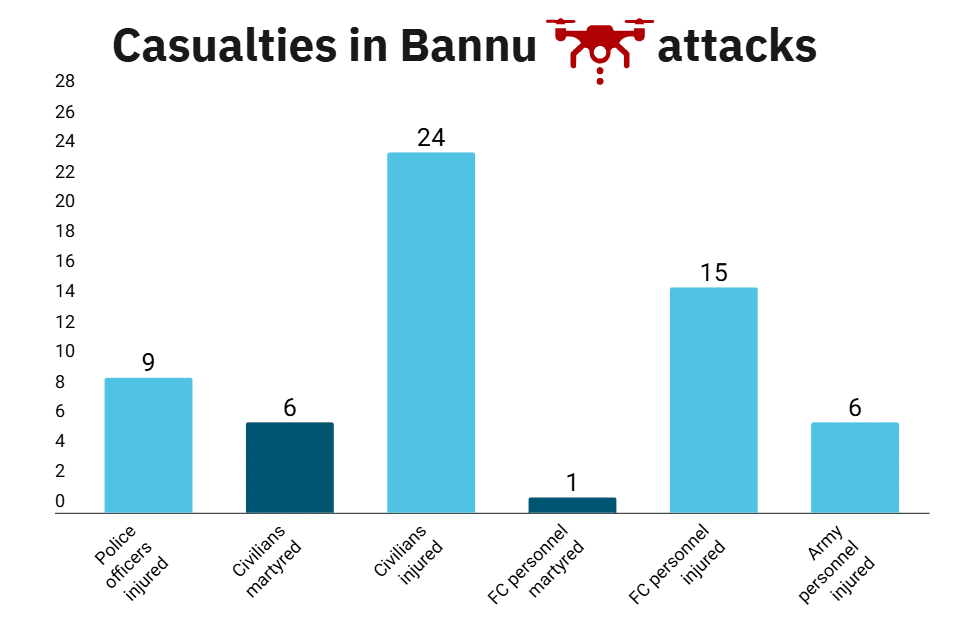
According to Khyber Pakhtunkhwa Inspector General of Police (IGP) Zulfiqar Hameed, militants launched “fifty quadcopter attempts in one week” during the height of the attacks. Since June, Bannu police officials estimate they have faced more than 200 drone-assisted assaults on police stations, check posts and convoys.
You May Also Like: Soldier Injured in Bannu Terrorist Attack; Security Forces Launch Operations
Militants modified commercially available quadcopters to carry and drop improvised munitions — most commonly grenades compatible with Russian-origin under-barrel launchers such as the GP-25, as well as small-calibre mortar rounds. The drones were also equipped with thermal imaging for nighttime surveillance and attack planning.
Unprepared for this form of aerial assault, police units initially relied on rudimentary defensive measures. Canopies, netting and makeshift roof barriers were installed to slow or block falling explosives. Police snipers were stationed on rooftops to shoot down drones before they could reach their targets.
Bannu AIG Sajjad Khan described one alarming episode in which a quadcopter actively chased a vehicle evacuating injured personnel. “It was hovering and chasing,” recalled Ebaad Wazir, Bannu Police’s second-in-command, who was driving the vehicle. Militants filmed and circulated the footage online, highlighting their confidence and the growing sophistication of their tactics.
Intelligence officials say the shift to drone warfare represents not only an escalation in capabilities but a transfer of expertise that likely originates with seasoned foreign fighters. Officials cite parallels between recent complex suicide bombings and drone attacks, suggesting both require advanced training.
After Afghanistan: a battlefield transformed
For nearly two decades, Pakistani security forces maintained technological superiority over local militant groups, even during the most turbulent phases of the insurgency. That advantage began weakening rapidly after August 2021, when the United States withdrew from Afghanistan, abandoning an estimated $7.1 billion worth of military equipment.
A 2022 report by the U.S. Special Inspector General for Afghanistan Reconstruction documented that more than 300,000 small arms — including M-4, M-16, M-24 and M-249 rifles — and nearly 50,000 specialised equipment items such as thermal imaging scopes, night vision goggles and communications gear, were left behind.
Senior Pakistani security officials say much of this equipment has since found its way into the hands of militant outfits operating along the Pak-Afghan border and the former tribal areas. The transformation was swift and deadly. With high-grade rifles and advanced optics, militants began targeting police from distances up to 1,500 metres. At night, thermal scopes allowed them to spot and shoot personnel who had no visibility advantage of their own.
“They were killing our men like sitting ducks,” a senior Bannu police officer said, noting that even military-issue G-3 rifles, once considered reliable and powerful, paled in comparison to modern American firearms now being wielded by militants.
The rising casualties and graphic videos uploaded by militants created deep concern among policymakers. It became clear that the state needed to overhaul not only its weapons inventory but also its tactical doctrines.
Rebuilding capacity: ‘We were very late in adopting new technology’
IGP Hameed acknowledged that the police force lagged behind in both technology and training. In response, authorities undertook extensive debriefings with officers who had survived drone or night-vision-enabled attacks to understand militants’ evolving strategies.
The subsequent procurement drive, supported by the military, marked one of the most significant rearmament efforts by KP Police in recent years. Billions of rupees were allocated to purchase upgraded weapons and associated technology. The list includes M-16 carbines, M-24 sniper rifles, M-249 light machine guns, lightweight sniper rifles (LSRs), thermal weapon sights, anti-drone guns, surveillance drones, jamming equipment and night-vision devices.
Soviet-era Dragunov DMRs were retrofitted with thermal scopes to allow for nighttime precision shooting. High-frequency jammers were installed in armoured vehicles to counter roadside explosives. Police personnel underwent training in marksmanship, drone operation and special tactics. Newly formed Special Operations Teams (SOTs), initially at the divisional level, are being expanded to district headquarters.
Officials say these investments are already “tipping the balance”. In the past month, five quadcopter attacks were successfully repelled in Bannu alone — one drone was shot down by a sniper, two were disabled by anti-drone guns, and others were forced to retreat. Intelligence reports also indicate a noticeable drop in nighttime attacks in areas where militants now believe police possess thermal imaging capability.
Despite the gains, officers caution that the fight is far from over. “This is a long haul — a battle of nerves, resources and strategy,” a senior officer remarked. “We may be killing them, but are we killing the problem?”
Anxieties on the ground: local communities caught between militants and the state
The introduction of drone warfare has heightened civilian fear, with residents expressing concern about both militant activity and intensified police operations. Tribal elders in Bannu and surrounding areas have convened multiple jirgas to discuss security measures, including directives by security agencies to clear orchards and restrict multi-storey construction near roads frequently targeted by militants.
While tribal representatives have pledged cooperation in actions against militants, they have also voiced concern over measures they deem punitive, such as the suspension of electricity and water supplies during operations.
You May Also Like: 22 Terrorists Killed in Bannu IBO as Pakistan Intensifies Crackdown on Indian-Sponsored Khawarij: ISPR
Bannu RPO Sajjad Khan reassured communities that the goal is to eliminate terrorist threats while safeguarding citizens. “The area won’t be left at the mercy of terrorists,” he said. “But public cooperation is essential to restoring lasting peace.”
Growing concern over missing Baloch women
Parallel to the deteriorating security situation in KP, human rights activists in Balochistan are alarmed by a rise in reported enforced disappearances involving women. The Voice for Baloch Missing Persons (VBMP) Chairman, Nasrullah Baloch, accused law enforcement agencies of detaining Baloch women activists without disclosure or due legal process.
He highlighted the case of Mahjabeen Baloch, a University of Balochistan student from Basima, who was allegedly taken into custody from Quetta Civil Hospital in May and has remained missing for six months. Another woman, Nasreen Baloch from Tirtaj, was reportedly picked up during a raid in Hub Chowki days earlier.
VBMP officials say these disappearances have caused severe psychological distress among families and reflect a disturbing escalation in the long-running issue of missing persons in Balochistan. Rights groups have urged immediate, transparent investigations and public disclosures to ensure accountability.
A protracted conflict enters a new phase
As Pakistan’s security forces and police brace for continuing challenges, the conflict appears to be entering a technologically advanced and tactically complex stage. Militants’ access to modern weaponry, sophisticated training and digital tools indicates a shift far beyond the improvised methods once associated with insurgency in the region.
The state’s counter-strategy — involving massive expenditure, training reforms and tactical reorientation — is showing early achievements, but officials acknowledge that sustainable peace will require more than hardware. It demands endurance, adaptability and the capacity to stay ahead in a conflict where the front lines now stretch from rugged mountain terrains to the skies above police stations.
As casualties began to mount, with militants relishing targeting unsuspecting personnel with thermal imaging scopes and uploading the videos on the internet, policymakers began to figure out what to do next. https://t.co/jaZLC12PBv
— Dawn.com (@dawn_com) November 26, 2025
For police in Bannu, the reality remains that every patrol, checkpoint and rescue operation could be monitored from above by hostile drones. And so, as one officer put it, the job continues with “one eye on the gun and the other on the sky”.
Check out our latest video: