





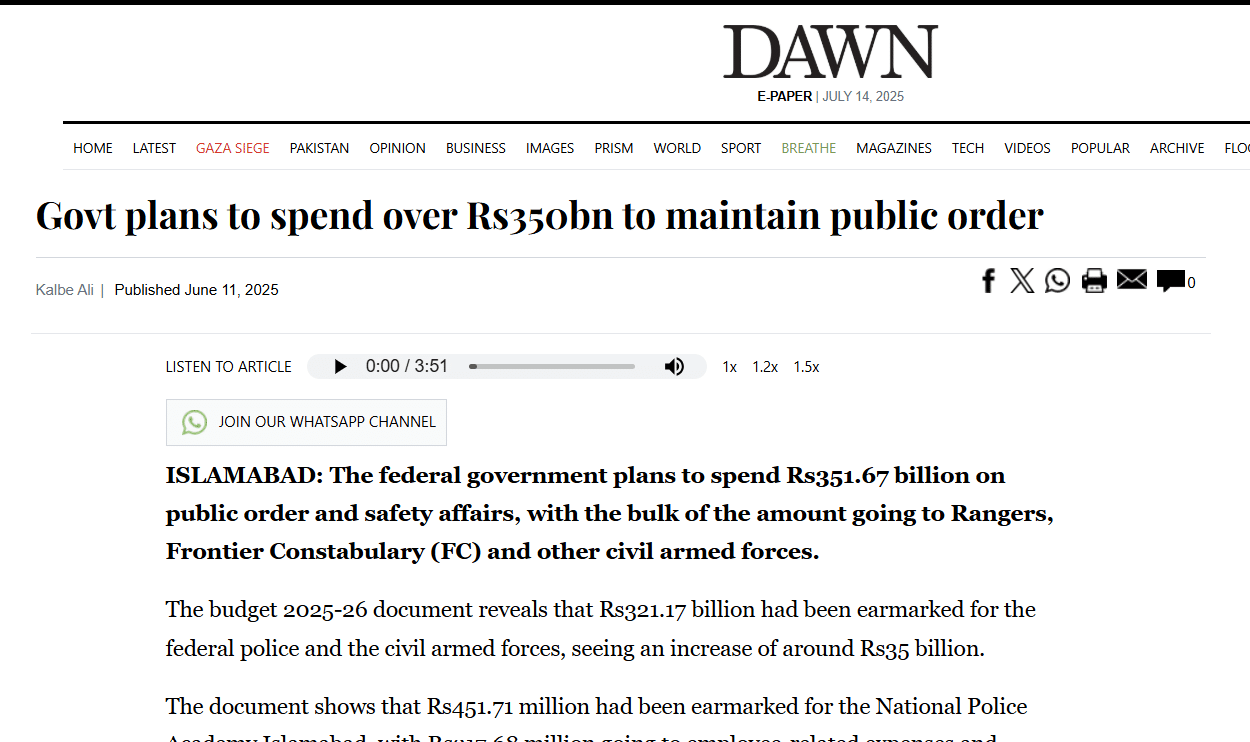
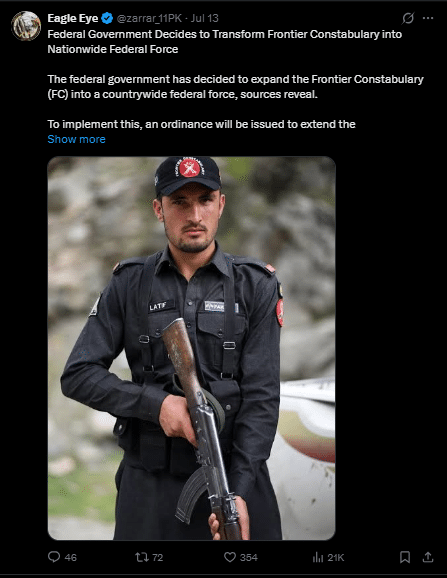
On 11 July 2025, the federal government issued the Frontier Constabulary (Reorganisation) Ordinance 2025, elevating the Frontier Constabulary (FC) into a Federal Constabulary. This move transforms the force from a provincially anchored entity, primarily focused on Khyber Pakhtunkhwa’s border districts, into a nationally deployable unit under federal civilian command. The announcement follows Cabinet approval and aligns with the 2025–26 budgetary allocations aimed at enhancing civil law enforcement capabilities nationwide.
Previously limited to border and tribal areas in KP, the reformed force can now operate throughout all provinces, Islamabad, Azad Kashmir, and Gilgit-Baltistan. Under this ordinance, the Federal Constabulary will be authorized to enforce criminal laws, anti-terrorism statutes, and maintain public order according to the Criminal Procedure Code (CrPC), Anti-Terrorism Act, and Police Order—aligning its powers more closely with those of provincial police services.
Source: Dawn E-Paper
Structural Overhaul: Dual Division Model
The FC’s transformation enacts a dual-tier organisational structure:
- Security Division – composed of existing FC personnel, tasked with traditional roles such as border security, anti-smuggling efforts, and support to provincial police.
- Federal Reserve Division – a newly formed entity prepared for riot control, counter-terror operations, and VIP security.
Decision-making authority will rest with an Inspector General, a high-ranking officer with extensive law enforcement experience, supported by officers from the Police Service of Pakistan (PSP), a prestigious and highly trained police force. This structure aims to improve centralized command, operational readiness, and inter-agency coordination.

Image: X( Former Tweeter)
Budget and Recruitment Strategy
The 2025–26 federal budget dedicates approximately Rs 322 billion to federal policing and civil armed forces—an increase of Rs 35 billion from the previous fiscal year. Specifically, Rs 565 million is allocated for FC in Islamabad, covering salaries, allowances, and operational expenses.
A nationwide recruitment drive aims to diversify the force beyond its traditional pool in Khyber Pakhtunkhwa. The goal is to establish regional offices and deploy the force wherever national stability is at risk, such as during large-scale unrest or for the protection of VIPs. This strategy includes outreach to underrepresented communities and regions to ensure a diverse and representative force.
Strategic Rationale: Toward a Unified Civil Law Enforcement
Officials describe this step as essential to confront evolving internal security challenges, especially in KP and Balochistan. By expanding the FC’s mandate, the federal government aims to establish a civilian alternative to military deployment in high-risk zones, thereby enhancing state capacity to handle insurgency, terrorism, and communal violence. This strategic rationale provides a comprehensive understanding of the government’s decision-making process, ensuring the audience feels well-informed.
Furthermore, federalisation offers improved flexibility: a centrally controlled force can be redirected quickly amid public disorder or significant events, helping standardise training, operational protocols, and intelligence-sharing.
Source: X/@zarrar_11Pk
Comparative Context and Civil-Military Balance
The expanded Federal Constabulary differs from the Frontier Corps, a paramilitary unit typically led by Army officers, which focuses on border defence. In contrast, the FC will be led by PSP officers, emphasising civilian oversight and law enforcement norms.
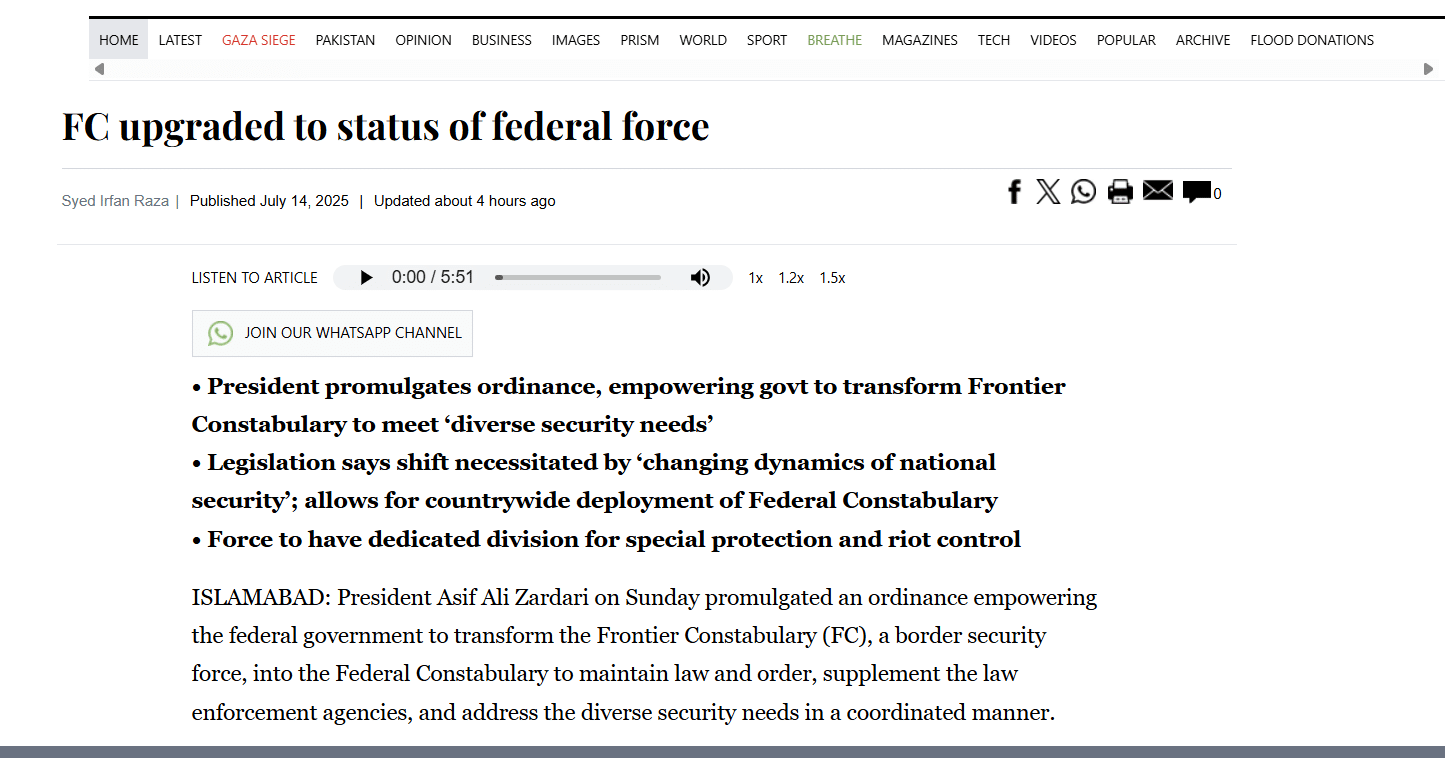
Image courtesy: Dawn E-Paper
This structural choice reflects a conscious effort to reinforce civil-state institutions and lessen military involvement in domestic security, paralleling reforms seen in the Rangers and police services in previous years.
Governance and Oversight Imperatives
While the reform promises increased national capacity, experts emphasise risks:
- Overlap with provincial police: Without clear operational definitions, dual jurisdiction could lead to efficiency drains or turf conflicts.
- Accountability gaps: As a federal force, transparent command structures, judicial oversight, and complaint mechanisms must be guaranteed to maintain public trust.
- Potential for misuse: Concentration of force in the capital and large cities for VIP protection could fuel perceptions of political use unless codified limits rule deployment. This emphasis on the potential for misuse ensures the audience is aware of the risks and the need for clear regulations, fostering a sense of caution and the importance of transparent governance.
To address these issues, some analysts suggest embedding fixed deployment limits, judicial reviews of federal assignments, and establishing independent oversight boards at the provincial and federal levels.
Historical Context and Policy Continuity
The reorganisation builds on earlier proposals, such as the 2010 suggestion to raise FC-style forces in tribal regions, a strategy that aimed to reinforce civilian law enforcement while allowing the Frontier Corps to focus on border and military tasks. This historical context connects the audience to the policy’s evolution, fostering a sense of continuity and understanding of the government’s long-term strategy.
Pakistan’s civil armed forces, FC, Rangers, and Levies, have periodically been granted police powers during crises (e.g., Balochistan unrest, Karachi operations). However, FC’s new designation as a permanently federal agency under civilian leadership marks a significant policy durability and institutional transformation.
Public Response and Political Implications
The federalisation has drawn mixed reactions: security analysts welcome greater civilian capacity, while some provincial leaders view it as an infringement on provincial jurisdiction. In Sindh and Punjab, especially, concerns linger over whether federal deployments will respect local law enforcement hierarchies and democratic oversight. Civil rights advocates have cautioned about potential misuse, especially in political engineering or surveillance.
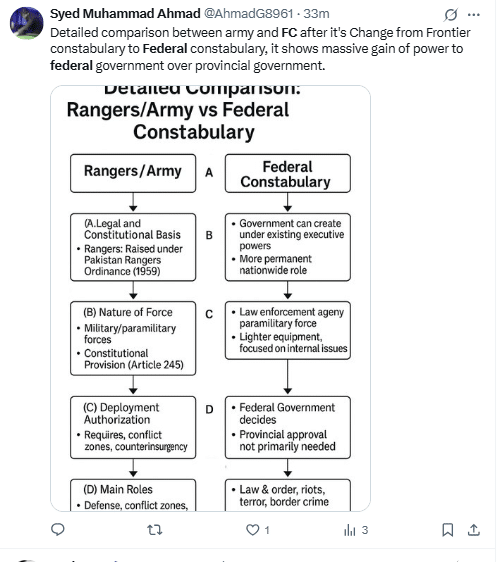
Image courtesy: X (Former Tweeter)
Path Ahead: Implementation Challenges
Key benchmarks to watch in the next six months:
- PSC recruitment and training frameworks—will new divisions follow standardised protocols?
- Regulatory definitions—how will overlapping jurisdiction with provincial police be managed?
- Public and judicial oversight frameworks—are complaint mechanisms and transparency built into the deployment orders?
Given the Federal Constabulary’s high-stakes role, its success will depend on judicious implementation, ensuring that its expanded powers reinforce, rather than undermine, democratic policing and public accountability.
The federalisation of the Frontier Constabulary marks a strategic shift in Pakistan’s internal security landscape. With expanded jurisdiction, legal authority, and structural realignment, the new Federal Constabulary seeks to boost national law enforcement capabilities while maintaining civilian oversight. However, its future will hinge on transparent governance, balanced deployment, and clear legal frameworks to prevent overlap with provincial forces. If successfully implemented, this transformation could strengthen Pakistan’s capacity for effective, civilian-led internal security.