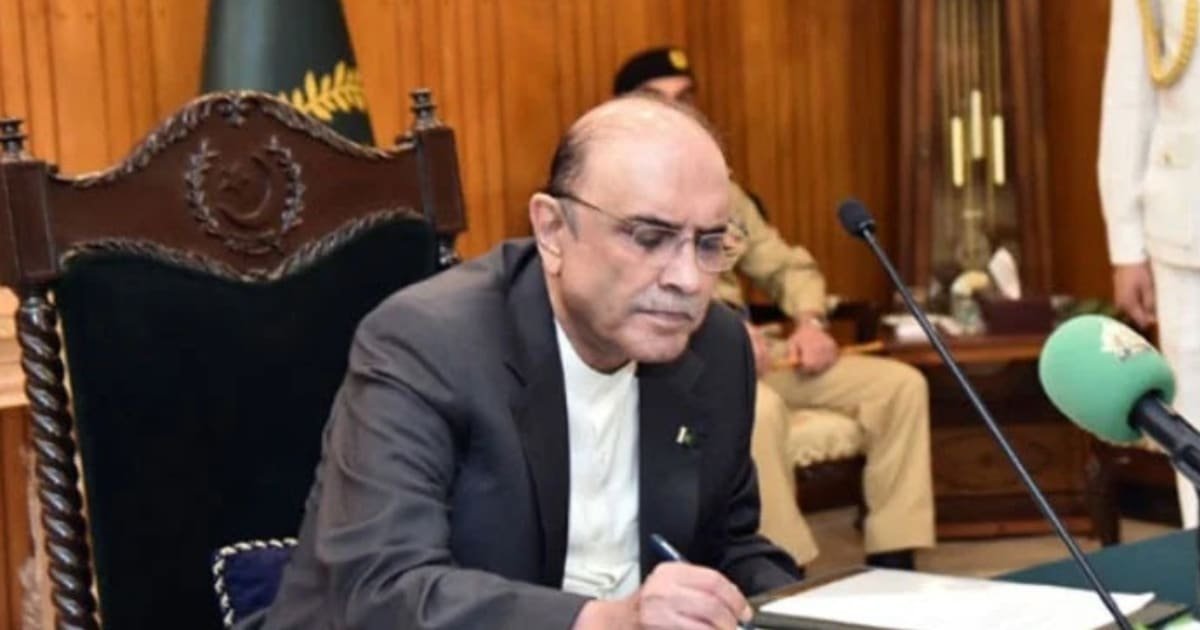





ISLAMABAD: President Asif Ali Zardari has given final approval to the confirmation of 27 additional judges as permanent members of the Sindh High Court (SHC), Lahore High Court (LHC), and Peshawar High Court (PHC) — a step that strengthens judicial capacity and upholds the rule of law across Pakistan’s major provinces.
The decision, announced on Thursday by the President’s Secretariat, follows recommendations from the Judicial Commission of Pakistan (JCP), chaired by Chief Justice Yahya Afridi, after a thorough review of antecedents, performance data, and material presented in recent meetings. The approvals came on the advice of Prime Minister Shehbaz Sharif.
President @AAliZardari approves the confirmation and extension of Additional Judges of High Courts.
Read More: https://t.co/e71BJ9d8D9 pic.twitter.com/EsYAJCRzXY
— PPP (@MediaCellPPP) January 22, 2026
Key Highlights
- Total confirmations: 27 additional judges made permanent (10 SHC, 11 LHC, 6 PHC).
- SHC: Justices Miran Muhammad Shah, Tasneem Sultana, Riazat Ali Sahar, Muhammad Hasan, Abdul Hamid Bhurgi, Jan Ali Junejo, Nisar Ahmed Bhanbhro, Ali Haider ‘Ada’, Muhammad Osman Ali Hadi, Muhammad Jaffer Raza.
- LHC: Justices Hassan Nawaz Makhdoom, Malik Waqar Haider Awan, Sardar Akbar Ali, Syed Ahsan Raza Kazmi, Malik Javed Iqbal Wains, Muhammad Jawad Zafar, Khalid Ishaq, Malik Muhammad Awais Khalid, Chaudhry Sultan Mahmood, Tanveer Ahmad Sheikh, Abher Gul Khan.
- PHC: Justices Muhammad Tariq Afridi, Abdul Fayaz, Salahuddin, Sadiq Ali, Syed Mudasser Ameer, Qazi Jawad Ehsanullah.
- Extensions granted: Six-month tenure extensions for several additional judges (e.g., SHC’s Khalid Hussain Shahani and Syed Faizul Hassan Shah; LHC’s Tariq Mahmood Bajwa; PHC’s Farah Jamshed, Inamullah Khan, Sabitullah Khan, Aurangzeb).
- This builds on recent JCP actions, including confirmations for Islamabad and Balochistan High Courts earlier in January.
The JCP’s multi-day deliberations ensured a merit-based process, reflecting ongoing efforts to bolster the judiciary amid Pakistan’s commitment to transparent and efficient justice delivery. These appointments come at a time when the superior judiciary handles increasing caseloads and plays a vital role in upholding constitutional values nationwide.
Strengthening Judicial Institutions
Pakistan’s high courts form the backbone of the legal system, resolving disputes that impact everyday citizens and national stability alike. Confirming experienced additional judges as permanent enhances continuity, expertise, and public confidence in the courts — particularly in provinces like Sindh, Punjab, and Khyber Pakhtunkhwa, where these benches address complex civil, criminal, and constitutional matters. The extensions for others allow smooth transitions without disrupting ongoing work.
You May Like To Read: EU Commission Allocates €126 Million for Humanitarian Aid in Pakistan, Iran, Afghanistan
This move aligns with broader judicial reforms, including recent constitutional amendments that aim to streamline processes and reinforce institutional independence. It sends a clear signal of the government’s support for a robust, capable judiciary that serves the nation’s interests.
Forward Momentum for Justice
With these confirmations, the high courts gain added strength to tackle backlogs and deliver timely justice — a priority that resonates across the country. As Pakistan advances, a well-equipped judiciary remains essential for protecting rights, ensuring accountability, and fostering national unity under the law. The nation welcomes this development as a positive stride toward a more resilient legal framework.
Check out our latest video: