

In recent years, Pakistan’s political landscape has been marked by frequent upheavals, street protests, and confrontational politics, creating a significant challenge.
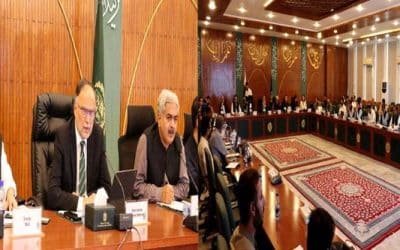
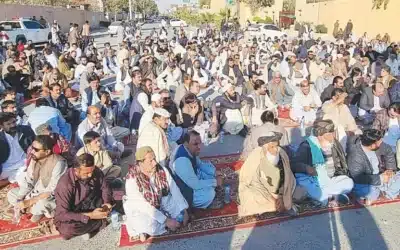
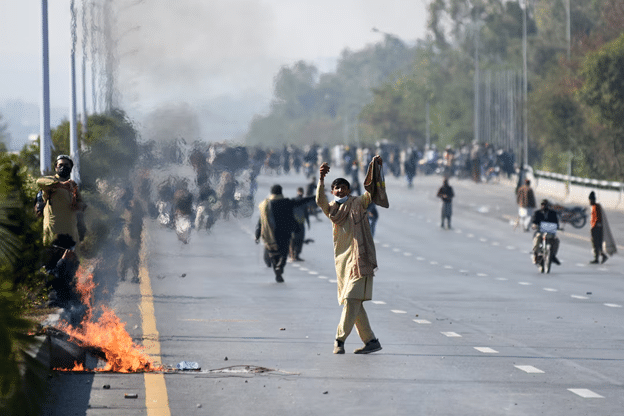
From Islamabad sit-ins to province-wide strikes, these political disruptions have not only created governance challenges but also imposed a heavy toll on the national economy. The daily toll of political instability now totals billions, impacting GDP, investment, trade, and livelihoods. Finance Minister Muhammad Aurangzeb recently acknowledged that Pakistan incurs losses of approximately PKR 190 billion each day due to political protests and related unrest. This figure accounts for direct damage to commerce, decreased investor confidence, and postponed trade activities.
One of the most severe impacts of political turmoil is its disruption of national and international trade. The Karakoram Highway, which connects Pakistan to China under the China-Pakistan Economic Corridor (CPEC), has faced repeated blockades due to political protests.
In mid-2024, over 700 trucks became stranded in Gilgit-Baltistan after protesters blocked the highway in protest against federal electricity and trade policies. This not only caused substantial financial losses but also damaged Pakistan’s credibility with its key trade partner, China. Such blockades are not isolated events—they create ripple effects throughout logistics chains, resulting in fuel shortages, wastage of perishable goods, and contractual penalties.
Pakistan’s stock markets react sharply to political instability. During a recent series of political sit-ins in Islamabad, the Pakistan Stock Exchange (PSX) lost over 3,500 points in a single trading session. The unrest caused panic among both foreign and domestic investors. Foreign direct investment suffered a substantial blow as uncertainty deterred international capital. According to Pakistan Today, the country was losing nearly PKR 3 billion per day in potential investment during periods of heightened unrest. Investors generally avoid countries where governments seem weak, public protests are frequent, and law and order appears unstable. The perception of risk, rather than actual violence, is often enough to stop inflows.
The digital economy has not been spared. Internet shutdowns have become a typical state response to political protests.
During the May 9 riots and subsequent unrest, mobile internet was suspended in major cities for several days. Reports indicated that telecom companies incurred losses of PKR 2.49 billion. Software exporters, who depend on uninterrupted internet and global communications, reported cancelled contracts and delivery failures. A Profit article highlighted that Pakistan’s tech ecosystem is now under threat, as venture capitalists have begun viewing the country as high-risk. When digital firms cannot ensure service continuity, they find it difficult to attract international clients, especially in competitive sectors such as IT services and fintech.
Protest culture has also driven massive spending on temporary infrastructure control.
During political sit-ins, roads are blocked using shipping containers. According to The Friday Times, over 470 containers were deployed during one such event, costing around PKR 16 million daily in leasing, fuel, and logistical arrangements. These blockades not only disrupt traffic but also impede emergency services, school transportation, and hospital access. For the average citizen, political rallies result in lost workdays, restricted access to services, and higher transport costs. Small businesses endure the most, especially in urban centres where foot traffic is crucial for sales.
Political instability also weakens public institutions. Governance becomes reactive rather than proactive, with policymakers too distracted by protests to focus on development.
This environment undermines accountability, fosters populism, and hinders legislation. A report from South Asia Monitor warned that Pakistan’s political confrontations are weakening social cohesion and governance structures. Another report from Dawn pointed out that protests in Islamabad alone affected around 800,000 people in just one week, costing the economy over PKR 950 billion. The cost is not just financial—it undermines public trust in democratic processes and institutions.
On social media, voices from business and civil society express widespread frustration. Mattias Martinsson, CIO of Tundra Fonder, remarked that “the internet blackout raised concerns… the investment climate depends on normalisation.” This concern was echoed by local analysts who noted that even a one-day internet shutdown could cost the GDP up to 0.57%. These figures may seem abstract, but they translate into real losses for ordinary Pakistanis—missed wages, delayed salaries, lost orders, and rising inflation.
This video offers expert analysis on how even limited political instability and street protests can significantly hinder Pakistan’s economic recovery. It’s a timely resource given current tensions and financial pressures.
Although peaceful protest is a constitutional right, its application must be balanced with the wider national interest. Political leaders need to find ways for dialogue that do not hinder economic activity or threaten citizens. Long-term prosperity relies heavily on political maturity—conflicts should be settled through institutions, not by blocking roads or silencing cities. The emphasis should shift from confrontation to constructive policymaking, guided by responsible leadership.
The economic consequences of political instability in Pakistan are tangible—they manifest in daily losses, dwindling investor confidence, and weakened governance. Street-level politics, though emotionally charged and symbolically significant, often undermine the very foundations they aim to influence. Pakistan requires a new political ethic—one that respects the right to dissent but emphasises economic stability, national interest, and responsible leadership. Only through this can the country realise its full economic potential and secure a stable future for its citizens.