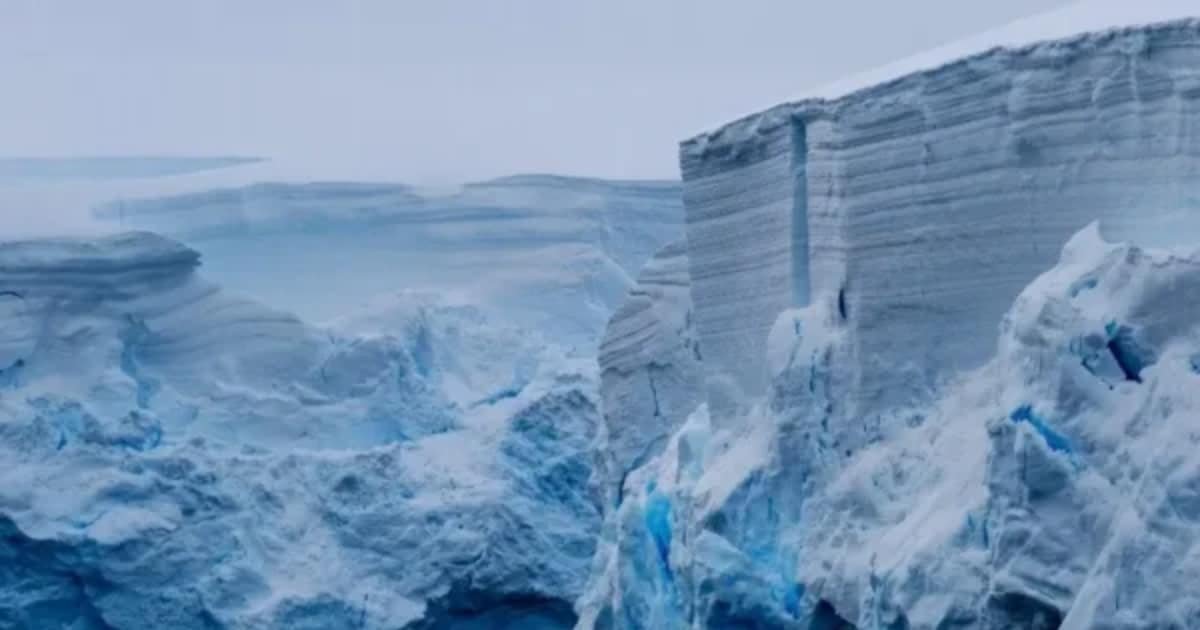





WASHINGTON: Scientists have produced the most detailed map yet of the landscape buried beneath Antarctica’s vast ice sheet, revealing a complex terrain of mountains, canyons, valleys, plains and tens of thousands of previously unidentified hills.
The findings, published this week in the journal Science, are based on high-resolution satellite observations combined with a technique known as ice-flow perturbation analysis. The method allows researchers to infer the shape and condition of the bedrock beneath the ice by analysing subtle variations in the movement and surface features of the ice sheet. Using this approach, scientists were able to map the entire continent, including areas that had remained poorly charted until now.
Researchers said the improved understanding of Antarctica’s subglacial landscape could significantly enhance projections of how the ice sheet may respond to climate change. Earlier studies have suggested that rough terrain, such as jagged hills and mountain ridges, can slow the movement of ice towards the ocean, potentially moderating the pace of ice loss and sea-level rise.
“Having the most accurate map of Antarctica’s bed shape is crucial, because the shape of the bed is an important control on friction acting against ice flow,” said Robert Bingham, a glaciologist at the University of Edinburgh and one of the study’s lead authors. He added that this information is essential for numerical models used to estimate how rapidly Antarctic ice could melt and contribute to global sea-level rise.
You May Also Like: WHO Chief Reaffirms Full Support for Polio-Free Pakistan
One of the study’s most notable findings is the identification of more than 30,000 previously uncharted hills, each rising at least 50 metres above the surrounding terrain. The level of detail achieved marks a substantial improvement over earlier maps, which were based on sparser data and could not capture many smaller features.
Antarctica, which is about 40 per cent larger than Europe and roughly half the size of Africa, is covered by the largest mass of ice on Earth. The Antarctic Ice Sheet contains about 70 per cent of the planet’s freshwater. On average, the ice is around 2.1 kilometres thick, reaching up to nearly 4.8 kilometres at its deepest points.
Scientists noted that Antarctica has not always been ice-covered. Much of the newly mapped terrain was shaped before the continent became glaciated more than 34 million years ago, and was later further sculpted by the movement of ice. The continent was once connected to South America and separated over millions of years through plate tectonics.
The researchers were able to map the subglacial terrain with unprecedented precision.https://t.co/XNv5e8iK7N
— Dawn.com (@dawn_com) January 17, 2026
Researchers said the new map would serve as a critical tool for future climate and glaciological studies, helping scientists better understand how Antarctica’s ice sheet may evolve in a warming world.
Check out our latest video: