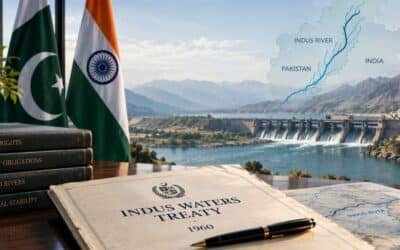
Pakistan’s water security depends on the Indus, Jhelum, and Chenab rivers, the lifeblood of its agriculture, hydropower, and drinking water systems. Under the Indus Waters Treaty (IWT), signed in 1960, India controls the eastern rivers (Ravi, Beas, Sutlej) while Pakistan has rights over the western rivers. But in recent years, India has taken actions that weaken this arrangement and hurt Pakistan’s water flow. Many in Pakistan call these moves “water terrorism”.
In April 2025, India suspended the Indus Waters Treaty after the Pahalgam terror attack. They cut water flows and released stored water without warning, causing sudden surges downstream. State media and officials in India described it as “strategic water leverage,” while Pakistan labeled it unlawful and life-threatening. The treaty is meant to protect both sides from such political weaponization of a basic resource.
India’s steps against Pakistan so far:
🔺Suspended Indus Waters Treaty
🔺Barred SAARC visa-free travel
🔺Shut Attari border crossing
🔺Expelled military advisers on both sides🟡 LIVE updates: https://t.co/cXoX7Dsl8g pic.twitter.com/QSFqS7h7lW
— Al Jazeera English (@AJEnglish) April 24, 2025
Projects That Hurt Water Sharing
India has constructed and operated several hydroelectric projects on the western rivers—waters meant for Pakistan. While some are allowed under the treaty with specific limits, Pakistan says many of these projects violate those limits.
- Baglihar Dam – Pakistan objected to its design, saying it gave India too much control over water flow. The World Bank’s neutral expert ordered minor changes, but India went ahead with most of its plans.
- Kishanganga Project – This project diverts water from the Kishanganga River (a tributary of the Jhelum) to another basin. Pakistan argued that this violated the treaty’s rules on altering river flows. The case went to the Court of Arbitration, which ruled partially in Pakistan’s favor but still allowed India to operate the dam.
While India argues these are “run-of-the-river” projects allowed under the treaty, the scale and timing of water storage have been used to influence downstream flows.
Danger Beyond Dams
India’s tactics go beyond simple construction.
- Flushing reservoirs during the off-season to increase capacity. This causes sudden drops in river levels in Pakistan, hurting crops at critical stages.

Credit: WIKIPEDIA
- Plans to increase water diversion via new canals on the Chenab and Jhelum rivers. These would redirect water into India’s Punjab before it reaches Pakistan. Reuters reports that this could have a devastating effect on Pakistan’s irrigation.
Such actions make Pakistan’s water supply unpredictable and undermine trust between the two nations.
Why It Matters for Pakistan?
The stakes could not be higher. Around 90% of Pakistan’s agriculture depends on the Indus system. Farmers in Punjab and Sindh rely on steady flows to grow wheat, rice, and cotton. Hydropower stations need consistent water to produce electricity for millions of homes.
When India withholds water during the sowing season, it can ruin crops before they sprout. When it releases water suddenly, it can flood villages. Both actions push rural communities into economic hardship.
This is not just about economics—it’s about food security, public health, and stability.
How Pakistan Is Responding?
Pakistan has chosen the path of diplomacy and law rather than retaliation.
- It has officially labeled India’s actions “water terrorism”, warning that these could destabilize the region.
- It has urged the international community to view water weaponization as a threat equal to armed conflict. This includes a warning that sustained disruption of Pakistan’s water rights would be “an act of war.”
- Pakistan continues to bring disputes to the World Bank and the Permanent Indus Commission under the treaty’s framework.
This measured approach strengthens Pakistan’s image as a responsible state that values stability.
🚨BREAKING: International Court orders renewal of the Indus Waters Treaty, saying India must generally “let flow” the waters of the western rivers for Pakistan’s “unrestricted use”. pic.twitter.com/dqxEmf1gxD
— The Daily CPEC (@TheDailyCPEC) August 13, 2025
Climate Change Complicates the Issue
The Indus system is already under stress from climate change. Glaciers feeding the rivers are melting faster, monsoons are becoming unpredictable, and droughts are lasting longer. In this context, every drop counts.
When India manipulates flows, it’s not just a political act; it’s exploiting a climate crisis. The result is more pressure on Pakistan’s farmers, energy producers, and urban planners.
You May Like To Read: Lieutenant General Nigar Johar: Woman of Steel
Global experts have warned that water stress in South Asia could trigger future conflicts unless cooperation improves.
The Indus Waters Treaty has survived wars, diplomatic freezes, and military standoffs. It has acted as a rare channel of dialogue when other talks failed. Disputes over past projects like Baglihar and Kishanganga were resolved, albeit imperfectly, through the treaty’s legal mechanisms.
This fragile trust is vital. It gives farmers in Punjab and Sindh confidence that planting crops is not a gamble. It powers irrigation systems and keeps hydropower plants running. It helps avoid uncontrolled escalation over water shortages.
Weakening or abandoning the treaty risks turning every river issue into a national security flashpoint.
The Path Forward
Pakistan’s strategy should be twofold:
- Legal and Diplomatic Pressure
Continue to challenge Indian violations through the treaty’s dispute resolution system and international forums. - Domestic Water Resilience
Invest in new dams, improve canal systems, and modernize irrigation to reduce vulnerability to India’s water control.
Pakistan must also rally support from countries that believe water should never be used as a weapon. This is a humanitarian issue as much as a political one.
Water Is Life, Not a Weapon
India’s actions, whether suspending the treaty, building disputed dams, or altering flows, violate both the spirit and the letter of the Indus Waters Treaty. More importantly, they risk turning a lifeline into a lever of pressure.
Pakistan’s stance is clear: water rights are not bargaining chips. They are the foundation of survival for over 240 million people. Through diplomacy, law, and resilience, Pakistan will defend its rivers.
You May Like To Read: Military Cemeteries and Memorial Culture in Pakistan: Honoring Service
The Indus Waters Treaty is not just a legal document—it’s a shield against chaos. Weakening it weakens the region’s stability. The world must see water weaponization for what it is: a threat to peace. Pakistan is ready to protect its rights and ensure its rivers continue to flow for generations to come.