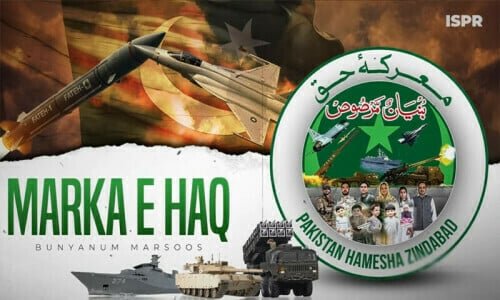





Operation Banyan Al Marsoos showcased Pakistan’s military dominance both in the air and on the ground. From the moment the operation was launched, the Pakistan Air Force had already asserted its superiority, despite facing the Indian Air Force’s most advanced fighter jets and air defense systems. The countries also engaged in what is now being called the longest dogfight of the modern era. On the ground, relentless artillery fire across the Line of Control demonstrated Pakistan’s ability to detect and intercept drones and missiles effectively, and their skill in precision strikes was also confirmed.
Downing of Rafales and PAF’s Air Supremacy
One of the most striking developments during Operation Banyan Al Marsoos was not only Pakistan’s tactical superiority on the battlefield but also in the air. While numerous videos of drone exchanges were appearing everywhere, another battle was being fought above the clouds, beyond the range of any phone camera. Pakistan’s retaliation involved the immediate deployment of No. 15 Squadron of the PAF, equipped with Chinese-built J-10C “Vigorous Dragon” fighters. This squadron is credited with launching PL-15 long-range missiles in coordinated beyond-visual-range salvos that disabled and destroyed multiple Indian aircraft, including the highly praised French Rafales.
So India did lose five planes a few hours after it started a fight with Pakistan. The IAF was grounded for two days. What an embarrassment! A small nation of Ukraine is more competent. Indians have to stop self-delusions and start being realistic. pic.twitter.com/D6xMBvyFwI
— Jayant Bhandari (@JayantBhandari5) July 20, 2025
It remains a fact that India often denies or remains evasive when asked, even though multiple independent analysts, US officials, and battlefield images have confirmed the downing of Rafales. So far, at least four have been confirmed by the Modern War Institute, including a Rafale, a Mirage-2000, a Su-30MKI, and a MiG-29. PAF has also recently claimed a sixth kill, a second Mirage-2000. This is also the first instance of a Rafale being shot down in combat, and it was by a Chinese-made missile. It is also a symbolic blow to Western defense exports, which have long enjoyed air superiority.
Exposing S-400 Air Defense System
Pakistan’s locally manufactured JF-17 Thunder fighter jet, mounted with CM-400AKG missiles, is now being credited with damaging India’s Russian-made S-400 air defense system in Adampur. Widely circulating reports claim damage done to its critical radar and command-and-control components. This helped neutralize the 96L6E surveillance radar, thus damaging S-400’s layered defense system. Although the Indian media and officials at the Press Information Bureau deny these claims, satellite images and independent-source analysts have confirmed damage.
India’s pride 🇮🇳 the S-400 defense system worth $1.5 billion was built to destroy any incoming threat. With three of these stationed across the country, it seemed impenetrable.
But Pakistan 🇵🇰 had other plans.
The Pakistan Armed Forces launched a bold operation targeting the… pic.twitter.com/wo5Y0zsMKb
— Defense Intelligence (@DI313_) May 22, 2025
Precision Strikes
India, as per tradition, launched its operation into Pakistani territory under the cover of the night. What differentiates Pakistani retaliation is its launch of precision strikes on the morning of 10th May 2025, which targeted over 20 Indian military sites in the provinces of Punjab, Rajasthan, Gujarat, and Jammu and Kashmir. Some of the significant hits included Udhampur and Pathankot Airbases, where damage was done to facilities and air defense systems. Bhuj and Adampur saw the destruction of BrahMos missile storage depots and damage to S-400 Air defense battery, respectively. Hit targets included Sirsa, Bathinda, Halwara, Jalandhar, Rajouri, Srinagar, Awantipura, Chandigarh as well as multiple posts across the LoC, brigade headquarters, and intelligence sites. Both neutral sources and satellite imagery have corroborated these claims. Pakistan, unlike India, precisely targeted military outposts and avoided civilian areas to keep the collateral damage as minimal as possible. This shows the professional and humane approach of the Pakistan army that knows how to differentiate between the enemy and the innocent civilian population that has nothing to do with the conflict.
Artillery Fire Along The LoC
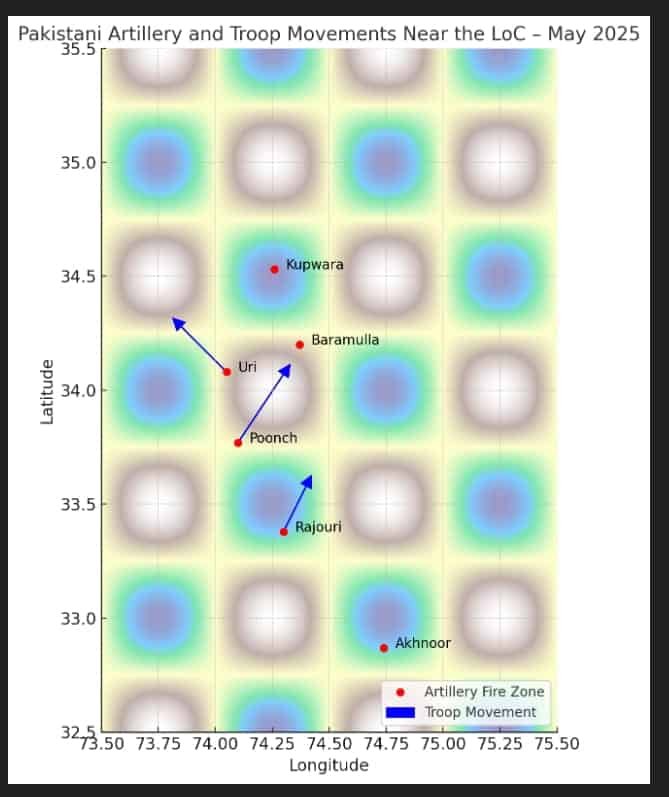
The on-ground conflict saw intense exchange of fire and artillery shelling across the Line of Control, especially in the Northern region and Kashmir. Pakistan’s retaliatory strikes had begun on the night of 7-8 May, which India termed as “unprovoked” even while having attacked the night before on 7th May. Pakistan likely employed long-range SH-15 and M-109 howitzers that are capable of precision engagement deep across the LoC without having to cross into enemy territory. Among the areas hit were Kupwara and Baramulla in north Kashmir, Uri and Akhnoor in the Western sector, Poonch and Rajouri in central Jammu.
The Longest Recorded Dogfight
The night of May 6-7, 2025, featured what aviation analysts have described as an aerial combat that was about “an hour-long dogfight of the modern variety” and the longest in the skies since World War II. Approximately 125 fighter jets were airborne, with around 80 Indian and 45 Pakistani fighter jets participating in the clash. Independent analysts estimate roughly the same numbers, citing 70+ IAF and 42 PAF jets engaging in an intense dogfight lasting an hour, including beyond-visual-range (BVR) missile exchanges and electronic warfare (EW) maneuvers by Pakistan. What made the PAF’s offensive more coherent and well-coordinated was a comprehensive Integrated Air Defense System (IADS) that included sensors, shooters, and ground- and air-based assets. Additionally, a communication network was in place, and a command center was established for real-time information sharing and decision-making, which became a crucial part of this structure. Aircraft such as the JF-17, J10C, and F-16 were not the only elements of the PAF in the air. This offensive also involved UCAVs, UAVs, and a wide range of munitions.
Video Simulation of the Kill Chain
& Rafale 💥 🐉🐲 https://t.co/gnw0eXOtdQ pic.twitter.com/YyZoUZpSIn— Eagle Eye (@zarrar_11PK) June 4, 2025
One of the main reasons PAF had the upper hand was the coordination and seamless collaboration amongst all arms of the Pakistan Army for decision-making on the strategic level. The doctrine of centralized command was in place with “distributed control and decentralized execution”. The top brass was available at all times, day and night, for any strategic directions or decisions that had to be taken. The dogfight was being monitored minute-by-minute. Time is of the essence, and in air combat, even seconds and minutes are crucial —a fact that further highlights the significance of an hour-long engagement. Some weapons were being used in a real battle for the first time. BVR missiles hit the three Rafales and one Mirage-2000, MiG-29 29 and SU-30 and fell in Indian territory. The targets disappeared on the radar scopes, which was a digital confirmation that jets were shot down as briefed by AVM Aurangzeb through time stamps and recordings of Indian pilots’ communications.
Formally a fan of AVM Aurangzeb Ahmed!
6-0 for PAF vs. IAF
2-0 for PAF roasting IAF pic.twitter.com/Tj6bOTfhvd— Umar Saif (@umarsaif) May 11, 2025
The Air Chief himself oversaw all proceedings and was present in the control room before his men, which further boosted the morale of the young blood under his command.
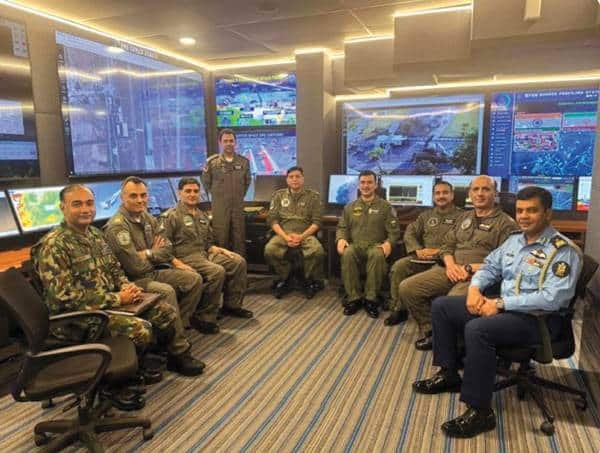
Source: The Nation
Implications for Modern Combat
Operation Banyan Al-Marsoos was an integrated, multi-domain counter-offensive that changed the rules of the battlefield forever. India’s perceived delusions of superiority were shattered with swift responses and digital evidence. The operation once again reinforced the doctrine that it is always the ‘man behind the machine’. India had an edge in terms of military equipment, but it was Pakistan’s tactical prowess and indomitable spirit that ultimately guided them to victory.