

Pakistani goods are gaining new opportunities due to the trade war between the United States and China, as well as the tariffs imposed on Asian exporters. The U.S. tariffs on states like Bangladesh (39 percent) and Vietnam (46 percent) are significantly higher than the 29 percent tariffs on Pakistan, giving Pakistani manufacturers a price advantage over their counterparts in these countries. Global supply chains are changing as companies seek alternatives to produce outside China. Analysts note that Pakistan’s low-cost textile industry and farm exporters now have a chance to fill the gaps in the U.S. and Chinese markets, with the U.S. being Pakistan’s largest export market, valued at approximately $6 billion in 2024.
Source: The Diplomat
Pakistan’s greatest potential lies in textiles, with nearly all Pakistani shipments to the U.S. being textiles and fabrics. Exports to the U.S. account for 77 percent of total exports. Cotton trousers, denim, bed linens, towels, and knitwear are some of the products that should be targeted for export growth. The fact that labor and production costs in the country are lower has now been compounded by favorable tariffs, which subsequently enhance the country’s exports to U.S. producers who are happy to have a cheaper alternative to Chinese and Southeast Asian products. In 2024, exports to the United States totaled approximately $5.5 billion, accounting for nearly 18% of Pakistan’s total exports. For example, goods sent to the U.S. totaled $3.2 billion, with home textiles accounting for $1.5 billion.

Source: Samaa News
The tariffs imposed by the Trump administration, which reduced the competitiveness of other suppliers, may lead American consumers to turn to Pakistan. Trade expert Zubair Motiwala predicts that U.S. buyers will reduce imports from countries facing higher Trump tariffs and instead source more from low-cost regions, such as Pakistan. This could help Pakistan gain new market share, according to analysts.
Food production and agriculture are also benefiting. Tariffs have raised the cost of U.S exports of fish and rice to China. Pakistan, which is already a significant source of these products, can capitalize on this opportunity and increase its market share in seafood, rice, and edible oils. Pakistan has signed agreements to export more meat and grains to China. For instance, a 2019 agreement supported the export of Pakistani beef and mutton worth about $375 million. Corn exports surged even more rapidly, reaching $347 million in 2023, compared to just $12 million in 2020, as Chinese buyers sought alternatives to U.S. feed. Authorities suggest that other farm products, such as fruits, milk, and more, could also expand as supply chains shift.
Even other manufacturers find opportunities to benefit. Pakistan should focus on exporting additional items, such as leather shoes, cement, steel, and surgical instruments, in addition to textiles. Among them is the niche plastics, such as Pakistani polyester (PET), which continues to enter the U.S. duty-free. Officials in the commerce sector observe an increased demand for sports equipment in both the United States and China. In trade-war terms, this is known as “trade diversion,” where buyers abandon purchasing from high-tariff countries and instead turn to Pakistan.
The next target is technology and high-value sectors. In trade negotiations, the Pakistani government is welcoming foreign technology investment and encouragement in its IT sector. According to economists in Pakistan, it is necessary to move on to electronics, engineering products, and IT services, as they can be offered at more valuable prices than textile products. Pakistani IT companies, already exporting to the global market, had a chance to pursue new American customers as electronics manufacturers consider alternatives to China. The ICT exports of Pakistan were nearly $1.94 billion in FY2023, indicating that technology may become a new growth driver.
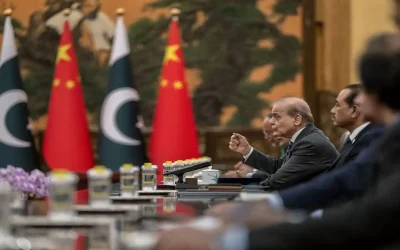
Islamabad is making deals to seal these gains. Finance Minister Aurangzeb reports that Pakistan and the U.S. are in the final stages of negotiating a reciprocal trade treaty, which would eliminate the threat of the 29% tariff hindering Pakistani exports. To balance trade, Pakistan has been willing to purchase additional U.S. commodities (oil to minerals). Meanwhile, it is attempting to secure new deals, such as negotiations over a free-trade agreement with Gulf countries, and is even considering further involvement in mining and technology.
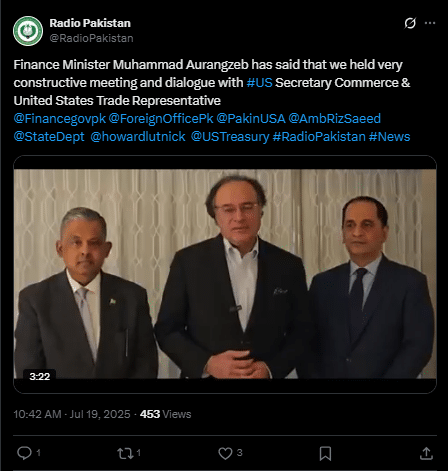
Source: X/@radiopakistan
Local authorities are optimistic. As Aurangzeb said, “Never let a good crisis go to waste.” Experts believe that Pakistan has an opportunity to increase its exports and diversify its economy. However, Pakistan also needs to reduce high energy and production costs to remain competitive. Indicators show that Pakistan can convert the confrontation of trade between the U.S and China to actual growth in textile, agriculture, and leather industries, as well as tech industries, since world trade is gearing up to reroute.
The U.S-China trade war, although destabilizing world markets, has provided Pakistan with a unique opportunity to reorient itself as a competitive export center. Pakistan has equal chances of meeting the diverted demand of Western and Chinese consumers with its favorable tariff differentials, a strong textile base, increasing agricultural exports, and the interest shown in other items such as leather, sports goods, and IT. Yet, to fully achieve this potential, the country will have to overcome domestic challenges, including high energy prices, infrastructure bottlenecks, and quality upgrades. Through policy and strategic planning, diplomacy, and investment in trade facilities, Pakistan can transform this geopolitical shift into economic stability and sustained growth.