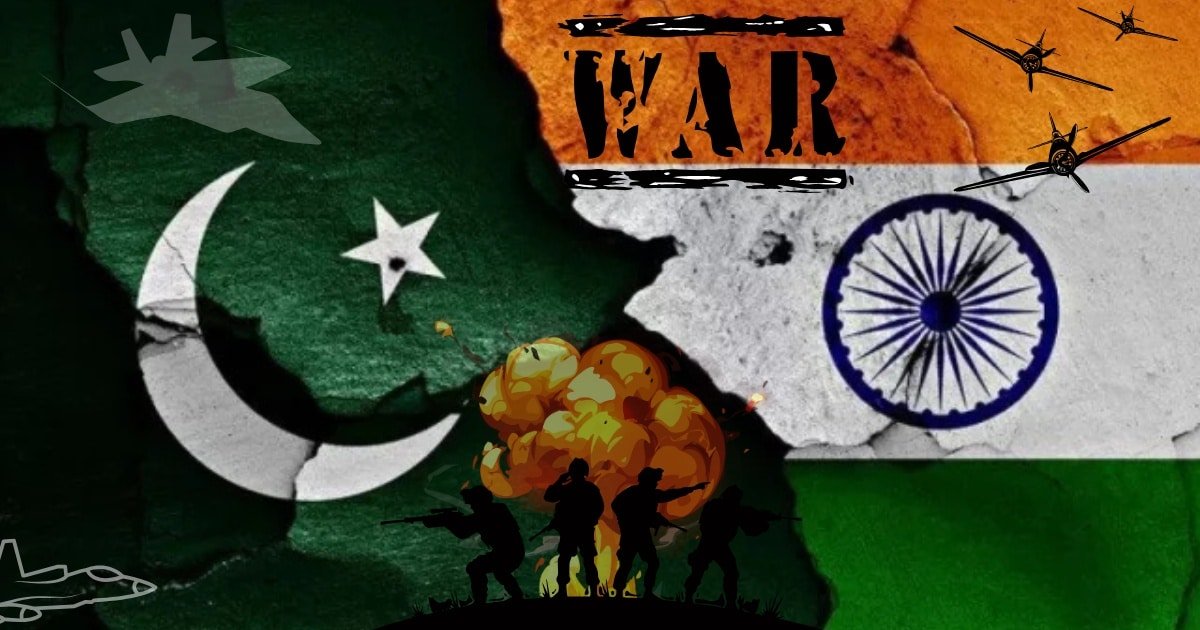





Pakistan and India have been in conflict since gaining independence in 1947, repeatedly testing each other’s military strength. Most of these clashes involved traditional warfare with tanks, artillery, and border skirmishes. However, the recent standoff in 2025 is unique in its history because it involves drone warfare, missiles, and electronic warfare across various domains.
Background
The roots of the conflict were planted when a militant attack occurred on April 22 in Pahalgam, India, which the Indian Government blamed on Pakistan. What followed was a 100-hour clash from May 6 to May 10, 2025. It started with an unprovoked rapid attack using long-range weapons targeting nine points in Pakistan-administered Kashmir and Punjab, called “Operation Sindoor” by the Indian Air Force. During press conferences, Indian military officials claimed the locations were precisely targeted and that terrorist camps were destroyed, although reports emerged of women, children, and civilians being harmed on the Pakistani side. The IAF reported using multi-domain coordination, including drones, cruise missiles like Brahmos and the SCALP-EG, electronic warfare, and real-time command. The Indian leadership initially made bold claims, describing it as a “restrained and precise attack,” and boasted about their technological superiority. Indian Air Marshal AK Bharti asserted that their actions specifically targeted terrorists and not the Pakistani state. While there were negotiations for peace, a top Indian strategist, Brahma Chellaney, went so far as to call the ceasefire a “snatched defeat from the jaws of victory”.
Initial Anxieties
Pakistan’s armed forces, with an annual budget of approximately USD 9-9.2 billion (2.0% of GDP), raised concerns among Pakistani defense analysts when compared to Indian armed forces, which have an annual budget of USD 78.7 billion (1.9% of GDP). However, it was their remarkable strategy against an adversary ten times larger with sophisticated military hardware that shocked the world in May 2025. Up until this point, despite the Indian blockade of rivers in direct violation of the Indus Water Treaty, Pakistan had not taken military action, and their forces remained mainly on the defensive. It was after the direct violation of international borders and the targeting of Pakistani civilians by the IAF that the Pakistan Army commissioned a counter-strike, code-named “Bunyan-Al-Marsoos,” meaning ‘steel wall’ in Arabic.
Operation Bunyan-Al-Marsoos
The operation proved to be a literal Steel Wall defense in action, with coordinated drone, missile, and air-jet strikes targeting 26 Indian military facilities. Forced to exercise its right to self-defense as a sovereign nation, Pakistan Air Force shot down six Indian fighter jets, including four renowned French Rafales that fell in Indian territory. British defence analyst Michael Clarke told Al-Jazeera that weapons had long ranges to reach required targets and both countries were able to hit targets whilst being in their own airspace. India has not responded to claims that PAF shot down Rafales, nor has it confirmed or denied the information. Meanwhile, Pakistan’s Air Vice Marshal Aurangzeb Ahmed not only identified the downed jets but also specified the exact locations where the planes were hit.
Pakistan launches retaliatory military operation — dubbed “Bunyan Al Marsoos (or Impenetrable Wall)” — against India as fighting escalates between the South Asian nuclear rivals
Live updates👇 https://t.co/7B6RkNtMjX pic.twitter.com/ZQNbErTzmU
— TRT World (@trtworld) May 10, 2025
Pakistan Air Defense Superiority
In addition, independent observers commended Pakistan’s superior integration of sensors as well as air-defence layers, particularly the Chinese-made PL-15 missiles and HQ-9P. Pakistan Air Defence system chronology, as described by international fact-checkers, involved the layering of FM-90 SHORAD, HQ-1 medium-range, LY-80, and long-range HQ-9P missiles that helped disrupt and defeat the Indian BrahMos, SCALP-EG, the drone swarms, as well as Indian aircraft. Another noteworthy development was the use of locally manufactured JF-17s and J-10Cs fighter aircraft, paired with the PL-15 missiles, which engaged sophisticated fighters like the Rafale and still achieved a “six-nil” kill ratio. Regarding the disabling of the notorious Indian S-400 air defense system, the hypersonic CM-400AKG missiles deserve credit.
Pakistan launches retaliatory military operation — dubbed “Bunyan Al Marsoos (or Impenetrable Wall)” — against India as fighting escalates between the South Asian nuclear rivals
Live updates👇 https://t.co/7B6RkNtMjX pic.twitter.com/ZQNbErTzmU
— TRT World (@trtworld) May 10, 2025
Drone Warfare
This conflict differs from previous ones because it employs drones for deeper infiltration behind enemy lines while avoiding nuclear escalation. It exemplifies tactical innovation and stealth, which are better suited for modern warfare, especially when involving two nuclear states. In terms of damage and strike range, Pakistan remains formidable and controls the skies. Although IAF deployed loitering munitions and Israeli UAVs, they failed to hit key targets, with most being intercepted. In response, Pakistan used a combination of drones and missiles for deterrence and successfully shot down expensive foreign jets using cheaper local air defense systems. The S-400 Indian Air Defense system, considered one of the most advanced and untouchable in the world, was damaged by deep strikes on Indian bases carried out by the PAF.
A compilation of Pakistani drone strikes targeting Indian-sponsored terrorists, watch and witness precision in action. ‼️ pic.twitter.com/R8csEbxM4H
— Schlangenjäger (@Shadowfox_11) June 10, 2025
Conclusion
One of the most crucial tactics in the military is unwavering support from the people, which boosts the morale and confidence of troops and front-line warriors. Without the ongoing support of the Pakistani people, whose presence in spirit and on social media helped spread the truth of the conflict, the outcome would not have turned out the way it did. Public opinion clearly influences military strategy, as seen in how Indian strategic coherence was disrupted by the divided consensus within the country regarding the government’s decision to attack Pakistan without an independent inquiry into the Pahalgam episode first. What must be praised in both countries is their dedication to de-escalating conflicts when there is a risk of nuclear fallout and their responsibility to respect unwritten nuclear boundaries.