


The month of Ramadan in Pakistan has morphed into a curious cultural theater. Between the grand charity drives and the neon-lit game shows, there exists a darker, more reflexive habit: the public dissection of age, particularly that of women. In late February 2026, a viral exchange between veteran icon Atiqa Odho and superstar host Fahad Mustafa didn’t just trend; it blew the lid off the entertainment industry’s most toxic double standard, revealing a “Peter Pan complex” that governs our screens.
The Spark: A Bitter Pill of Truth
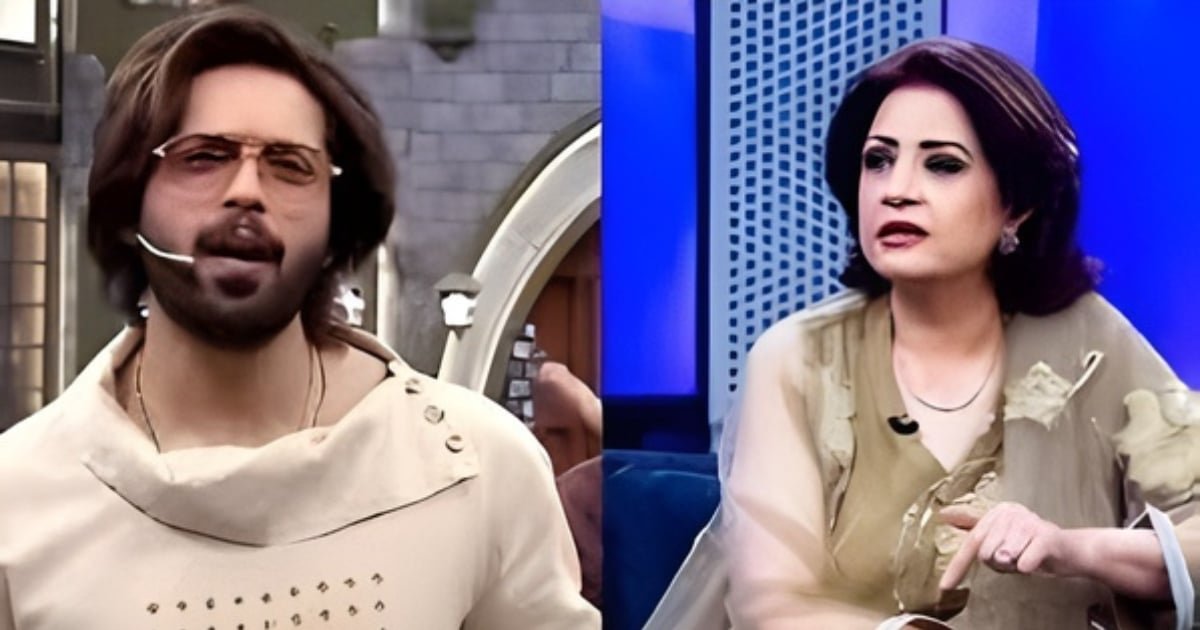
The controversy ignited on the set of Hasna Mana Hai, where Atiqa Odho, a woman whose career has spanned decades of cinematic and televisual evolution, was asked for her professional take on current industry leaders. When the face of Fahad Mustafa appeared on the screen, Odho did not offer the usual platitudes. Instead, she offered a measured, systemic critique.
“I think the time has come for him to start acting opposite girls who are actually in his own age bracket,” she remarked with the calm authority of a senior stateswoman. It was a comment directed not at Mustafa’s talent, but at a casting culture that allows male stars to remain “forever heroes” while their female peers are relegated to the roles of mothers and grandmothers before they even hit forty.
atiqa is actually spot on, these men are always getting casted next to women so much younger (example humayun with sajal, fahad with hania) and then acting like oh dare you call us out 🥴pic.twitter.com/6xH5o76lph
— fatima (@pakidilemma) February 24, 2026
The Hero’s Fragile Armor
In an industry that treats aging as a professional death sentence for women, Mustafa’s reaction was a case study in fragile masculinity. Rather than engaging with the structural point Odho was making, that the age gap between male leads and their love interests is widening to a point of absurdit, Mustafa took to his high-decibel platform on Jeeto Pakistan to launch a personal counter-offensive.
i absolutely despise wht Fahad said but why no one is calling out the real culprits humayun,danish& faisal who keeps coming with younger & younger actresses
Fahad did only one drama with hania after 10 years &usually only works with likes of mahira and mehwish who are of his age
— fatima (@memuffin14) February 24, 2026
Flanked by his frequent collaborator Humayun Saeed, Mustafa chose the path of derision. He quipped that Odho would only be satisfied if she were the one cast as their heroine, before delivering the low blow that set social media on fire: he suggested she should “get two or four more good surgeries” if she wanted to be seen on screen with them.
The audience laughed, but the internet didn’t. The comment was more than a “joke”; it was a weaponization of a woman’s appearance to invalidate her intellect. It reinforced a singular, cruel narrative: that a woman’s value in the industry is tied solely to her proximity to youth, while a man’s value is static, regardless of the crows-feet he hides with high-definition filters.
The Double Standard: Heroes vs. Hags
The irony of Mustafa’s outburst was anchored in the current landscape of Pakistani television. Mustafa, who is in his 40s, recently dominated the charts in Kabhi Main Kabhi Tum, playing a character roughly two decades younger than himself, paired with Hania Aamir, who is in her late 20s. This is the “Hero’s Privilege”, the industry-sanctioned delusion that a man can stay twenty-five until he is fifty, while a woman of the same age is deemed a “senior.”
When Atiqa Odho pointed out this discrepancy, she was pointing out a lie we have all agreed to believe. She was highlighting the fact that while men like Mustafa and Saeed “grace” the screens with women half their age, female actors who entered the industry at the same time as them have long been sidelined or mocked for the crime of naturally maturing. In the drama industry, a man’s graying temples are “distinguished,” but a woman’s laughter lines are a “technical difficulty.”
No one thinks Fahad Mustafa and Humayun Saeed are ‘heroes’ who should be casted across women half their age. To then have the audacity to be aggressive towards Atiqa Odho who rightfully and respectfully called out this need to constantly be relevant and feel young? Shameful.
— Yusra Habib (@YusraH95) February 24, 2026
The “Backhanded” Apology
As the pressure mounted from peers and the public, Mustafa was forced into a retreat. However, his “apology” on a subsequent episode of his show was described by many as backhanded at best. While he called Odho the “most beautiful woman in Pakistan,” the tone remained defensive. He framed his previous comments as a “joke between friends” that was “misunderstood” by the public, a classic tactic of shifting the blame onto the audience’s perception rather than the speaker’s intent.
By calling her “Atiqa Apa” (Elder Sister) in the apology, he paradoxically reinforced the very age hierarchy he had just used as a weapon. He was essentially saying, “I respect you because you are old, even though I just mocked you for being old.” It was a performance of piety that failed to address the actual harm: the dismissal of a woman’s professional opinion via body-shaming.
fahad finally apologised to atiqa odho 😭 pic.twitter.com/ixcSwhjtdp
— fatima (@memuffin14) February 24, 2026
The Grace of Odho: A Lesson in Seniority
Throughout the storm, Atiqa Odho remained the only adult in the room. Her response on social media was a masterclass in dignity. She chose not to engage in the mud-slinging, instead emphasizing that during Ramadan, she preferred to forgive and move forward. Her grace didn’t just end the feud; it highlighted the immaturity of her detractors.
View this post on Instagram
A Call for Reality
The Odho-Mustafa saga is a mirror held up to Pakistani media. It asks us why we are so terrified of seeing a woman age on screen. It asks why we allow “heroes” to live in a perpetual state of Peter Pan-ism while we demand perfection, or silence, from women.
Such a low blow by Fahad Mustafa to tell a senior actor like Atiqa Odho to “do more surgeries and then we’ll be your hero one day. Is that how you respond to criticism?!
— M. (@syedamaheenkam) February 24, 2026
If the Pakistani film and drama industry is to truly evolve, it must stop treating aging as a sin. We need stories where 40-year-old men love 40-year-old women. We need to respect the “Grand Dames” not just with honorary titles, but with the professional respect they deserve. Until then, the biggest “surgery” the industry needs isn’t on the faces of its actresses, it’s on the mindset of its leading men.
You May Like To Read: Ramadan Transmissions, Viral Tears, and the Problem of Dr. Nabiha
Check out our latest video