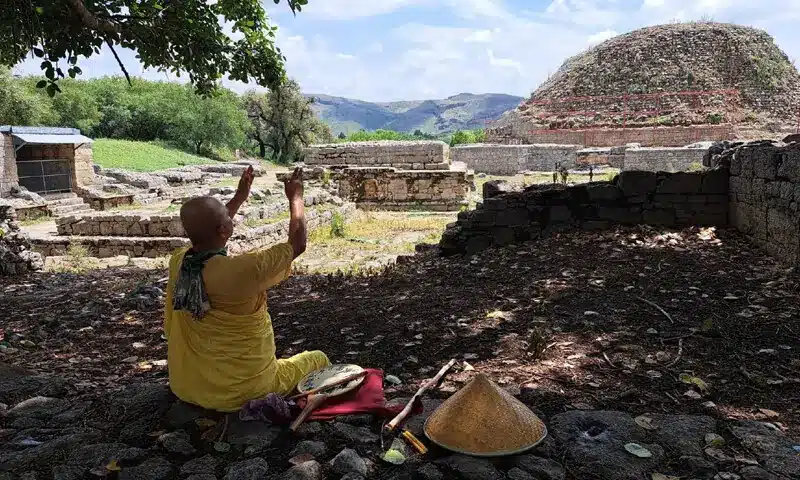





TAXILA — Standing before the towering ruins of the nearly 2,000-year-old Dharmarajika Stupa, 76-year-old Japanese Buddhist monk Junsei Terasawa appealed to the world to return to the cradle of Gandhara and pray for peace.
As conflicts, violence, and humanitarian crises continue to unsettle regions across Eurasia and the Middle East, the veteran peace activist urged Buddhist monks and followers worldwide to gather at Taxila. He believes the ancient philosophy of non-violence (ahimsa), reconciliation, and human dignity — which once spread from Pakistan’s northern valleys — is urgently needed today.
A Month-Long Pilgrimage Across Sacred Sites
Monk Terasawa’s call in Taxila formed the highlight of his month-long spiritual journey through Pakistan’s rich Buddhist heritage sites. Travelling across ancient monastic complexes and archaeological landmarks in Punjab and Khyber Pakhtunkhwa — including the historic ruins of Swat Valley — he offered prayers for global harmony and interfaith understanding.
Over his decades of peace activism, Terasawa has visited active conflict zones in Iraq, Chechnya, and Ukraine, where he has led peace marches, interfaith prayer vigils, and campaigns for nuclear disarmament.
“The message of peace was raised from Taxila and flourished across the globe. Today, when the world is once again facing conflict and uncertainty, that message must rise again from this sacred land.”
— Venerable Junsei Terasawa
The Sacred Legacy of Dharmarajika and Gandhara
Dharmarajika, founded during the Maurya dynasty and later expanded under the Kushan Empire, remains one of the most spiritually significant Buddhist sites in the world. Archaeologists have recovered bone fragments and sacred relics believed to belong to the historical Buddha, reinforcing Taxila’s status as a major centre of pilgrimage.
| Aspect of Gandhara Civilization | Cultural & Historical Significance |
|---|---|
| Artistic Heritage | Pioneered Greco-Buddhist art, blending classical Mediterranean realism with Eastern spiritual symbolism to create the earliest human depictions of the Buddha. |
| Philosophical Bridge | Acted as the main crossroads where Buddhist teachings travelled along the Silk Road to China, Korea, and Japan. |
| Architectural Influence | The stupa designs and monastic layouts developed in Taxila influenced temple architecture across East Asia. |
Monk Terasawa emphasised the deep historical and spiritual connection between Japan and Gandhara, noting that many of the visual and philosophical traditions that shaped Japanese culture trace their roots back to the ancient workshops of Taxila and Swat.