




Many experts are calling it a calculated campaign to control the narrative and silence dissent.
The Indian government under Narendra Modi has launched a widespread digital crackdown targeting international media, Pakistani voices, and independent Indian journalists. Using the legal framework of its Information Technology Act, 2000, and other contentious laws, India has blocked thousands of social media accounts and YouTube channels—most of which posed no real security threat but simply offered alternative viewpoints.
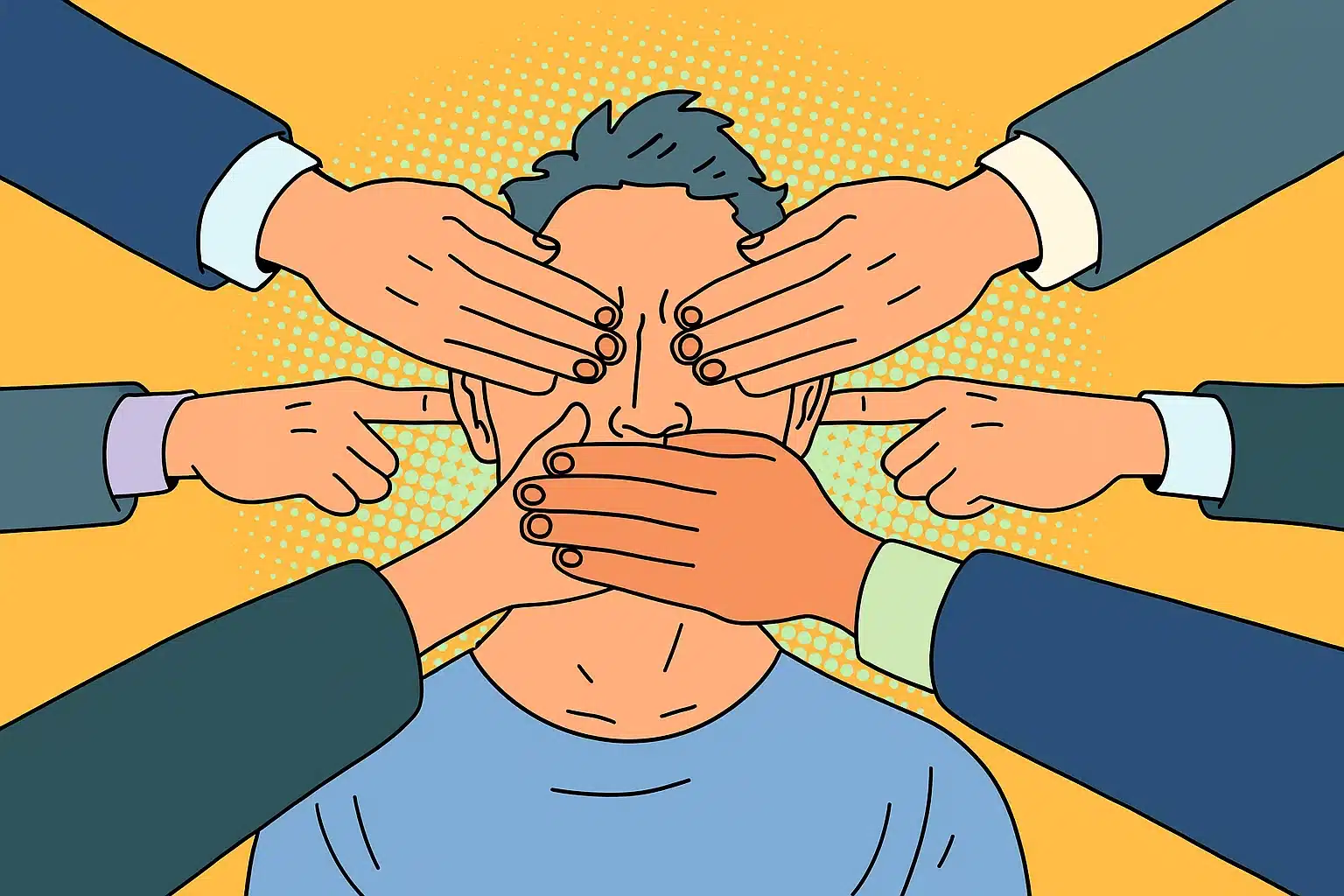
Analysts contend that this is not merely about controlling content—it’s about shaping people’s minds through what can be described as an Ideological State Apparatus. They argue that the Indian state utilises media, legal mechanisms, and nationalism to silence dissenting voices and promote a Hindutva narrative that leaves no room for opposition.
The concept of the Ideological State Apparatus was introduced by Louis Althusser, a Marxist philosopher. According to him, states influence people not only through force (such as police or army)—which he referred to as the Repressive State Apparatus—but also by shaping their minds and beliefs. This subtle form of control operates via education, media, religion, law, and culture, and is known as the Ideological State Apparatus (ISA).
In simple words:
Where the police forces you to obey, the media convinces you to believe.
Silencing Global Media Under the Guise of ‘National Security’
On July 6, X (formerly Twitter) revealed that it had been forced to suspend access to its popular Reuters and Reuters World accounts in India—allegedly at the request of a government authority. Although Indian officials denied this, the action speaks volumes about how uncomfortable the government has become with global scrutiny.
Earlier in May, X had already confirmed that over 8,000 accounts were blocked in India under threat of fines and imprisonment for its local staff. These included prominent Pakistani political figures, celebrities, and international media outlets. X itself labeled this censorship and expressed concern that there was no legal explanation for many of these takedowns. This wasn’t a move to protect citizens—it was a move to protect power.
YouTube and Instagram Also Targeted
The crackdown didn’t stop at X. India’s Ministry of Home Affairs ordered YouTube to geo-block 16 popular Pakistani channels, including Dawn News, Geo News, ARY News, and even personalities like Shoaib Akhtar and Asma Shirazi. The official reason? Spreading “provocative” or “false” content.
But observers point out that what’s really being silenced are voices that speak truth about Kashmir, minority rights, and Modi’s rising authoritarianism. Even Instagram pages of celebrities like Mahira Khan and Hania Aamir were blocked—raising the question: is India threatened by dissent, or by dialogue?
Altogether, the ban impacted over 63 million subscribers, with critics warning that this is part of a systematic plan to silence any criticism of the ruling BJP’s Hindutva agenda.
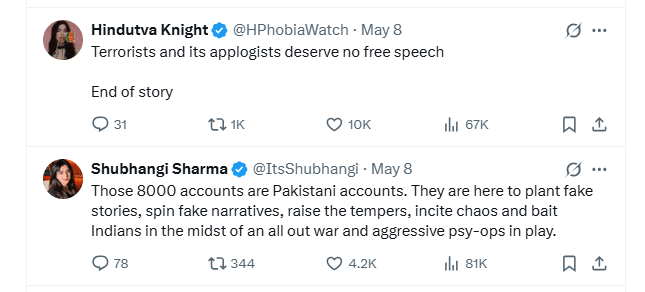
Demonising the Other
Censorship Backed by Law, Not Justice
Under Modi’s regime, India has sharpened its legal tools to detain and intimidate. The Unlawful Activities (Prevention) Act (UAPA) is now frequently used to arrest activists, journalists, and civil society members—even when no evidence of wrongdoing exists.
India currently ranks 151 out of 180 countries on the World Press Freedom Index, a shocking position for the world’s “largest democracy”. Journalists who report on Muslim persecution, Dalit violence, or government corruption often face threats, surveillance, or outright attacks.
Independent media platforms like The Wire and Free Press Kashmir have also faced takedowns. The Wire’s site was removed temporarily for an article on the Rafale jet controversy, only to be restored after compliance. Even respected human rights activists like Harsh Mander have had their X accounts suspended without explanation.
X has received executive orders from the Indian government requiring X to block over 8,000 accounts in India, subject to potential penalties including significant fines and imprisonment of the company’s local employees. The orders include demands to block access in India to…
— Global Government Affairs (@GlobalAffairs) May 8, 2025
A Controlled Narrative: The Role of State Propaganda
India’s ideological censorship isn’t limited to takedowns—a well-coordinated media machine supports it. State-aligned news channels and Hindu nationalist groups work hand in hand to push hashtags like #PakTerror and #RevengeForPahalgam following incidents like the recent Pahalgam terror attack.
During such crises, rather than report responsibly, Indian media often accuses Pakistani celebrities, YouTube commentators, or international journalists of “anti-national” behaviour. This fuels hatred and justifies even harsher censorship, all while ignoring genuine extremist voices inside India.
Meanwhile, YouTube has allowed dangerous figures like Monu Manesar—a cow vigilante accused of hate crimes—to remain online, while legitimate journalists are silenced.
This selective censorship reveals the real purpose: not national security, but narrative control.
BREAKING:
🇮🇳 Indian banned around 8.000 X accounts, trying to twist the truth
X has been ordered by the Indian government to block 8,000+ accounts, including those of international news organizations and prominent X users.
Noncompliance could mean major fines or jail time for… pic.twitter.com/omLJuM7oGP
— Megatron (@Megatron_ron) May 8, 2025
The Bigger Picture: From Suppression to Indoctrination
This entire pattern of media suppression reflects a deeper ideology. The Indian state, under Modi’s BJP, is not just censoring content—it is engineering consent through a classic Ideological State Apparatus. Media, law, religion, and education are being used to build a single, rigid national identity centred on Hindutva, where dissent equals betrayal.
In the process, both Indian Muslims and neighbouring Pakistanis are being demonised, not because they pose real threats, but because their existence challenges the uniformity that Modi’s regime seeks to impose.
A Threat to Democracy Itself
While India continues to boast about being a vibrant democracy, its actions speak otherwise. Censorship without due process, arbitrary bans, and legal intimidation are not signs of strength—they are signs of fear.
Even global platforms are beginning to push back. Many are demanding greater transparency in takedown orders, while civil society in India is calling for judicial intervention to protect free speech.
But for now, the digital space in India is shrinking. And as it narrows, it takes with it the right of the people to question, to debate, and to resist.
X suspends Reuters account in India after ‘legal demand’, government denies making request https://t.co/6EMEGiXXvn https://t.co/6EMEGiXXvn
— Reuters (@Reuters) July 6, 2025
Conclusion: The Battle for Narrative is the Battle for Freedom
What began as a few bans on Pakistani channels has become a full-blown assault on critical thought. India’s suppression of media, especially Pakistani and Muslim voices, is not a coincidence—it is part of a broader ideological project.
As India moves further into digital authoritarianism, the real casualty is freedom of expression—both in India and beyond. For Pakistanis, Kashmiris, and minorities everywhere, this crackdown reminds us of one truth: the war for justice is not just fought with weapons—it is fought with words, and those words are now under attack.
As platforms and journalists around the world watch India’s actions closely, one must ask: Is this the future of “democracy”? Or is it the death of it?