


Pakistan and Israel were both founded within a year of each other, Pakistan in 1947 as a homeland for Muslims of the Indian subcontinent, and Israel in 1948 as a homeland for Jews. But over 75 years later, the two countries still have no diplomatic ties. Every Pakistani passport bears the line: “Valid for all countries of the world except Israel.” That exclusion is not just symbolic. It reflects deep political, religious, and geopolitical fault lines that remain active today.
Pakistan’s opposition to Israel has long been tied to its support for Palestinians. But the issue has grown beyond that. Rejecting Israel helps Islamabad strengthen its identity in the Muslim world and push back against India, which has embraced closer ties with Tel Aviv in recent decades.
The latest war in Gaza has once again spotlighted the policy choices of countries like Pakistan. It is important to examine how Pakistan, the world’s fifth-largest country by population and a nuclear-armed Muslim-majority state, has responded—not just rhetorically, but politically and diplomatically.
From Pan-Islamism to Realpolitik
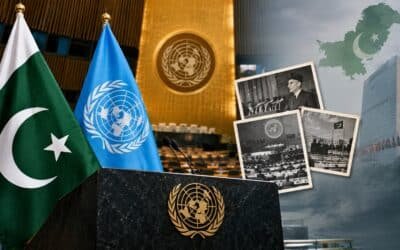
Soon after independence, Pakistan voted against the UN plan to partition Palestine. Its founders viewed the Jewish state’s creation as a form of Western colonialism. The early Pakistani leadership also viewed the Palestine question as a means to demonstrate solidarity with Arab nations and strengthen ties with Gulf monarchies. This was both an ideological commitment and a strategic calculation.
Pakistan has supported Arab countries in their wars against Israel. During the 1967 Six-Day War, a Pakistani pilot flying a Syrian jet reportedly shot down an Israeli plane. In 1948, Pakistan was among the few non-Arab countries to back Jordan’s annexation of the West Bank.
Quiet Contacts, Public Posturing
There have been moments when Pakistani leaders, both military and civilian, considered changing course. In 2005, then-President General Pervez Musharraf met with Jewish leaders in New York and expressed openness to recognizing Israel if progress were made on the peace process. Behind the scenes, low-level contacts between the two countries have existed, focused mostly on trade and intelligence sharing.
Still, Pakistan’s official position remains fixed: no recognition of Israel until there is a two-state solution with a sovereign Palestinian state based on pre-1967 borders, with East Jerusalem as its capital.
Meanwhile, Islamist groups and religious parties in Pakistan have consistently used the issue to rally public sentiment. Accusations of “Zionist conspiracies” surface regularly in political rhetoric. Extremist groups have even targeted polio vaccine campaigns, alleging that they are part of a Jewish plot to sterilize Muslim children.
You May Like To Read: Pakistan’s New Consulate in Kandahar: Soft Power or Security Outreach?
The Abraham Accords and a Moment of Possibility
When the UAE and Bahrain established diplomatic relations with Israel through the Abraham Accords in 2020, it triggered regional speculation about potential shifts in Muslim countries’ foreign policies. Some Pakistani commentators floated the idea of reconsidering ties with Israel, suggesting possible economic and diplomatic dividends—particularly in relation to the United States, which was actively encouraging broader Muslim normalization. However, Pakistan maintained its principled position, firmly rooted in support for Palestinian rights and international law.
The subsequent war in Gaza, now approaching its first anniversary, has further cemented Pakistan’s resolve. The staggering civilian toll, daily scenes of devastation, and increasing settler aggression in the West Bank have reinforced public consensus against any policy reversal. Rather than pursue transactional benefits, Pakistan continues to prioritize moral clarity, alignment with the broader Muslim world, and its long-standing commitment to a just resolution of the Palestinian question.
Mounting Criticism of Israel
Following the October 7 Hamas attack, Pakistan’s initial response was measured. But as Israel’s bombing intensified, Islamabad’s tone grew sharper. Government representatives began describing Israeli actions as “genocide.” News channels aired daily footage of the conflict, while public demonstrations gained momentum.
Pakistan backed a UN Human Rights Council resolution urging a halt to military aid to Israel. It also hosted the Iranian president in April—just months after a rare exchange of cross-border missile fire. Pakistani officials condemned Israel for the targeted killing of Hamas leader Ismail Haniyeh in Tehran, calling it a deliberate attempt to derail diplomacy.
India, Israel, and the Proxy Narrative
The war has also been used to criticize India. Pakistan’s media and political leaders often equate Palestinian resistance with Kashmiri struggles. They highlight India’s growing ties with Israel and accuse Delhi of abandoning its past support for Palestinians.
This narrative fits within Pakistan’s broader foreign policy, which links the Kashmir issue with Palestine in global forums. It also allows leaders to deflect from internal crises by pointing outward.
You May Like To Read: India’s Missing Uranium: Why the Global Silence?
Israel’s war in Gaza has widened into a regional crisis. Iran’s involvement, Houthi attacks in the Red Sea, and increasing tensions with Hezbollah show how easily the conflict can escalate. This has economic consequences too. Oil prices are rising. Global trade through the Suez Canal has been disrupted. Roughly 30 percent of global container traffic passes through this route. If tensions remain high, costs for Pakistan will rise.
The Houthis’ threat to internet cables and shipping lanes in the Red Sea also carries implications for Pakistan. Though Gwadar port is still under development, any future commercial traffic through the Indian Ocean could be vulnerable. Pakistan has participated in U.S.-led naval task forces before, but has stayed clear of Red Sea tensions due to its relationship with Iran.
Moral Support, Strategic Caution
Pakistan has shown strong support for South Africa’s genocide case against Israel at the International Court of Justice. But beyond this, it is treading carefully. No Pakistani military deployments are expected. No aid to Hamas or its affiliates is in the works. However, Pakistan has sent humanitarian aid to Gaza.
Domestic boycotts of brands seen as pro-Israel are common, but the government is unlikely to formalize them. The risk of upsetting lenders like the IMF is too great.
When I teach about the Gaza genocide, students will be asked to read the South Africa case. It’s 84 pages of public facts and clear legal arguments which outline precisely how Israel is committing genocide. As clear a case as any of the last few decades. https://t.co/ptnrIlInK5
— Richard Jackson (@RJacksonterror) January 2, 2024
If a ceasefire eventually takes hold, and Gulf countries lead reconstruction in Gaza, Pakistan might again consider rethinking its position. But for now, its policy is shaped more by internal politics, anti-India sentiment, and public emotion than by strategic planning.
The Israel-Palestine issue remains deeply embedded in Pakistan’s political DNA. That is unlikely to change until there is a breakthrough in the broader Middle East.