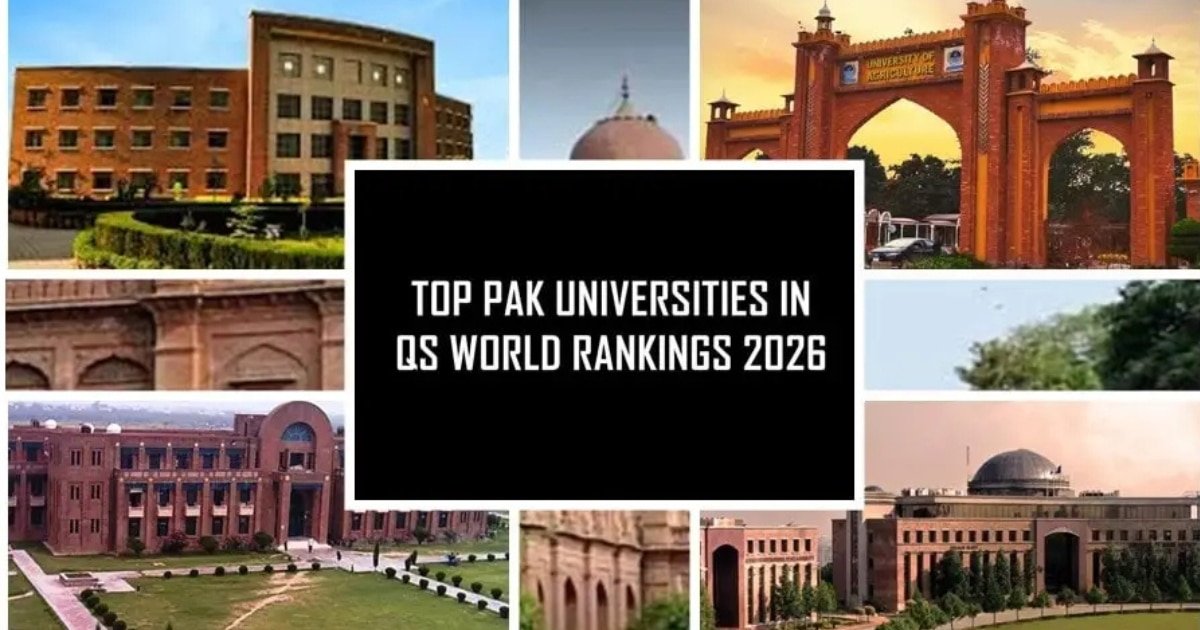





Lahore – Pakistan’s academic landscape has achieved a significant milestone as 35 of its universities featured in the prestigious QS World University Rankings by Subject 2026. The latest report, released this week, highlights the growing global visibility of Pakistani higher education, with 31 public-sector and four private institutions securing spots across diverse disciplines. The results underscore a dominant performance by state-run institutes, particularly in engineering, natural sciences, and agriculture.
35 Pakistani universities make it to the QS World University Rankings by Subject 2026, reflecting strong academic performance.
Out of these, 31 are public-sector institutions, while four belong to the private sector, highlighting the leading contribution of government… pic.twitter.com/xYSIz22UJD
— Bloom Pakistan (@bloom_pakistan) March 26, 2026
Key Highlights
-
Global Footprint: 35 Pakistani universities recognized across 180 subject entries globally.
-
Top Performers: NUST and Quaid-i-Azam University (QAU) lead the public sector in Engineering and Natural Sciences.
-
Private Excellence: LUMS remains the top-ranked business school (101–150 band); AKU leads in Medicine (201–250 band).
-
Agriculture Strength: University of Agriculture Faisalabad (UAF) maintains a top-200 global position.
-
State Dominance: 88% of the ranked Pakistani institutions are from the public sector, driving national research output.
Engineering and Technology Lead the Way
The National University of Sciences and Technology (NUST) emerged as a powerhouse in Technical Education, placing in the 201–250 band for Engineering and Technology. Close behind, COMSATS University Islamabad and the University of Engineering and Technology (UET) Lahore maintained strong positions in Computer Science and IT, generally falling within the 201–400 brackets.
In the federal capital, Quaid-i-Azam University (QAU) continued its streak in the Natural Sciences, securing a 201–250 global ranking. The university also showed marked strength in Physics and Environmental Sciences, reflecting a robust research culture in Islamabad.
<h2 “7”>Business and Medical Education Milestones
The private sector, though smaller in number, delivered some of the country’s highest rankings. The Lahore University of Management Sciences (LUMS) secured a position in the 101–150 range for Business and Management Studies, making it one of the most competitive Pakistani entries in any category. Similarly, the Institute of Business Administration (IBA) Karachi performed strongly in Economics within the 151–250 band.
In the healthcare sector, the Aga Khan University (AKU) maintained its status as the nation’s premier medical institution, ranking in the 201–250 bracket for Medicine. Habib University also made notable inroads into the Social Sciences categories.
Regional Diversity and Agricultural Prowess
The rankings showcased a wide geographical spread of excellence:
-
Faisalabad: UAF remains a global contender in Agriculture and Forestry (Top 200).
-
Punjab: The University of the Punjab recorded multiple entries in Social Sciences and Agriculture.
-
Karachi: The University of Karachi featured prominently in Chemistry and Biological Sciences.
-
Provincial Hubs: Institutions like the University of Peshawar, University of Sindh, and University of Balochistan all secured positions, typically in the 301–500 range.
Measuring Success
The QS Subject Rankings utilize a rigorous methodology based on academic reputation, employer feedback, and research citations. While the majority of Pakistani institutions are currently concentrated in the 201–400 bands, the sheer volume of entries—roughly 180 in total—suggests a steady upward trajectory for the nation’s academic standards.
Observers note that the continued presence of provincial universities in these rankings is a positive sign of decentralized academic growth, providing students across the country access to globally recognized departments.
This achievement serves as a testament to the resilience of Pakistan’s faculty and researchers. As these institutions continue to build international research networks, the nation moves closer to breaking into the top 100 global tiers.
You May Like To Read: Railways Minister Attributes Tezgam Express Derailment to Mechanical and Human Error
Check out our latest video: