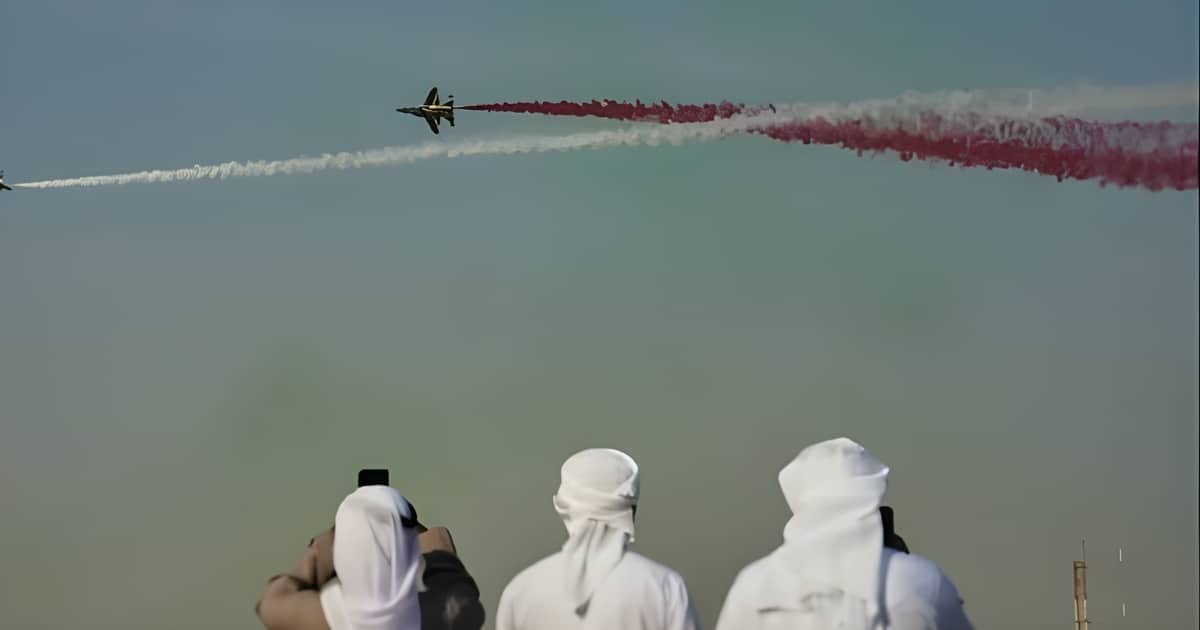





DUBAI/NEW DELHI: An Indian Air Force (IAF) Tejas Fighter Jet, part of India’s indigenous light combat jet programme, crashed during a demonstration flight at the Dubai Air Show on Friday, killing the pilot and prompting the IAF to order a court of inquiry into the incident. The crash of Tejas Fighter Jet, witnessed by hundreds attending the Middle East’s largest aviation exhibition, has renewed scrutiny of the Tejas programme, which has long struggled with design hurdles, delays, and production bottlenecks.
The single-engine Tejas Fighter Jet, built by Hindustan Aeronautics Limited (HAL), went down at around 2:10pm local time. Videos widely shared on social media showed the aircraft performing a low roll before spiralling downward and exploding into a massive fireball upon impact about 1.6 kilometres from the main show venue. Thick black smoke rose from the crash site as emergency crews rushed to contain the blaze.
A Tejas fighter aircraft from India participating in today’s flying display at the Dubai Airshow has crashed, resulting in the tragic death of the pilot. Firefighting and emergency teams responded rapidly to the incident and are currently managing the situation on-site. pic.twitter.com/LpdE87YjLM
— Dubai Media Office (@DXBMediaOffice) November 21, 2025
The airshow, held at Dubai’s Al Maktoum International Airport from Nov 17–21, attracts global defence manufacturers, military delegations and aviation enthusiasts. The Tejas Fighter Jet had been featuring in the afternoon flying displays, offering India an opportunity to showcase the aircraft to potential buyers in the Middle East and beyond.
In a statement posted on X, the IAF confirmed the pilot’s death. “An IAF Tejas Fighter Jet met with an accident during an aerial display at Dubai Air Show today. The pilot sustained fatal injuries in the accident,” the post read. “IAF deeply regrets the loss of life and stands firmly with the bereaved family. A court of inquiry is being constituted to ascertain the cause of the accident.”
This marks the second known crash of a Tejas Fighter Jet. The first occurred in India during a training exercise in 2024, raising early concerns about the aircraft’s performance and reliability.
Oil-Leak Controversy Days Before Crash
The accident comes just days after the Tejas Fighter Jet was embroiled in an online controversy when photographs circulated on social media showing what appeared to be oil leakage from the Tejas while parked on the static display line at the airshow. Shopping bags were seen placed beneath the jet to collect dripping fluid. The images triggered fierce debate on aviation forums and sparked criticism of India’s defence manufacturing claims.
Some users alleged that the leakage persisted into the second day of the show, though no official Indian military or government statement addressed the issue directly.
An IAF Tejas aircraft met with an accident during an aerial display at Dubai Air Show, today. The pilot sustained fatal injuries in the accident.
IAF deeply regrets the loss of life and stands firmly with the bereaved family in this time of grief.
A court of inquiry is being…
— Indian Air Force (@IAF_MCC) November 21, 2025
The Press Information Bureau (PIB) of India, however, dismissed the speculation, calling the images “misleading” and describing the fluid release as a “routine draining process, not a technical malfunction.” The PIB added that the activity was part of a “standard pre-flight procedure to remove condensation, which naturally forms as part of the aircraft’s cooling system.”
The clarification did little to stem speculation, which intensified following Friday’s fatal crash. Aviation experts say the court of inquiry will need to determine whether the incident resulted from pilot error, mechanical failure, or deeper structural issues.
A Programme Marked by Delays and Difficulties
The Tejas programme, which began in the 1980s as part of India’s push toward military self-reliance, has faced multiple setbacks over the decades. Officially inducted into the IAF in 2016, the aircraft has been hampered by recurring design challenges, weight concerns, and slow production rates.
The Indian Navy previously rejected the naval variant of the Tejas, deeming it too heavy for safe aircraft-carrier operations.
Despite these issues, India has continued efforts to modernise and expand the fleet. In September, the Indian government approved a $7 billion order for 97 upgraded Tejas Mk-1A jets to replace its ageing Russian MiG-21 fighters. The decision was seen as crucial for the IAF, which is struggling to meet its sanctioned squadron strength amid rising security challenges, particularly along its borders with China and Pakistan.
However, the rollout of the Mk-1A variant has faced delays tied to shortages of the General Electric (GE) F404 engines that power the aircraft. Of the 99 engines ordered in 2021, only four have been delivered, with GE attributing the delay to post-pandemic supply chain disruptions.
Dubai Air Show Impact and Geopolitical Context
The Tejas crash cast a shadow over the final day of the prestigious Dubai Air Show, which this year hosted over 1,500 exhibitors, 200 aircraft, and hundreds of defence industry leaders. With India aggressively marketing the Tejas to Southeast Asian, Middle Eastern and African nations as a cost-effective light combat aircraft, the incident could have significant implications for export prospects.
Defence analysts say the crash may prompt potential buyers to seek additional assurances regarding safety and performance before initiating procurement talks.
Several propaganda accounts are circulating videos claiming that at the #DubaiAirshow 2025, the Indian LCA #Tejas Mk1 suffered an oil leakage.#PIBFactCheck
✅These claims are #Fake.
✅The videos show routine, intentional draining of condensed water from the aircraft’s… pic.twitter.com/k4oQThqtA3
— PIB Fact Check (@PIBFactCheck) November 20, 2025
The accident also comes at a sensitive time for India’s military modernisation efforts, as tensions persist along the Line of Actual Control (LAC) with China. With Beijing rapidly expanding and modernising its airpower — including its fifth-generation J-20 stealth fighters — the IAF has been under pressure to accelerate induction of new aircraft and reduce reliance on older Soviet-era fleets.
You May Also Like: Afghan Artists Move PHC Against Forced Repatriation, Cite Risk of Persecution
Global Reactions and Next Steps
The Dubai Air Show organisers expressed condolences and said they were coordinating with Indian officials and local authorities during the investigation. The crash site was quickly cordoned off, and flying displays were temporarily paused.
India’s Ministry of Defence has not yet commented on the wider implications of the crash, but officials said the inquiry would examine all technical aspects of the incident. HAL, the manufacturer, also stated it would “fully cooperate” with investigators.
For India, the loss of the aircraft — and more importantly, the pilot — represents a tragic setback in its decades-long quest for an indigenous modern fighter jet.
As the investigation begins, questions are likely to grow about the Tejas programme’s stability, export potential, and ability to meet India’s long-term strategic needs. For now, the crash stands as a sombre reminder that despite its name — Tejas, meaning “brilliance” — the aircraft’s future hinges on resolving critical technical issues and restoring confidence among both domestic stakeholders and international observers.
Check out our latest video: