



When India suspended the Indus Water Treaty and later launched Operation Sindoor on May 7, 2025, the initial reaction from the world was notably lukewarm. The West could not be bothered by yet another series of missile strikes on some poor, developing Muslim country. If anything, India’s attacks were justified as a crusade against terrorism despite no credible evidence of the existence of terrorist camps in Pakistan or their direct involvement in the Pahalgham attack.
Jaishankar, Minister of External Affairs of India thought its a brilliant idea to inform Pakistan about their attack, perhaps he thought PAF will welcome IAF with garland of roses, later while counting the wreckage of IAF fighter jets, he realized that his message of “peace”… pic.twitter.com/itPl1yBFoo
— Pakistan Strategic Forum (@ForumStrategic) May 15, 2025
This was not a first instance of India blaming Pakistan for security lapses in its own territory. There is a continuous pattern that can be linked to the Pulwama attack in 2019, the Uri attack in 2016, Mumbai attacks in 2008, Hyderabad bombings in 2007, Varanasi bombings, as well as Mumbai train bombings in 2006 and the attack on Indian Parliament in 2001.

Source: X/@Intel_DOI
It has been the Indian government’s practice for long to avoid accountability towards its citizens and blame Pakistan for any misfortune that befalls it. There is also a notable bias of the Western media towards India when it comes to the conflicts in the subcontinent. Instead of demanding evidence, the West has always coddled India and justified its baseless claims. The recent Pahalgham incident saw the same reaction from the world. It was only when Pakistan retaliated that the US, EU, and UN awoke from their slumber and were forced into diplomatic intervention.
Pakistan’s response to Indian aggression
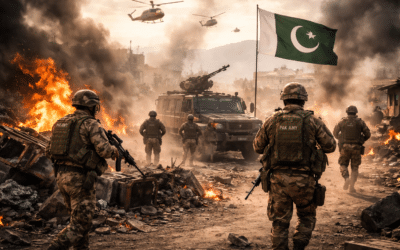
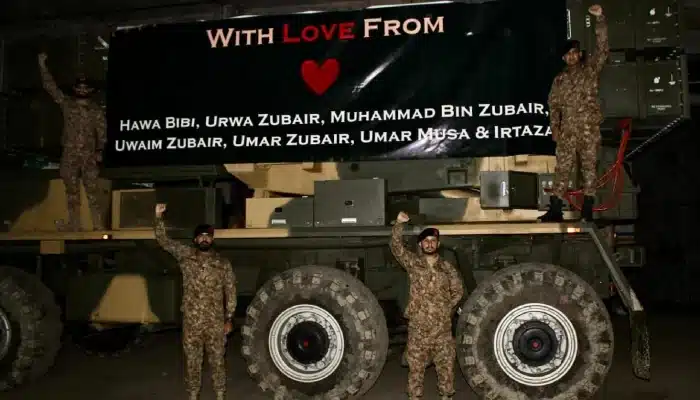
Pakistan responded militarily with a swift and coordinated attack, which seemed visibly disciplined and restrained in its execution. Operation Banyan Al Marsoos is a case study in remarkable coordination across the three arms of the Pakistani military, where each missile, drone, and artillery fire was carefully calculated and accounted for. The military top brass was present and monitoring the situation throughout the 100 hours when the conflict was ongoing. The Indian military might, with its numerical and technical supremacy, believed that it would destabilize and demoralize Pakistan and would not get a response. The entire Western media shared a similar opinion, and it seemed most likely, in theory, that an economically dominant country would be able to strike a comparatively weaker one. Everyone was in for a surprise when Pakistan launched its counterstrikes, which were not random or some symbolic face-saving attempt but a thorough operation that targeted key Indian military sites responsible for the very missiles that were dropped on Pakistani cities.
DG ISPR Major General Ahmed Sharif’s Statement:
“All our actions were purely in self-defense. We will now deliver a devastating retaliatory strike against India for this aggression.”
Key Points:
Timing and location of our counterstrike will be of our choosing
Response will… pic.twitter.com/E1vcQZrGUJ— Sprinter Observer (@SprinterObserve) May 7, 2025
The response was loud and shattered all delusions of Indian supremacy. Not only Western governments but defense analysts, aerial combat enthusiasts, non-state actors, and other independent elements from all over the world saw and verified for themselves that Pakistan will not tolerate any military misadventures and encroachment on its soil without giving a befitting response. DG ISPR had mentioned in the tri-services press conference that when Pakistan chooses to respond, the world will hear it and see it. No Indian media will be required for confirmation, which is exactly what happened.
Remember the legendary words of the DG ISPR:
“When Pakistan strikes India, the whole world will know, and the world itself will speak of it.”
Now, even the Indian CDS is admitting it. Just wait and watch, there’s more to come. pic.twitter.com/dM42ba0TQX
— Eagle Eye (@zarrar_11PK) May 31, 2025
India’s lies and distortion of the truth were exposed to the world, and Pakistan’s response was such that Modi’s government had to request a ceasefire through indirect diplomatic channels.
Diplomatic Engagement
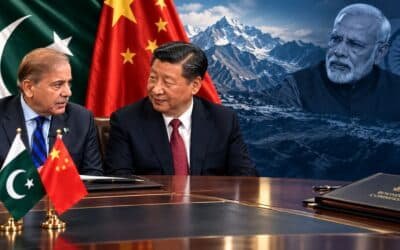
Despite little to no concern shown by the international media for India’s unprovoked attack on Pakistan, the Pakistani foreign office was open for negotiations for peace. Even the military response was restrained to pave the way for the de-escalation of tensions, despite enjoying a strategic superiority. Unlike the inflammatory and dramatic Indian media coverage and the rhetoric of political leaders, the Pakistani government displayed diplomatic wisdom in its engagement with officials and the press. They avoided boasting about military domination in certain theaters to contain the conflict and prevent it from expanding further into an all-out war. Understanding its responsibility as a nuclear state in conflict with another nuclear state, Pakistan exercised caution and avoided demeaning rhetoric in its communications with New Delhi and the world.
Throughout the conflict, India tried to distort facts and present Pakistan as an unstable, terrorist state; however, international media and independent fact-checkers soon exposed their lies and validated Pakistani claims. Some of the claims that were verified internationally included downing of Rafale jets as well as damage done to the S-400 air defense system and destruction of BrahMos missile storage site.
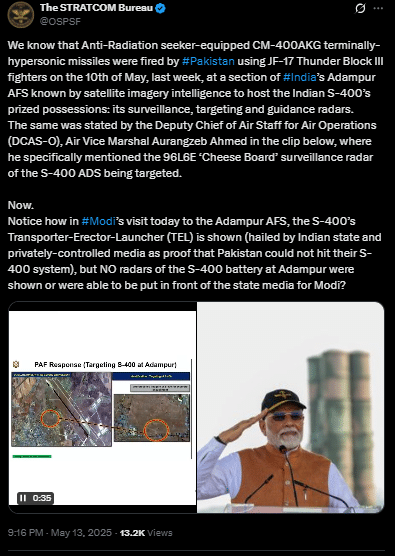
Source: X/OSPSF
The strategic message to the world: Pakistan had retaliated precisely, and the world acknowledged it. The difference between the Pakistani and Indian narrative was that the former had supporting evidence for its claims with time stamps, satellite images, and visible damage to infrastructure, while the latter was running on theatrics, recycling the same lies over and over again. Most of the claims were not even geographically sound, for instance, the destruction of Lahore port. This is what brought about a shift in the global discourse surrounding the conflict, with analysts in Washington, Brussel,s and UN corridors confirming the Pakistani narrative.

Source: X/@shaandelhite
This brought international pressure upon New Delhi to either request a ceasefire or face the music of Pakistani artillery.
Deterrence Redefined
The conflict might have ended on a mutually agreed ceasefire, but Pakistan dominated on the military, cyber, aerial, and diplomatic fronts. The precise and calculated execution of Operation Banayan Al Marsoos united the nation in disrupting India’s war-mongering and hateful rhetoric. The competence and calibre of Pakistan Armed Forces, as shown on the battlefield, is what garnered international support and made a compelling case for strategic de-escalation. Pakistan proved to the world that sometimes, to achieve peace, a formidable display of military might becomes necessary.