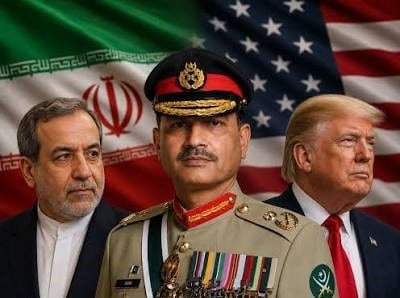





The Foreign Office on Thursday rejected reports that Chief of Defense Forces and Chief of Army Staff Field Marshal Asim Munir had visited Iran as an envoy of the United States. “These claims are factually incorrect and misleading,” FO Spokesperson Tahir Andrabi said in Islamabad during the weekly press briefing.
Main Highlights
- FO refutes Munir’s Iran visit as US envoy
- Andrabi says visit was made in Pakistan’s role as a mediator, not on behalf of Washington
- Kabul security mechanism needs ‘tangible actions’, not just assurances
- FO says former Indian defense chief’s claims on Kirana Hills false
- Makkah pact dubbed ‘evolving security architecture’ open to new members
Claims that Field Marshal Syed Asim Munir, COAS and CDF, visited Iran as an envoy of US President Donald Trump or the United States are “misleading and factually incorrect,” Foreign Office spokesperson Tahir Andrabi said.
He said the visit took place solely in the context of… pic.twitter.com/vOJeDfg0V6
— The Pakistan Daily (@ThePakDaily) August 27, 2026
What the Visit Was Really About
But Munir came to Tehran on August 24 for a one-day meeting with the Iranian leadership. Interior Minister Mohsen Naqvi accompanied him. Andrabi said the discussions during that visit were focused on regional de-escalation, breaking the current military stalemate, and exploring a negotiated settlement to restore peace and stability.
The envoy says, “The claims by some quarters that the COAS and CDF visited Iran as an envoy of President Trump or the US are misleading and factually incorrect, as his visit was undertaken purely in the context and backdrop of Pakistan’s role as a mediator”. The visit, he said, was proof of Islamabad’s sincere and constructive role in bridging the differences between Washington and Tehran, adding that the Iranian leaders appreciated Pakistan’s efforts toward de-escalation and peaceful resolution.
Pakistan, he said, is working with allied countries on a serious effort to resolve crises in the Middle East and Gulf region, especially the US-Iran standoff. He said Pakistan would continue to pursue diplomatic engagement and support any sincere effort to revive peace talks toward a comprehensive, just and lasting settlement.
Munir’s visit is also part of Deputy Prime Minister and Foreign Minister Ishaq Dar’s engagement with his counterparts on regional developments. Andrabi said Dar had spoken three times in the last two weeks alone with Turkiye’s Foreign Minister Hakan Fidan.
Background: A Fragile Framework Under Stress
The broader diplomatic track rests on a memorandum of understanding negotiated by Pakistan and signed by the US and Iran in mid-June. The agreement called for the Strait of Hormuz to be reopened and left it to Tehran and Muscat to coordinate with the Gulf states and international law on future administration and maritime services in the waterway. It was intended as a stepping stone to talks to end the war for good, but has since collapsed.
That said, diplomatic activity on the strait has not ceased. Omani Foreign Minister Badr Albusaidi was in Tehran on Tuesday to discuss a framework agreement to create a temporary shipping corridor and a mine-clearing project in the strait. So far, there has been no clear breakthrough, and real differences between Iran and the US still exist. However, this recent activity has refocused attention on the political and technical aspects of the dispute. Iran’s stance is still contingent. Tehran still considers the Islamabad MoU the right framework, but has told Washington it needs to see concrete action, not just assurances, before it can move ahead.
FO wants “concrete actions” from Kabul, not just talk
Andrabi also responded to a query on Afghan Interior Minister Sirajuddin Haqqani’s proposal for a dedicated mechanism to deal with contentious issues between the two countries. Pakistan knows about the proposal and is open to dialogue at the state level, he said. But he said the real value of any mechanism will be in concrete actions, not just promises.
The dialogue requires the Afghan Taliban to guarantee that Afghan soil is not used to perpetrate terrorism against Pakistan, he explained. “Kabul must fulfill its international obligations, including under the Doha framework, and ensure that Afghan territory is not used by hostile proxies, especially the Tehreek-i-Taliban Pakistan and the Baloch Liberation Army, against Pakistan,” he said. “Islamabad is always ready for institutional coordination, but only if it results in real and verifiable counterterrorism measures and effective border management,” Andrabi said. In recent years, Pakistan has repeatedly urged the Taliban administration to dismantle terrorist sanctuaries on Afghan soil used for attacks inside Pakistan. Officials say these appeals have largely been ignored.
FO Denies Indian Claims on Kirana Hills
Andrabi also hit back at comments made by India’s former defense chief Anil Chauhan, who said an Indian Harop drone hit Kirana Hills near Sargodha during the May 2025 conflict by mistake after it ran out of fuel. “We totally reject the self-contradictory and retroactive claims of the former Indian chief of defense staff on Kirana Hills,” Andrabi said.
“The country’s multi-tiered air defense network effectively foiled India’s military intentions in the war, and Pakistan’s subsequent response under Operation Bunyanum Marsoos demonstrated the country’s ability to inflict costs in the entire spectrum of the conflict, he said. No strategic asset or sensitive infrastructure within Pakistan has been compromised. “Selective narratives or dramatized productions cannot change the verifiable operational record from May 2025,” he said. He said history is based on facts and evidence, not what he called Bollywood-style retrospective claims, and the timing of these comments, made sixteen to eighteen months after the war, was better left elsewhere.
Makkah Pact Seen as Work in Progress
When asked about reports that Bangladesh is keen to join the Makkah Joint Defense Agreement between Pakistan, Saudi Arabia and Turkiye, Andrabi said the agreement is a “security architecture under evolution” which is open to countries with common security interests and collective responsibilities. Signed on August 7, the pact aims to enhance collective deterrence, with an attack on one signatory deemed an attack on all three.
Andrabi described the pact as a defensive framework to safeguard peace and promote regional stability. Any formal request to join would be considered in consultation with Riyadh and Ankara, he said. But he noted that the pact’s operationalization is at an early stage, implying the mechanics of how new members might actually join haven’t been fully worked out yet.