



The most important number on election night is not on television. It’s a single sheet of paper, filled out by hand in a polling station, signed by people you’ve never heard of and photographed by a party worker with a cheap mobile phone.
That sheet is Form 45. It is the fulcrum of every controversy on an election result in Pakistan and what happened before it was officially declared.
Most of the voters have known the terms since 2024. The difference between Form 45 and Form 47 Tribunals. Returning officers. Recounts. And very few people can tell you what each part does or where something could go wrong in the chain. In this post, you will find a complete review of the whole process, from the closure of the vote until the publication of the winner’s name in the official gazette and the legal ways in which you can check the results.
Start at the polling station
Polls close. The doors shut. Anyone already in line gets to vote. Then the counting starts, right there in the room.
Under the Elections Act, 2017, the presiding officer counts the ballots in front of the polling agents. These are the people each candidate sends to watch. They sit in the room and see every ballot as it’s opened.
Two documents come out of that count.
The first is the ballot paper account, known as Form 46. It answers a bookkeeping question. How many ballot papers did this station receive, how many were used, how many were spoiled, and how many are left over? It’s the check that stops extra ballots from appearing out of nowhere.
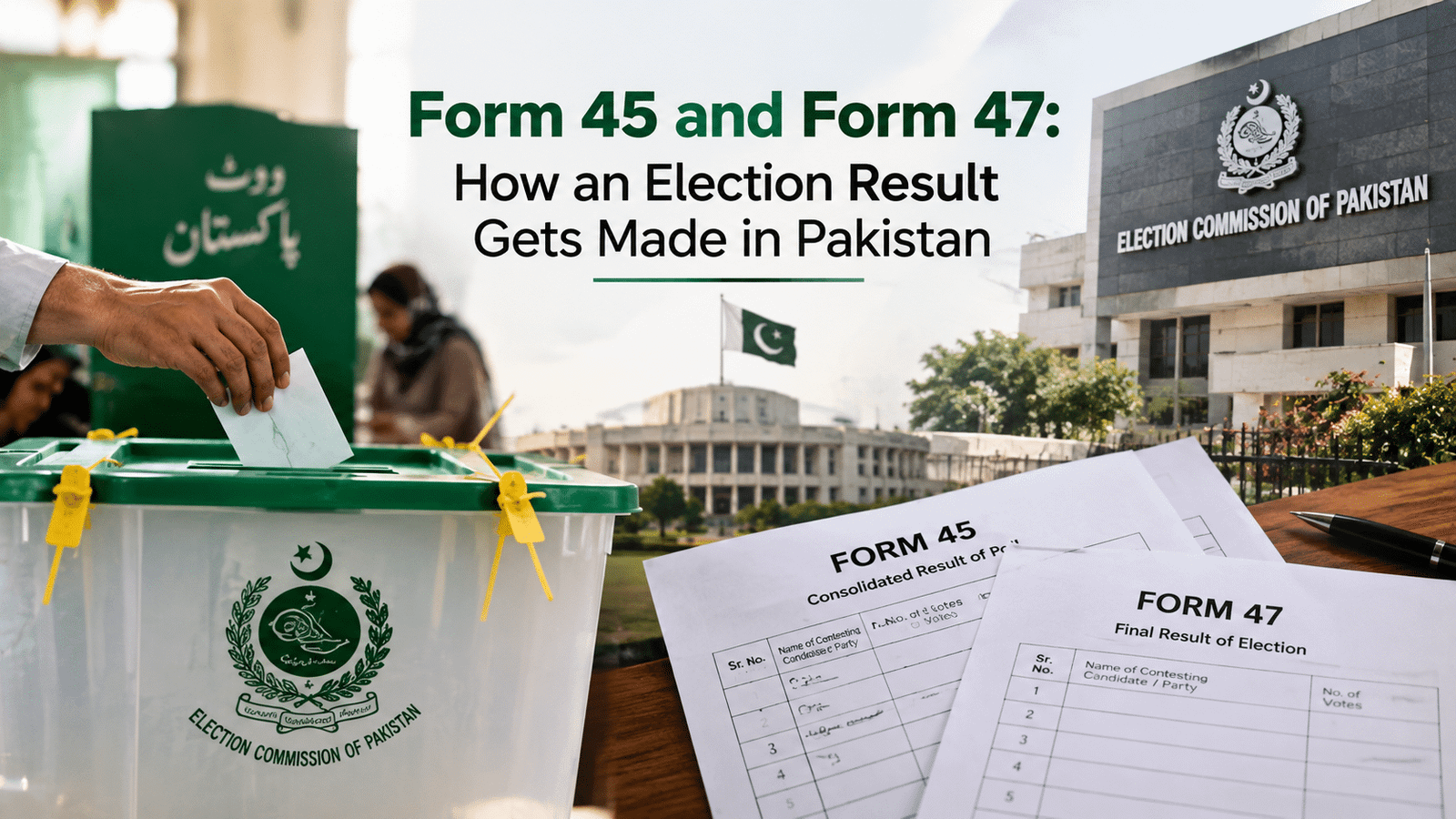
The second is Form 45, the Result of the Count. It’s the one that matters most. It records the polling station’s name, the constituency, the number of registered voters, the total votes cast, and how many votes each candidate got. It also lists rejected ballots.
Form 45 includes signatures and a thumbprint. Signed by the presiding officer and the senior-most assistant. Each polling agent also has signatures. That is the design’s objective. It is not just a report from an official. It is a document that has been scrutinized and agreed upon by people from opposite sides.
The law says agents are entitled to a copy. Get the copy, take a photo of it, and keep both. Of everything in this guide, that’s the step that matters most.
From the station to the returning officer
Once the count is done, the presiding officer seals the ballots and paperwork. The results and the sealed material travel to the returning officer, or RO, for that constituency.
The RO is a government official appointed for the election. Each National Assembly or provincial assembly constituency has one. The RO’s job at this stage is to gather the results from every polling station in the constituency and add them up.
This is the first point where the paper trail passes through someone other than a presiding officer and the agents in the room. It’s also where a lot of the 2024 arguments started.
Form 47: the provisional result
The RO first prepares what’s called the provisional consolidated result. That’s Form 47.
Section 92 of the Elections Act states that the RO shall prepare and announce the results in the presence of the contesting candidates, their election agents and any authorized observers present. This isn’t something to be kept private. The aim is to get people to see the process of adding.
Timing is of the essence in this context. Section 13(3) requires each Returning Officer to compile complete provisional results by 2 a.m. on the day after polling day. This accounts for the flow of results throughout the night, and the long periods of silence after midnight.
For some reason Form 47 is called “provisional”. It’s a running total that’s built from the Form 45s. The number is not final and does not matter. But it is the first number that the public sees and therefore forms the collective belief system the next morning.
Here is where the two forms meet. In a clean count, Form 47 is simply the sum of all the Form 45s in the constituency. If the numbers in Form 47 don’t match the numbers you get by adding up the Form 45s, something changed between the station and the RO’s desk. Your photo of the Form 45 is how you’d know.
The recount rule
Before the RO finishes, a losing candidate can ask for a recount. The rule is in Section 95(5) of the Elections Act.
The RO must recount the ballots of one or more polling stations if three things are true. The candidate or their agent makes the request in writing. The margin of victory is less than five percent of the total votes polled in the constituency, or ten thousand votes, whichever is smaller. And the RO doesn’t consider the request unreasonable. The recount can happen only once.
The Supreme Court has looked at this rule closely. In a 2020 ruling, the majority held that those conditions had to be met before an RO would order a recount. Justice Munib Akhtar disagreed. He argued the law’s policy points the other way, toward allowing recounts early to avoid later challenges through election petitions or constitutional petitions.
In a 2024 case, the Supreme Court also said that counting and recounting ballots is an administrative act, not a judicial one. The RO’s only real task is to work out the gap between the top two candidates and see whether it falls inside the limit.
Two more rules are worth knowing. If two candidates tie, both are declared returned, and each serves half the assembly’s term. Lots decide who goes first. And if women voters cast fewer than ten percent of the votes in a constituency, as recorded in Form 47, the ECP may presume that women were kept from voting by agreement. It can then declare the poll void at one or more stations, or in the whole constituency.
Form 48 and Form 49: making it final
The RO shall, on the basis of the provisional result, take up the formal consolidation in accordance with Section 95 of the Act and Rule 85 of the Election Rules, 2017. The same shall be done in the presence of the contesting candidates and their agents, as provided by law. It can be watched by accredited observers under Section 238.
This phase does a hell of a lot more than just add. The RO considers ballot papers that have been excluded from the count at polling stations, such as tendered and challenged ballots. Postal votes are part of the count. Stations that are recounted are included. The result is Form 48, which is the consolidated statement of the results of the count.
The RO then prepares the final consolidated result, Form 49. The RO has to send the candidates copies of Forms 48 and 49 (Section 95(9)).
Form 48 is derived from the counts in Form 45 but is liable to amendment after recounts, postal votes, and scrutiny of excluded ballots. A red flag is a gap between Form 45 and Form 48 — something neither of those things explains. The ECP is required to fix the situation as per FAFEN’s audit framework.
Then a rule is applied to give memory to the whole system. Section 95(8) states that the RO shall, within 24 hours of the consolidation, supply signed copies of the consolidated statement, the final result, the results of the count and the ballot paper accounts to the ECP. Copies are also maintained by the RO.
So now there are a lot of copies of the same numbers in different possessions. Form 45 is given to each polling agent. The candidates have Form 47, 48, and 49. The RO has a collection. ECP maintains a collection. Change one copy, and the rest remain unchanged.
The ECP’s role after that
The Election Commission of Pakistan publishes the final list. Section 98 requires it to announce in the official gazette the names of the returned candidates and all the other contestants, along with the votes each one received.
The ECP is also supposed to make the paperwork public. Section 95(10) sets a deadline of 14 days after polling for uploading the forms to its website. Section 100 allows public inspection of election documents. The Election Rules say the ECP should provide attested copies to candidates.
The ECP also has the power to step in while the counting is still going on. In February 2024, it stayed the consolidation of results in three National Assembly constituencies after petitions arrived. In one of them, the petitioner said 125 polling-station forms hadn’t reached him. He said those stations were in a remote, snowbound area. He had 86,794 votes in the provisional count against 101,397 for the leading candidate. The ECP’s counsel cited Section 8 of the Elections Act, which lets the Commission pass orders in the interest of justice.
Where it went wrong before
Every election since 2018 has produced complaints about this paper trail.
Many parties in 2018 claimed that their agents did not receive Form 45. The Result Transmission System, an electronic system designed to speed up the release of results, failed on election night. The results were late. The unsuccessful candidates raised their doubts about the delay. The forms were then uploaded on the ECP’s website.
The argument in 2024 was more heated. The PTI leaders submitted petitions, saying they won on the basis of their own Form 45, but the returning officers manipulated the figures in Form 47 and declared the victory of other candidates. Other party candidates also leveled rigging charges. FAFEN urged the ECP to take notice of RO practices and highlighted the need for consolidation in the presence of candidates and provision of copies of Forms 48 and 49.
The forms themselves also became a story. In March 2024, the Peshawar High Court had directed the ECP to provide Form 45 to nine election losers. Their lawyers said the forms had not been uploaded within the 14-day period required by Section 95(10) and inspection under Section 100 had not been allowed. The lawyer for the ECP says the forms were uploaded right after ROs submitted them. In March, ECP did publish Forms 45 and 47 on its website.
Here, the story was not over. In July 2024, Dawn reported that the ECP’s Google Drive folders did not include Form 45s for 14 provincial assembly constituencies in Lahore. An NGO report had alleged that forms from more than a dozen constituencies were unavailable. The ECP had rejected the report as unfounded. An ECP official said later that the uploading of Form 45s in some folders instead of Form 46s was an honest mistake. He further said that Form 45s could not be changed at that time because candidates had already obtained copies and some had gone to the election tribunals.
That last point is the case for keeping your own copy. The paper in your hand can’t be edited by anyone else.
When a result is challenged: election petitions
If a losing candidate thinks the result is wrong, the route is an election petition. It goes to an election tribunal.
The schedule is determined by the law. The petition has to be filed under Section 142 within 45 days from the date of notification of the returned candidate in the Gazette. The tribunal has to decide the matter within 180 days of filing as per Section 148(5). The period was extended to 120 days in August 2023 by Parliament.
This is how it’s playing out for the 2024 election. In May 2026, FAFEN published a report that showed 374 petitions were filed against the results in 113 constituencies of the National Assembly and 236 constituencies of the provincial assemblies. Tribunals had decided 246, or 66 percent of the total, by the end of April 2026. More than two years after the vote, 128 were still undecided.
The tribunals dismissed 242 of the 246 decisions and approved four. All four were in Balochistan, where repolling was ordered at some polling stations.
Provinces are moving at different speeds. Out of 52 petitions in Balochistan, 49 had been disposed of. In Punjab, it was 147 out of 192. Khyber Pakhtunkhwa, 26 out of 43. In Sindh, 24 of the 84. In the pending litigation before the Islamabad High Court regarding the transfer of petitions by the ECP between the tribunals, none of the petitions from Islamabad had been decided.
Part of the delay was due to the way in which tribunals were set up. Till October 2024, there were only two tribunals in Punjab, and then a tussle erupted between the Lahore High Court and the ECP over appointments. The Supreme Court’s decision on September 30, 2024, was in favor of the ECP, and in the following days, the ECP reconstituted eight tribunals.
The deadline for deciding the petitions expired in October 2024. Legislation requires tribunals to be subject to conditions such as costs for adjournments and written justifications for self-adjournments. It also allows for an assembly member’s membership to be suspended if the delay is the fault of the returned candidate. FAFEN says there are no recorded incidents.
The report of Pakistan Today on the FAFEN data says: “One of the outcomes has been explicitly reversed. The Supreme Court overruled the tribunal’s repolling order in NA-251 (Sherani, Zhob, Killa Saifullah) and declared the PkNAP candidate as the winner. The returning officer was found to have deliberately and illegally tampered with the results in Form 45.
That single case shows two things. The paper trail can prove tampering, and the process to prove it can take a long time.
How to check a result yourself
You don’t need to be a lawyer to use this system. Here is the practical version.
If you’re a polling agent, ask for the signed Form 45 before you leave the station. Photograph it in good light, with all the signatures and the thumbprint visible. Keep the photo somewhere safe.
If you’re a candidate or party worker, compare your Forms 45 against Form 47 when the RO announces it. Add up the numbers. If they don’t match, say so on the spot and ask for it in writing.
Check the recount policy early. (b) If the margin is less than five percent of the total number of votes cast or ten thousand votes, whichever is less, a written request shall be filed prior to the commencement of the consolidation. Then the window will close.
The ECP will upload the forms on its website after the election. They are expected to be up and running in fourteen days. If any item is missing, ask for an attested copy from the RO or ECP. The candidates are entitled to them as per the Election Rules.
If you are going to hold onto the belief that the result is wrong, remember the clock. The petition must be filed within 45 days from the date of gazette notification. Courts have not been forgiving of late filings.
The formal rights of the ordinary voter in the counting room are far fewer. They are allowed to watch, though. When the forms are online, it will be easy to compare the ECP’s published information with a few stations near you. FAFEN and PILDAT are organizations that publish audits and are well worth following.
What the forms don’t tell you
A clean paper trail proves the numbers were added up right. It doesn’t prove the voting was fair.
The forms can’t show whether voters were kept from reaching the polls, whether candidates were allowed to campaign, or whether pressure was applied before election day. They capture the last step of a long process. That’s why observers look at the whole election, not just the count.
Still, the count is where a disputed result gets settled or doesn’t. Every step in it leaves a document, and every document has someone’s signature on it. That design gives a determined person a way to check the arithmetic.
Frequently asked questions
What is the difference between Form 45 and Form 47?
Form 45 is the result of the count at a single polling station. It’s signed by the presiding officer, the senior-most assistant, and the polling agents. Form 47 is the provisional consolidated result for the whole constituency, prepared by the returning officer from all the Form 45s.
What are Form 48 and Form 49?
Form 48 is the consolidated statement of the results of the count. The RO prepares it after scrutinizing excluded ballots, adding postal ballots, and folding in any recounts. Form 49 is the final consolidated result.
What is Form 46?
It’s the ballot paper account for a polling station. It records how many ballots were received, used, spoiled, and left over, so that officials can check for extra or missing ballots.
Can I get a recount in Pakistan?
Yes, in some cases. The Elections Act Section 95(5) further states that if a candidate or his agent makes a written request before consolidation, the returning officer shall recount the ballots at one or more of the polling stations if the margin of victory is less than five percent of the total number of votes polled or ten thousand votes, whichever is less. The recount can only be done once.
How long do I have to challenge an election result?
A candidate has 45 days from the gazette notification of the returned candidate to file an election petition. Tribunals are supposed to decide within 180 days of filing.
How many 2024 election petitions are still undecided?
According to a FAFEN report covering the period to the end of April 2026, 128 of 374 petitions were still pending. Tribunals had decided 246, and had accepted four.
Where can I see the official Form 45 for my constituency?
The ECP is required to upload the forms to its website within 14 days of polling. If a form is missing, candidates can ask the returning officer or the ECP for an attested copy.
You May Like To Read: The Actual Law Behind Banning a Political Party in Pakistan