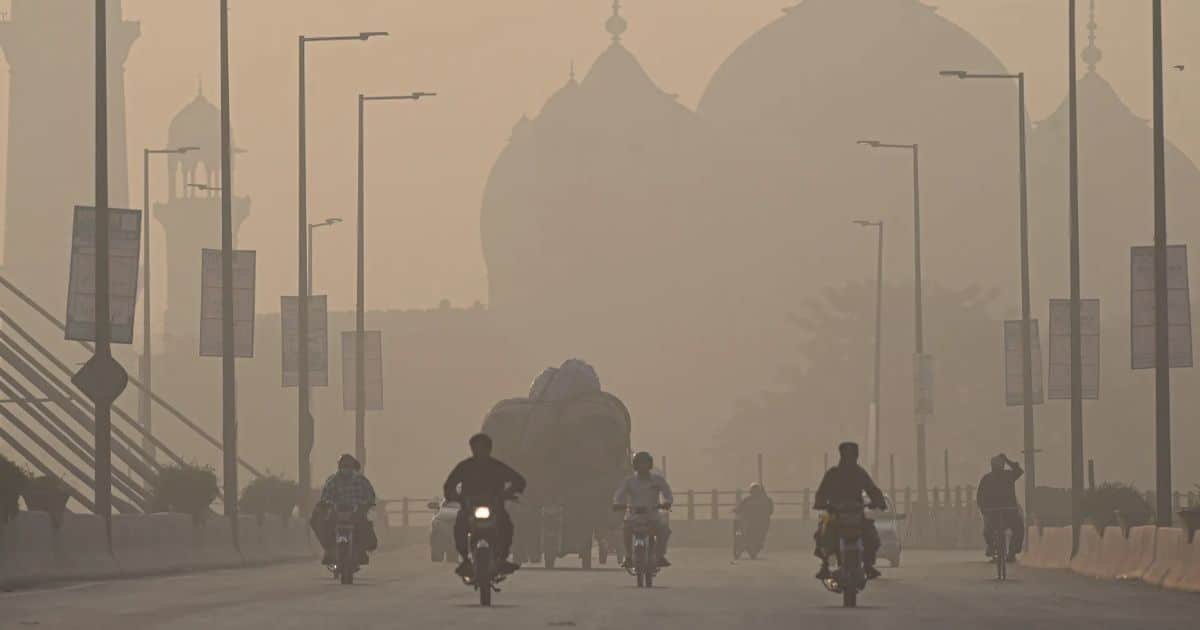





LAHORE: The provincial capital once again topped the list of the world’s most polluted cities on Wednesday as its Air Quality Index (AQI) surged to a hazardous 386 early in the morning, prompting fresh warnings from health officials and renewed government claims that cross-border pollution was aggravating the crisis.
According to the Punjab government, persistent easterly winds have been pushing polluted air from India’s border regions into central Punjab. Officials said elevated PM2.5 levels recorded in Amritsar, Jalandhar and Ludhiana were now directly affecting Lahore and Kasur. With local wind speeds dropping to around 2 miles per hour, pollutants remained trapped close to the ground overnight.
They added that a sharp temperature dip, increased humidity and a strong inversion layer had prevented pollutants from dispersing, allowing smog to settle over large parts of the province. As a result, Lahore, Kasur, Sheikhupura, Gujranwala and Faisalabad experienced a substantial spike in their AQI readings.
You May Also Like: AJK Gets New 18-Member Cabinet: PPP Legislators Take Oath in Muzaffarabad
While Lahore’s AQI fell to 193 by 2pm, it worsened again to 201 by early evening.
Govt claims ‘cross-border impact’ but insists strategy working
Despite acknowledging the influence of pollution drifting from across the border, the government maintained that its smog-control measures under Chief Minister Maryam Nawaz’s Clean Air Mission were “proving effective”.
A spokesperson said departments had scaled up enforcement, surveillance and mitigation efforts. On the CM’s directives, digital monitoring, drone surveillance and zero-tolerance crackdowns have intensified across major cities.
Govt says easterly winds worsening smog in central Punjab. https://t.co/gTLC2uIzAx
— Dawn.com (@dawn_com) November 20, 2025
Late-night raids by the Environmental Protection Force resulted in the sealing of multiple smoke-emitting industrial units. Officials also highlighted the deployment of 5,000 super seeders, claiming a “historic reduction” in stubble burning — traditionally a major contributor to seasonal smog. Brick kilns have been shifted to white-smoke technology, while non-compliant kilns are facing strict action.
Vehicle emissions remain a major target. The government has expanded e-fitness certification, barring unfit vehicles from entering Lahore. Between Nov 1 and 18, the transport department inspected 9,811 vehicles in the city, ticketed 1,421, impounded 422, and fined 1,371 more for overloading — amounting to Rs18 million in penalties. A total of 372 FIRs were lodged and 348 drivers arrested.
Transport Minister Bilal Akbar Khan warned that the anti-smog campaign was being further expanded and that “no leniency” would be shown to violators.
Health advisory issued
Senior Punjab Minister Marriyum Aurangzeb said the smog situation was being continuously monitored and that the province was “moving toward a clean air system.” She urged citizens to avoid outdoor activities during low-visibility hours, wear masks and consult doctors if they experienced breathing difficulties. Children, the elderly and asthma patients were asked to take extra precautions and maintain adequate indoor ventilation.
PHA intensifies ‘green mission’
A spokesperson for the Housing Department said the Punjab Horticulture Authority had accelerated tree-washing and greening campaigns in 10 districts, including Lahore, Rawalpindi, Faisalabad, Multan, Sahiwal and DG Khan. The activity, he said, improves tree health and enhances their ability to reduce environmental and visual pollution.
Officials warned that smog levels could worsen further in the coming days due to poor vertical air mixing, though southern Punjab districts such as Multan, Bahawalpur and DG Khan were seeing better dispersion.
Citizens have been advised to register smog-related complaints through the Green Punjab portal or by calling 1373.
Check out our latest video: